
The fundamental purpose of a motorcycle boot is to provide comprehensive protection in a crash. Unlike standard footwear, every feature is engineered to guard against specific risks, including impact, abrasion, and unnatural twisting of the foot and ankle. The most critical features are over-the-ankle coverage, reinforced toe and heel boxes, integrated ankle protection, and a torsionally stiff sole.
A true motorcycle boot is not a fashion accessory; it is a critical piece of safety equipment. Its design prioritates managing impact forces, resisting abrasion during a slide, and preventing the complex twisting injuries that are common in motorcycle accidents.
The Anatomy of Protection: Beyond Simple Leather
A common mistake is to assume any sturdy leather boot will suffice. However, dedicated motorcycle boots incorporate specialized safety systems designed for the unique physics of a crash.
Impact Absorption: Hard Armor and Reinforcement
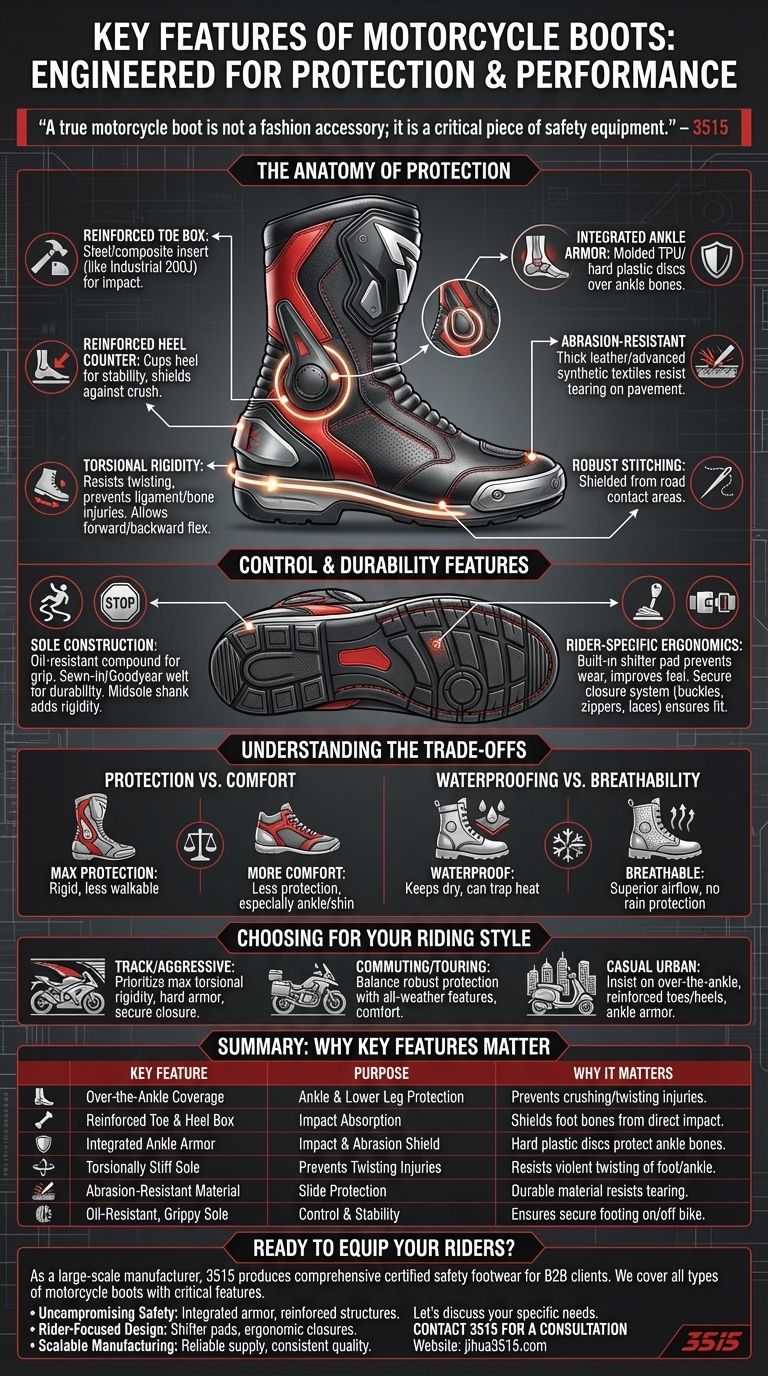
The boot must absorb and distribute sudden, sharp forces. This is accomplished with integrated armor.
Look for a reinforced toe box, often with a steel or composite insert rated to withstand significant impact (similar to the 200-joule standard for industrial safety boots).
A reinforced heel counter is equally important. It cups the heel to provide stability and protect the delicate bones from being crushed.
Finally, molded ankle protection is non-negotiable. These are discs or plates made of hard plastic or TPU that sit directly over the ankle bones to shield them from impact.
Torsional Rigidity: Preventing Twists and Flex
One of the most severe risks in an accident is the violent twisting of your foot. A proper boot is designed to resist this.
Torsional stiffness is a measure of the boot's resistance to twisting along its length. This prevents your ankle from flexing or rotating in ways it shouldn't, a common cause of debilitating ligament and bone injuries.
While the boot must be stiff to protect you, it still needs to allow for the forward and backward flex required for shifting and braking.
Abrasion Resistance: The First Line of Defense
During a slide, your footwear is ground against the pavement with incredible force.
The boot's main chassis should be constructed from a highly durable material like thick, high-quality leather or advanced synthetic textiles. This material is designed to withstand abrasion without tearing through.
Stitching should be robust and, ideally, shielded from the areas most likely to make contact with the road.
Essential Features for Control and Durability
Beyond crash protection, a boot must enhance your control of the motorcycle and withstand the rigors of daily use.
Sole Construction: Grip and Stability
The sole connects you to the bike and the ground. Its construction is critical for both safety and durability.
The sole must be made from an oil-resistant compound to ensure you maintain grip on slick surfaces at a stop. A slip-resistant rating provides an objective measure of this capability.
A sewn-in or Goodyear welt sole is far more durable than a simple glued sole, preventing it from peeling away under stress.
Some boots also feature a shank in the midsole, which adds rigidity and protects your foot from penetration by road debris.
Rider-Specific Ergonomics
Small details distinguish a true riding boot from a generic work boot.
A built-in shifter pad, which is an extra layer of material on top of the toe box, prevents the bike's shift lever from wearing a hole in your boot and provides better feel.
The boot's closure system—be it laces, buckles, or zippers—must be secure enough to ensure the boot stays on firmly during a crash.
Understanding the Trade-offs
Choosing the perfect boot involves balancing competing needs. No single boot is best for every situation.
Protection vs. Comfort and Walkability
There is a direct trade-off between maximum protection and off-the-bike comfort.
A full-height race boot offers the highest level of torsional stiffness and armor, but it can be rigid and awkward to walk in.
Conversely, a shorter, more casual "riding shoe" is more comfortable for walking but offers significantly less protection, particularly for the ankle and shin.
Waterproofing vs. Breathability
For riders who face varied weather, climate control is a key factor.
A boot with a waterproof membrane will keep your feet dry in the rain. However, that same membrane can trap heat and sweat, making the boot uncomfortably warm on hot, dry days.
Non-waterproof boots with perforated panels offer superior airflow but provide no protection from rain.
Making the Right Choice for Your Riding Style
Your decision should be based on an honest assessment of how and where you ride.
- If your primary focus is track days or aggressive canyon carving: Prioritize maximum torsional rigidity, comprehensive hard armor, and a secure closure system above all else.
- If your primary focus is daily commuting or long-distance touring: Seek a balance of robust protection, all-weather features like waterproofing, and reasonable off-bike comfort.
- If your primary focus is casual, short-distance urban riding: Insist on the non-negotiables—over-the-ankle coverage, reinforced toes/heels, and ankle armor—even in a more stylized boot.
Choosing the right boot is an investment in your control, comfort, and most importantly, your safety on every ride.
Summary Table:
| Key Feature | Purpose | Why It Matters |
|---|---|---|
| Over-the-Ankle Coverage | Ankle & Lower Leg Protection | Prevents crushing and twisting injuries in a crash. |
| Reinforced Toe & Heel Box | Impact Absorption | Shields delicate foot bones from direct impact forces. |
| Integrated Ankle Armor | Impact & Abrasion Shield | Hard plastic discs protect ankle bones during a slide. |
| Torsionally Stiff Sole | Prevents Twisting Injuries | Resists violent twisting of the foot and ankle. |
| Abrasion-Resistant Material | Slide Protection | Durable leather/textiles resist tearing on pavement. |
| Oil-Resistant, Grippy Sole | Control & Stability | Ensures secure footing on the bike and at stops. |
Ready to Equip Your Riders with Superior Protection?
As a large-scale manufacturer, 3515 produces a comprehensive range of certified safety footwear for distributors, brand owners, and bulk clients. Our production capabilities encompass all types of motorcycle boots and riding shoes, engineered with the critical features outlined above.
Partner with us to offer your customers:
- Uncompromising Safety: Boots built with integrated armor, reinforced structures, and high-abrasion materials.
- Rider-Focused Design: Features like built-in shifter pads and ergonomic closures for control and comfort.
- Scalable Manufacturing: Reliable supply and consistent quality for your business, from small batches to large-volume orders.
Let's discuss your specific needs and how we can support your product line.
Contact 3515 today for a consultation
Visual Guide
Related Products
- Wholesale Tactical Boots High-Traction & Reflective for Bulk & Brand Orders
- High Performance Fire-Retardant Waterproof Safety Boots
- Durable Goodyear Welt Leather Work Boots for Wholesale & Private Label
- Wholesale High-Traction Camo Boots - Custom Manufacturer for Brands
- Heavy-Duty Waterproof Nubuck Safety Boots Safety Shoes for Bulk Supply
People Also Ask
- How do tactical boots protect against injuries? Discover the Integrated Safety System
- What are the consequences of wearing ill-fitting tactical boots? Avoid Injury and Boost Performance
- What are the advantages and disadvantages of tactical boots? Lightweight Comfort vs. Rugged Durability
- How do manufacturing processes for electronic textiles balance durability with wearing comfort? Innovation in Footwear
- What features do tactical boots typically have? A Guide to Rugged Durability & Performance



















