
In military operations, secure footing is the foundation of every action. Good traction is critically important in military boots because it provides the stability necessary to prevent slips and falls across the unpredictable and often hazardous terrains encountered in the field. This directly translates to enhanced operator safety, mobility, and overall mission effectiveness.
The importance of traction goes beyond simply preventing a fall. It is a fundamental component of combat readiness, allowing a soldier to move with confidence, maintain stability while carrying heavy equipment, and focus entirely on the mission rather than their footing.
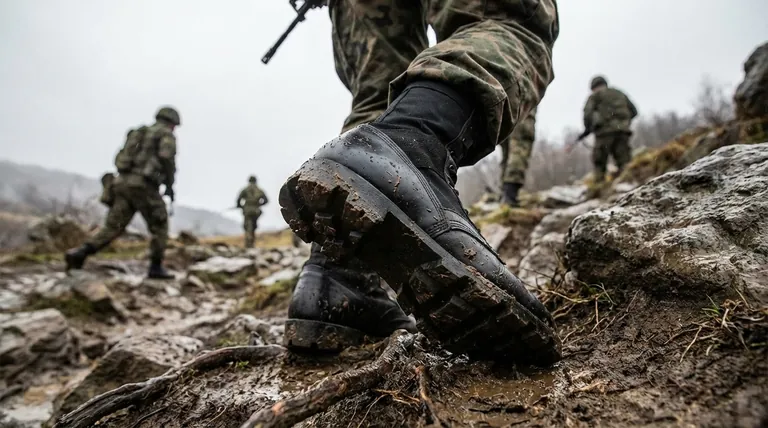
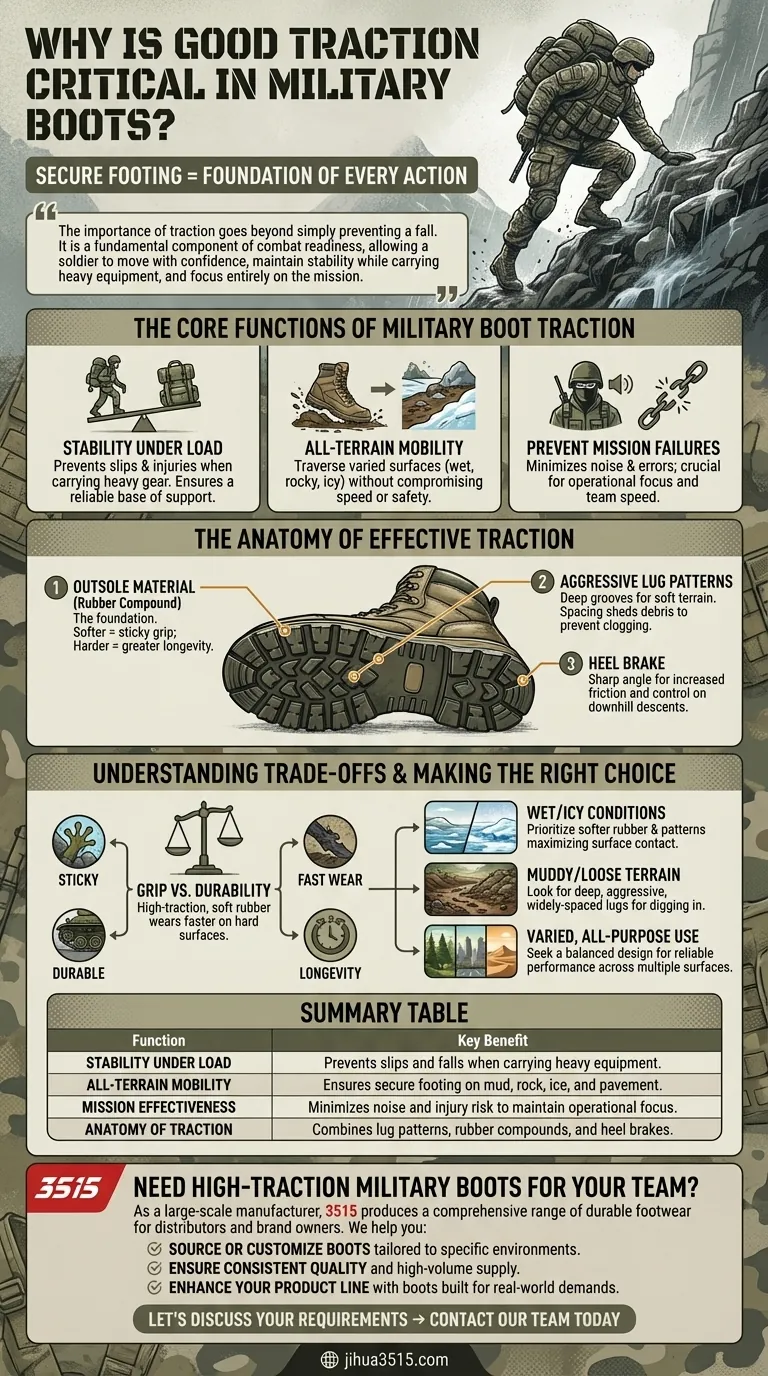
The Core Functions of Military Boot Traction
Excellent traction is not a luxury; it is an essential performance feature that serves several distinct, mission-critical functions.
Ensuring Stability Under Load
A soldier rarely moves unencumbered. They carry heavy loads, including body armor, rucksacks, and weapon systems.
A slip or loss of footing under this weight doesn't just risk a fall—it risks serious injury and equipment damage. Good traction creates a stable, reliable base of support.
Maintaining Mobility Across Terrains
Operational environments are rarely uniform. A single patrol might cross wet asphalt, rocky hillsides, deep mud, or icy patches.
Effective traction, provided by well-designed outsoles, allows a soldier to traverse these varied surfaces without compromising speed or safety.
Preventing Mission-Critical Failures
In a tactical situation, a minor slip can have major consequences. It can create noise that compromises a unit's position or cause an injury that slows the entire team down.
Reliable traction ensures each step is secure and deliberate, minimizing the risk of errors that could jeopardize the mission.
The Anatomy of Effective Traction
Traction isn't a single feature but the result of several design elements working in concert. Understanding these components helps clarify what makes a boot effective.
The Outsole Material
The foundation of grip is the rubber compound used for the outsole. Different compounds offer different balances of stickiness and durability.
Softer rubber provides excellent grip, especially on wet or smooth surfaces, while harder compounds offer greater longevity.
Aggressive Lug Patterns
The deep grooves and channels on the bottom of a boot are called lugs. Their pattern is crucial for performance on soft or loose terrain.
Deep, widely-spaced lugs are designed to dig into mud, sand, or snow, providing positive grip. The spacing helps shed debris, preventing the sole from clogging and becoming slick.
The Heel Brake
Many military boots feature a distinct, sharp-angled heel. This is known as a heel brake.
Its function is to increase friction and control when moving downhill. It allows the operator to dig in their heel to slow or stop their descent on steep or slippery slopes.
Understanding the Trade-offs
No single outsole design is perfect for every possible condition. Recognizing the inherent compromises is key to understanding boot performance.
Grip vs. Durability
As mentioned, there is often a trade-off between the "stickiness" of the rubber and its durability.
A very high-traction, soft rubber sole might provide superior grip on wet rock but will wear down much faster during movement on pavement or concrete.
Specialization for Environment
An outsole designed for deep mud will have massive, widely spaced lugs. While perfect for the jungle, this design can feel unstable and wear unevenly on flat, hard surfaces.
Conversely, a boot designed for urban operations may have a flatter sole with more surface contact, which would be ineffective in thick mud.
Making the Right Choice for Your Environment
Your boot's traction should be matched to its most likely operational environment.
- If your primary focus is wet or icy conditions: Prioritize boots with softer rubber outsoles and patterns that maximize surface area contact.
- If your primary focus is muddy or loose terrain: Look for designs with deep, aggressive, and widely-spaced lugs that can dig in and clear themselves easily.
- If your primary focus is varied, all-purpose use: Seek a balanced design with a durable rubber compound and a moderately aggressive lug pattern that performs reliably across multiple surfaces.
Ultimately, choosing the right traction is a critical decision that directly supports your safety and mission success.
Summary Table:
| Function | Key Benefit |
|---|---|
| Stability Under Load | Prevents slips and falls when carrying heavy equipment. |
| All-Terrain Mobility | Ensures secure footing on mud, rock, ice, and pavement. |
| Mission Effectiveness | Minimizes noise and injury risk to maintain operational focus. |
| Anatomy of Traction | Combines lug patterns, rubber compounds, and heel brakes. |
Need High-Traction Military Boots for Your Team?
As a large-scale manufacturer, 3515 produces a comprehensive range of durable and reliable footwear for distributors, brand owners, and bulk clients. Our production capabilities encompass all types of military boots and tactical footwear, engineered with mission-specific traction to ensure operator safety and performance.
We can help you:
- Source or Customize Boots tailored to specific operational environments (e.g., jungle, urban, arctic).
- Ensure Consistent Quality and high-volume supply for your distribution network.
- Enhance Your Product Line with boots built for real-world demands.
Let's discuss your requirements → Contact our team today
Visual Guide
Related Products
- Durable Military Combat Boots with Water Drainage for Wholesale & OEM
- High-Traction Suede Tactical Boots Wholesale & Custom Manufacturing
- Durable High-Ankle Tactical Boots for Wholesale & Custom Manufacturing
- Durable Mid-Cut Tactical Boots for Wholesale & Private Label
- Wholesale Waterproof Tactical Boots Custom Suede & High-Traction Soles
People Also Ask
- Why must gait validation for military applications be conducted in combat boots? Ensure Data Accuracy for Soldiers
- What are the common types of combat boots? Find the Right Boot for Your Mission
- What factors should be considered when choosing military boots for hiking? Durability vs. Weight for Your Terrain
- What are the key considerations when choosing military boots? Prioritize Compliance, Environment & Fit
- How should the midfoot and heel fit in military boots? Achieve a Snug, Secure Fit for Blister Prevention



















