
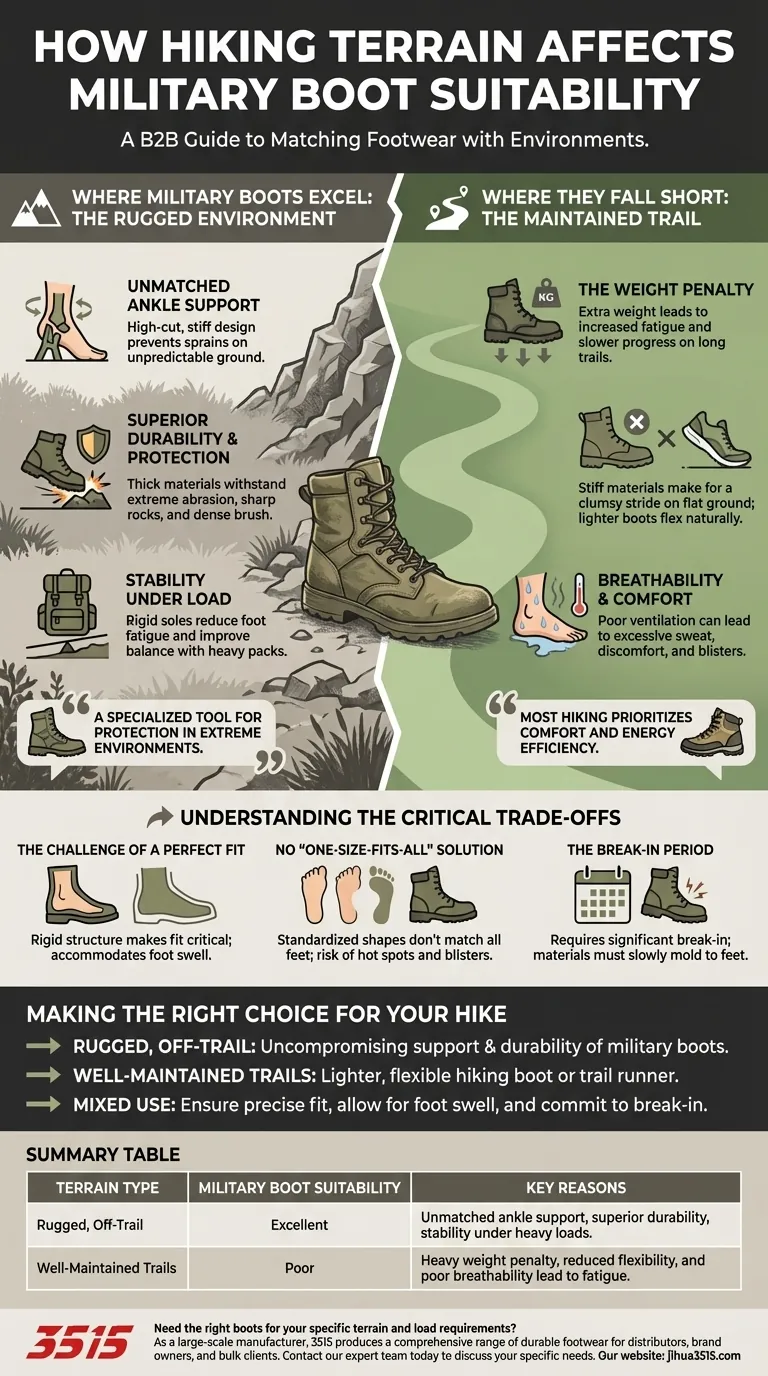
In short, military boots excel in rugged, unpredictable terrain but become a liability on well-maintained trails. Their design prioritizes maximum durability and ankle support for harsh conditions, often at the expense of the lightweight comfort and flexibility beneficial for standard hiking.
The suitability of a military boot is not a measure of its quality, but a question of alignment. It is a specialized tool for protection in extreme environments, whereas most hiking prioritizes comfort and energy efficiency over long distances.

Where Military Boots Excel: The Rugged Environment
The core design philosophy of a military boot is to protect the soldier's foot in the worst possible conditions. This translates directly to certain types of challenging hiking.
Unmatched Ankle Support
Military boots typically feature a high-cut design and stiff construction. This is essential for preventing sprains and twists when navigating rocky, uneven, or unstable ground where foot placement is unpredictable.
Superior Durability and Protection
Built from thick leather and robust synthetic materials, these boots are made to withstand extreme abrasion and impact. For off-trail hiking or scrambling, this provides a shield against sharp rocks and dense brush that would shred lighter footwear.
Stability Under Load
Their rigid soles and supportive structure create an exceptionally stable platform. This is a significant advantage when carrying a heavy backpack, as it reduces foot fatigue and improves balance on difficult terrain.
Where Military Boots Fall Short: The Maintained Trail
On predictable, well-groomed paths, the protective features of military boots become significant disadvantages.
The Weight Penalty
Military boots are heavy. Every extra ounce on your feet requires more energy to lift with each step. Over thousands of steps on a long trail, this added weight directly leads to increased fatigue and slower progress.
Reduced Flexibility
The same stiffness that provides support on rocks makes for a clumsy and unnatural stride on flat ground. Lighter hiking boots are designed to flex with your foot, resulting in a more comfortable and efficient walking motion.
Breathability and Comfort
Designed for durability above all else, many military boots offer poor ventilation. On a warm day or a long hike, this can lead to excessive sweat, discomfort, and a higher risk of blisters.
Understanding the Critical Trade-offs
Choosing the right boot goes beyond just the terrain; it involves understanding fundamental compromises in footwear design.
The Challenge of a Perfect Fit
The rigid structure of military boots makes a proper fit absolutely critical and difficult to achieve. A boot that feels acceptable when tried on can become painful once your feet inevitably swell during a long hike.
No "One-Size-Fits-All" Solution
Individual foot anatomy varies immensely. The standardized shapes used to build military boots cannot perfectly match every person's foot, making hot spots and blisters a common problem if the fit is not precise.
The Break-In Period
Unlike modern hiking boots that are often comfortable out of the box, traditional military boots require a significant break-in period. Their stiff materials must be slowly molded to your feet through gradual wear.
Making the Right Choice for Your Hike
Your decision should be guided by a realistic assessment of your most common hiking environment.
- If your primary focus is off-trail navigation or carrying a heavy pack in rugged terrain: The uncompromising support and durability of a military boot are a clear advantage.
- If your primary focus is covering distance on well-maintained trails: A lighter, more flexible hiking boot or trail runner will provide far greater comfort and reduce fatigue.
- If you are considering military boots for mixed use: Be absolutely certain of the fit, allowing extra room for foot swell, and commit to a thorough break-in period before tackling any serious distance.
Ultimately, choosing the right footwear is about matching the tool to the specific task at hand.
Summary Table:
| Terrain Type | Military Boot Suitability | Key Reasons |
|---|---|---|
| Rugged, Off-Trail | Excellent | Unmatched ankle support, superior durability, stability under heavy loads. |
| Well-Maintained Trails | Poor | Heavy weight penalty, reduced flexibility, and poor breathability lead to fatigue. |
Need the right boots for your specific terrain and load requirements?
As a large-scale manufacturer, 3515 produces a comprehensive range of durable footwear for distributors, brand owners, and bulk clients. Whether you need the rugged support of a military-style boot for extreme environments or a lighter, more flexible design for long-distance trails, our production capabilities encompass all types of shoes and boots.
Contact our expert team today to discuss your specific needs and discover how we can provide the perfect footwear solution for your market.
Visual Guide
Related Products
- Durable Military Combat Boots with Water Drainage for Wholesale & OEM
- High-Traction Suede Tactical Boots Wholesale & Custom Manufacturing
- Durable High-Ankle Tactical Boots for Wholesale & Custom Manufacturing
- Durable Mid-Cut Tactical Boots for Wholesale & Private Label
- Wholesale Waterproof Tactical Boots Custom Suede & High-Traction Soles
People Also Ask
- Why must gait validation for military applications be conducted in combat boots? Ensure Data Accuracy for Soldiers
- What are the common types of combat boots? Find the Right Boot for Your Mission
- What factors should be considered when choosing military boots for hiking? Durability vs. Weight for Your Terrain
- What are the key considerations when choosing military boots? Prioritize Compliance, Environment & Fit
- How should the midfoot and heel fit in military boots? Achieve a Snug, Secure Fit for Blister Prevention



















