
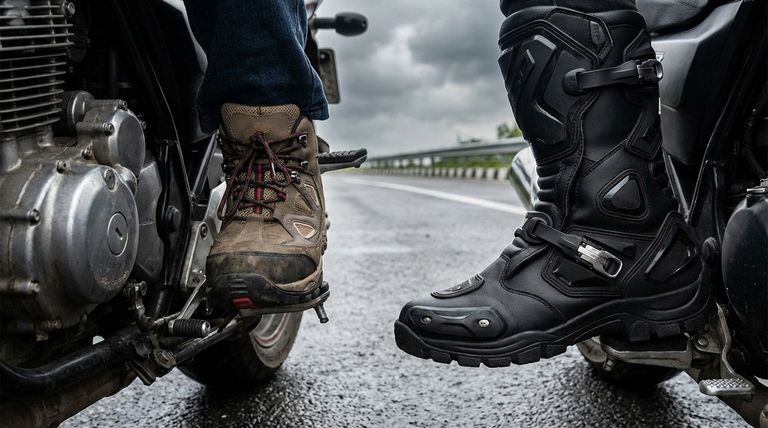
At a glance, combat boots seem like a good option for motorcycle riding, but they are not an adequate substitute for purpose-built motorcycle boots. While their sturdy construction and ankle coverage are superior to casual shoes, they critically lack the specific safety features designed to protect you from the unique forces involved in a motorcycle accident, such as torsional rigidity, impact absorption, and abrasion resistance.
The core issue is one of design philosophy. Combat boots are engineered for walking and marching, requiring flexibility. Motorcycle boots are engineered for crashes, requiring rigidity against unnatural twisting and sliding forces that can permanently injure your feet and ankles.
Why Your Choice of Footwear Is Critical
Your feet are your primary interface for controlling the motorcycle, aside from your hands. They operate the rear brake and gear shifter, and they bear the bike's weight when you stop. Their vulnerability in a crash makes proper protection non-negotiable.
The Forces a Riding Boot Manages
A motorcycle accident involves three primary threats to your feet: impact, abrasion, and twisting. A boot's effectiveness is measured by its ability to counter these forces.
Where Combat Boots Fall Short
Standard combat boots are simply not built for this environment. They lack the specific reinforcement needed for riding safety, leaving you exposed to significant risk.
The Critical Flaw: Lack of Torsional Rigidity
The single biggest failing of a combat boot is its flexibility. It is designed to allow your ankle to bend and flex for walking. In a crash, this same flexibility allows your ankle to twist and break. True motorcycle boots are extremely stiff to prevent this type of injury.
Inadequate Impact and Abrasion Resistance
A combat boot's leather or fabric will shred quickly when sliding on asphalt. Motorcycle boots use reinforced materials, double or triple stitching, and often have integrated armor or plastic sliders over the heels, toes, and ankles to withstand abrasion and impact.
The Hazard of Laces and Soles
The long laces on combat boots pose a serious snagging hazard on footpegs, shifters, or brake levers. Furthermore, their soles are designed for grip on dirt or terrain, not necessarily the oil-slicked asphalt of a roadway, and may lack the specific grip needed for secure footing.
Key Features of True Motorcycle Boots
Understanding what makes a dedicated boot safer clarifies why a substitute is a compromise. These features are designed with the physics of riding and crashing in mind.
Purpose-Built Ankle Protection
Motorcycle boots incorporate reinforced cups or armor around the ankle. Many feature advanced systems that allow for normal forward-and-back movement for shifting but physically block unnatural side-to-side twisting.
Reinforced Heel and Toe Boxes
These areas are hardened to protect your feet from being crushed by the weight of the bike or from direct impact with the ground or another vehicle.
Secure and Shielded Closures
Motorcycle boots typically use zippers, buckles, or hook-and-loop systems that are faster to secure and have no loose ends. If laces are used, they are often covered by a protective flap to prevent snags.
Rider-Specific Sole Design
The soles are made from compounds that provide excellent grip on pavement and are resistant to oil and gas. The design ensures a stable platform on the footpegs and secure footing when you stop.
Understanding the Trade-offs
Choosing footwear is often a balance of safety, convenience, and cost. It's important to make that choice with a clear understanding of the risks involved.
The "Better Than Nothing" Argument
A sturdy, over-the-ankle leather combat boot is undeniably better than a sneaker, sandal, or dress shoe. It provides some ankle support and minor abrasion resistance. However, acknowledging this does not make it a safe choice.
Cost vs. Consequence
Dedicated motorcycle boots are an investment, but that cost pales in comparison to the medical bills, lost work, and lifelong consequences of a crushed foot or shattered ankle. The protection they provide is a critical part of your safety system.
Style vs. Substance
Many brands now offer CE-rated motorcycle boots and riding shoes that look like casual sneakers, work boots, or dress boots. These provide a much safer alternative by integrating hidden armor and reinforcement into a stylish package.
Making the Right Choice for Your Ride
Your decision should be based on an honest assessment of the risks you are willing to take.
- If your primary focus is maximum safety on all rides: Invest in CE-rated motorcycle boots that offer certified impact, abrasion, and crush protection.
- If your primary focus is casual urban riding: Consider a CE-rated "riding shoe," which looks like a high-top sneaker but contains hidden ankle armor, a reinforced sole, and abrasion-resistant materials.
- If you need a single boot for riding and walking: Look for hybrid or touring-style motorcycle boots designed with comfort in mind, but never compromise on core protective features.
Ultimately, your footwear is not just an accessory; it is critical safety equipment that protects your mobility.
Summary Table:
| Feature | Combat Boots | Motorcycle Boots |
|---|---|---|
| Primary Design Goal | Walking, marching flexibility | Crash protection, rigidity |
| Torsional Rigidity | Low (risk of ankle twist/break) | High (prevents unnatural twisting) |
| Abrasion Resistance | Standard leather/fabric | Reinforced materials, double/triple stitching |
| Impact Protection | Minimal | Reinforced heel/toe boxes, integrated armor |
| Closure System | Laces (snag hazard) | Zippers, buckles, shielded closures |
| Sole Design | Terrain grip | Oil-resistant pavement grip, stable on footpegs |
Protect Your Ride with Purpose-Built Footwear from 3515
As a large-scale manufacturer, 3515 produces a comprehensive range of CE-certified motorcycle boots, riding shoes, and protective footwear for distributors, brand owners, and bulk clients. Our production capabilities ensure your customers get the critical safety features they need—like torsional rigidity, impact absorption, and abrasion resistance—without compromising on style or comfort.
Contact 3515 today to discuss your protective footwear needs and secure a reliable supply of high-quality riding gear.
Visual Guide

Related Products
- Heavy-Duty Waterproof Nubuck Safety Boots Safety Shoes for Bulk Supply
- Durable Goodyear Welt Leather Work Boots for Wholesale & Private Label
- Wholesale Tactical Boots High-Traction & Reflective for Bulk & Brand Orders
- Premium Wholesale Tactical Style Safety Shoes Boots with Quick Lacing
- Wholesale Waterproof Tactical Boots Custom Suede & High-Traction Soles
People Also Ask
- What primary protective functions do professional safety boots provide in urban solid waste recovery and waste picking processes? Discover Dual-Layer Protection.
- How do safety boots reduce cutting hazards? Essential Protection for Your Workforce
- Which organizations develop safety standards for work boots? Ensure Compliance & Worker Safety
- What are the common types of safety boots and their primary uses? A Guide to Industrial Footwear
- Why is ankle and arch support important in safety footwear? Prevent Injury & Fatigue



















