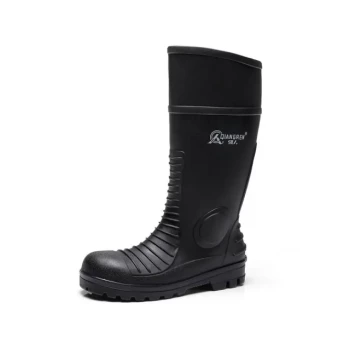
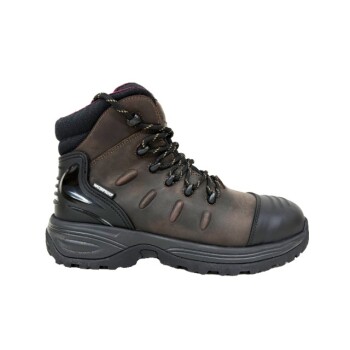
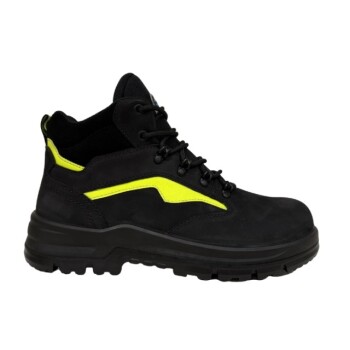
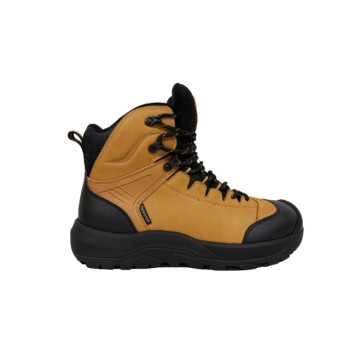
For warehouse and logistics professionals, the ideal work boot is a precise blend of certified protection and ergonomic design. The key features are ASTM-compliant safety toes for impact protection, highly slip-resistant outsoles to prevent falls on concrete floors, and substantial comfort elements like cushioning and arch support to combat fatigue from standing and walking all day.
Your work boot isn't just a piece of safety equipment; it's a critical tool that directly impacts your daily performance and long-term health. The right choice balances non-negotiable safety standards with comfort features that reduce physical strain.

The Foundation: Mandatory Safety Features
Every decision about a work boot must start with its ability to protect you from immediate, acute injury. This is governed by industry-wide standards that ensure a baseline of safety.
Understanding ASTM F2413
The most important label to look for on a safety boot is ASTM F2413. This is the standard specification for performance requirements for protective footwear. Compliance means the boot has been rigorously tested to meet specific safety benchmarks.
Protective Toes for Impact
This is the most well-known safety feature. Protective toes shield your feet from injury due to falling objects or compression from heavy equipment like pallet jacks.
They typically come in three materials: steel, composite, or alloy. All must meet the same ASTM standard for impact and compression resistance.
Slip-Resistant Outsoles
Warehouse floors are notoriously smooth and can be subject to spills or dust, creating hazardous conditions. A slip-resistant outsole is essential for preventing falls.
These outsoles use specific rubber compounds and tread patterns designed to channel away liquids and maximize surface contact, providing reliable traction.
Electrical Hazard (EH) Protection
Many boots carry an EH rating. This indicates they are made with non-conductive, shock-resistant soles and heels. This feature provides a secondary source of protection against accidental contact with live electrical circuits.
Beyond Compliance: Features for All-Day Performance
While safety standards prevent serious injury, comfort features prevent the chronic pain and fatigue that come from being on your feet for 8-12 hours a day on hard surfaces.
Cushioning and Shock Absorption
Standing on concrete all day sends constant impact shocks through your feet, knees, and lower back. Quality boots use midsoles made from materials like EVA foam or polyurethane to absorb this shock and dissipate the pressure.
Robust Arch Support
A lack of proper arch support causes your foot to flatten, leading to fatigue and painful conditions like plantar fasciitis. Good work boots have a structured insole or a supportive shank to maintain your foot's natural arch, improving alignment and reducing strain.
Lightweight Construction
The weight of your boots has a significant impact on your energy levels. A heavy boot requires more effort with every single step, leading to exhaustion over a long shift.
Materials like composite for safety toes and modern foam midsoles help reduce the overall weight of the boot without sacrificing protection or support.
Breathable Materials
Your feet will sweat during a physically active workday. Boots made with breathable linings and materials allow this moisture to escape, which is critical for preventing blisters, discomfort, and fungal growth.
Understanding the Trade-offs
Choosing the perfect boot often involves balancing competing features. Understanding these compromises is key to making the right choice for your specific needs.
Steel Toe vs. Composite Toe
A steel toe offers maximum protection and can be made thinner, but it is heavier and conducts heat and cold. A composite toe is much lighter and doesn't conduct temperature, but the toe cap is often bulkier to achieve the same safety rating.
Durability vs. Flexibility
Heavier, more rugged boots built with thick leather and stitched soles often provide maximum durability but can be stiff and require a significant break-in period. Lighter, athletic-style work shoes offer out-of-the-box comfort and flexibility but may not withstand the same level of abuse.
Making the Right Choice for Your Role
Select your footwear based on the primary demands of your specific job function.
- If your primary focus is protection around heavy pallets or machinery: Prioritize a boot with the highest ASTM F2413 ratings, and consider a steel toe for maximum strength.
- If your primary focus is covering long distances on foot: Choose a lightweight composite-toe boot with exceptional shock absorption and a flexible sole to conserve energy.
- If your primary focus is stability and fatigue prevention: Ensure the boot has excellent arch support and a well-cushioned, anti-fatigue insole.
Choosing the right boot is an investment in your daily performance and long-term well-being.
Summary Table:
| Feature | Key Benefit | Ideal For |
|---|---|---|
| ASTM F2413 Safety Toe | Protects from impact and compression | Handling heavy pallets/machinery |
| Slip-Resistant Outsole | Prevents falls on slick surfaces | All warehouse and logistics roles |
| Electrical Hazard (EH) Rating | Secondary protection from live circuits | Environments with electrical risk |
| Shock Absorption & Cushioning | Reduces fatigue from standing on concrete | Roles with long hours on hard floors |
| Lightweight Construction | Conserves energy over long shifts | Jobs requiring extensive walking |
Ready to equip your team with the perfect work boots?
As a large-scale manufacturer, 3515 produces a comprehensive range of ASTM-certified footwear designed for the demands of warehouse and logistics work. We provide distributors, brand owners, and bulk clients with durable, comfortable, and safety-compliant boots that protect workers and enhance productivity.
Contact us today to discuss your specific needs and receive a customized quote.
Visual Guide

Related Products
- Durable Leather Work Boots for Wholesale & Custom Manufacturing
- Durable Leather Work Boots for Wholesale & Custom OEM Manufacturing
- Durable Leather Work Boots Wholesale Manufacturer & Custom Factory
- Durable Leather Moc Toe Work Boots for Wholesale & Custom Manufacturing
- Wholesale Leather Work Boots with Customizable Wedge Sole for Brands
People Also Ask
- What is the difference between full-grain and top-grain leather? Premium Material Guide for Boot Manufacturers
- What are the common workplace hazards that can be mitigated with the right work boots? Protect Your Workforce
- What are the common foot issues workers face due to uncomfortable work boots? Prevent Pain & Deformities
- What are the advantages of leather versus synthetic work boots? A Guide to Choosing the Right Material
- What are the key components of modern work boots? Engineered for Ultimate Durability and Comfort