
The best insoles for ballet flats provide comprehensive structure that the shoe itself lacks. They must offer full, semi-rigid arch support from front to back and feature a deep heel cup to stabilize the foot, all within a slim profile that doesn't overcrowd the shoe.
The fundamental challenge with ballet flats is their complete lack of built-in support. Therefore, an effective insole doesn't just add cushioning; it must function as a replacement for the shoe's missing structural components—specifically the arch and heel support.
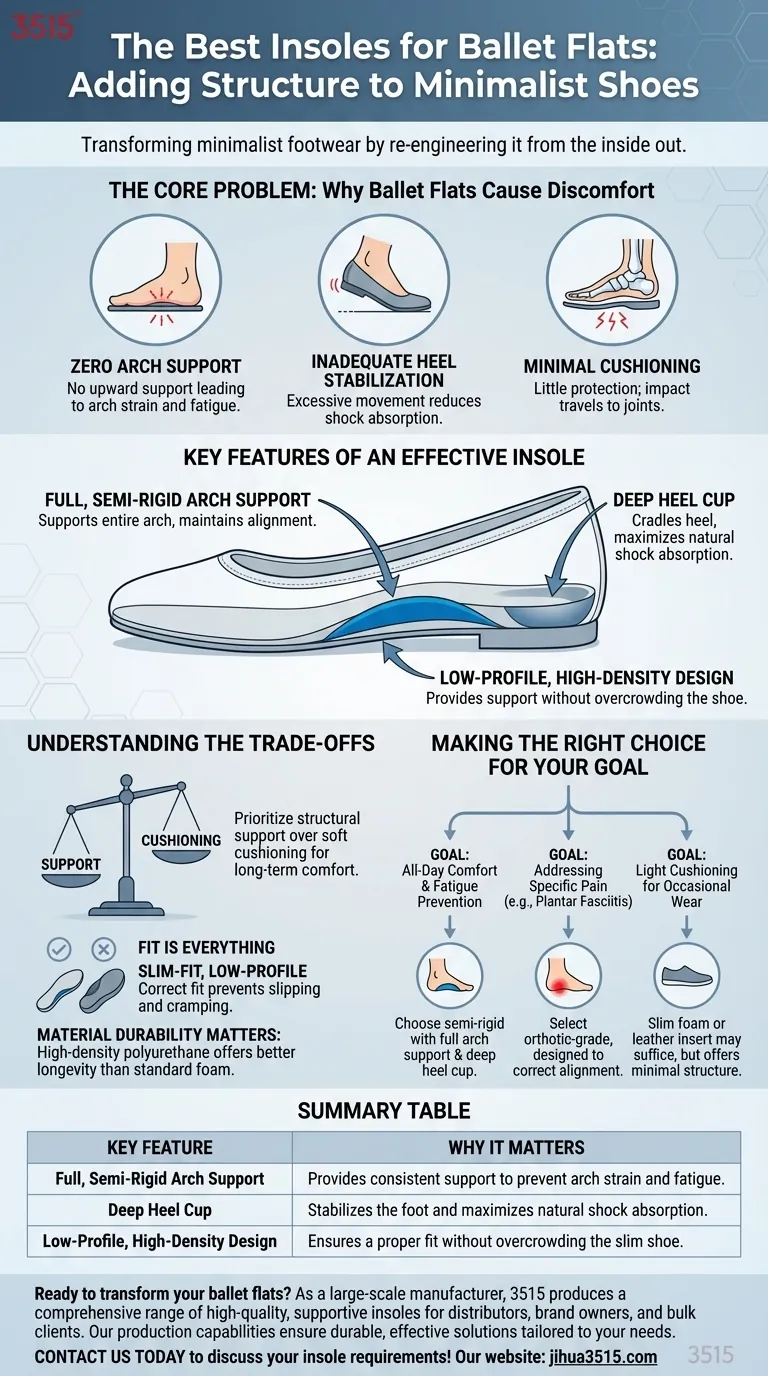
The Core Problem: Why Ballet Flats Cause Discomfort
Ballet flats are popular for their minimalist style, but this design is precisely what can lead to foot pain and fatigue. Understanding their inherent flaws is the first step to correcting them.
Zero Arch Support
The typically flat, flexible sole of a ballet flat provides no upward support for your foot's arch. Over time, this can lead to arch strain, fatigue, and even contribute to conditions like plantar fasciitis.
Inadequate Heel Stabilization
Without a structured heel counter or a supportive footbed, your heel can move excessively. This instability reduces shock absorption and can lead to inefficient walking mechanics and general discomfort.
Minimal Cushioning
The thin soles offer very little protection from hard surfaces. The impact of each step travels more directly into your joints, from your ankles and knees all the way to your hips and back.
Key Features of an Effective Insole
To counteract these issues, an insole must add back the specific structural elements that a ballet flat is missing. Look for these three critical characteristics.
Full, Semi-Rigid Arch Support
The insole should support the entire length of your arch, from the ball of your foot to the heel. Avoid soft, squishy materials that collapse under weight. A semi-rigid material provides consistent support that holds your foot in proper alignment.
A Deep Heel Cup
A well-designed heel cup is crucial for stability. It cradles the base of your heel, centering the foot's natural fatty pad directly under the heel bone. This maximizes your body's own shock absorption and prevents the heel from rolling inward or outward.
A Low-Profile, High-Density Design
This is non-negotiable for a ballet flat. A bulky insole will simply not fit. The best options use high-density materials like firm EVA foam or polyurethane to provide significant support without unnecessary thickness.
Understanding the Trade-offs
Choosing an insole for such a specific shoe type involves balancing competing priorities. Being aware of these will help you avoid common pitfalls.
Support Trumps Cushioning
In a low-volume shoe, you cannot have both maximum cushioning and maximum support. You must prioritize structural support. A firm, supportive insole that properly aligns your foot will provide more long-term comfort than a soft, gel-like cushion that offers no structure.
Fit is Everything
An insole that is even slightly too thick or wide will make your ballet flats unwearable. It can cause your heel to slip out of the shoe or cramp your toes. Always look for insoles specifically designated as "slim-fit," "low-profile," or designed for dress shoes.
Material Durability Matters
Thinner insoles made from less-dense materials can lose their supportive shape more quickly. Materials like high-density polyurethane are often more durable than standard foam but may feel more rigid initially.
Making the Right Choice for Your Goal
Your ideal insole depends on your primary reason for seeking one.
- If your primary focus is all-day comfort and preventing fatigue: Prioritize a semi-rigid insole with pronounced full-length arch support and a deep heel cup.
- If your primary focus is addressing specific pain (like plantar fasciitis): Choose an orthotic-grade insole designed to correct alignment issues, even if it feels more rigid at first.
- If your primary focus is light cushioning for occasional wear: A simple, slim foam or leather insert may be sufficient, but do not expect it to provide true structural support.
Ultimately, the right insole transforms your ballet flat by re-engineering it from the inside out.
Summary Table:
| Key Feature | Why It Matters |
|---|---|
| Full, Semi-Rigid Arch Support | Provides consistent support to prevent arch strain and fatigue. |
| Deep Heel Cup | Stabilizes the foot and maximizes natural shock absorption. |
| Low-Profile, High-Density Design | Ensures a proper fit without overcrowding the slim shoe. |
Ready to transform your ballet flats? As a large-scale manufacturer, 3515 produces a comprehensive range of high-quality, supportive insoles for distributors, brand owners, and bulk clients. Our production capabilities ensure durable, effective solutions tailored to your needs. Contact us today to discuss your insole requirements!
Visual Guide
Related Products
- Wholesale Durable & Breathable Training Shoes for Custom Brands
- Wholesale Leather Ankle Boots with Lug Soles for Custom Brand Manufacturing
- Wholesale Comfortable Business Casual Shoes Custom Manufacturing
- Wholesale Breathable Training Shoes Custom Athletic Footwear Manufacturer
- Custom OEM Training Shoes Wholesale Manufacturer Durable & Breathable
People Also Ask
- Why is structural stability in footwear required during dual-task walking tests? Ensure Sensor Precision & Data Integrity
- Why is the integration of advanced cushioning in training shoes necessary for athletes? Boost Recovery and Performance
- Why is the use of flat-soled or professional training shoes essential for WBV? Maximize Vibration Energy Transfer
- Why is it necessary for participants to wear professional training shoes? Ensuring Data Accuracy & Patient Safety
- How does the Ground Reaction Force (GRF) constancy hypothesis influence professional training shoes and sneakers?




