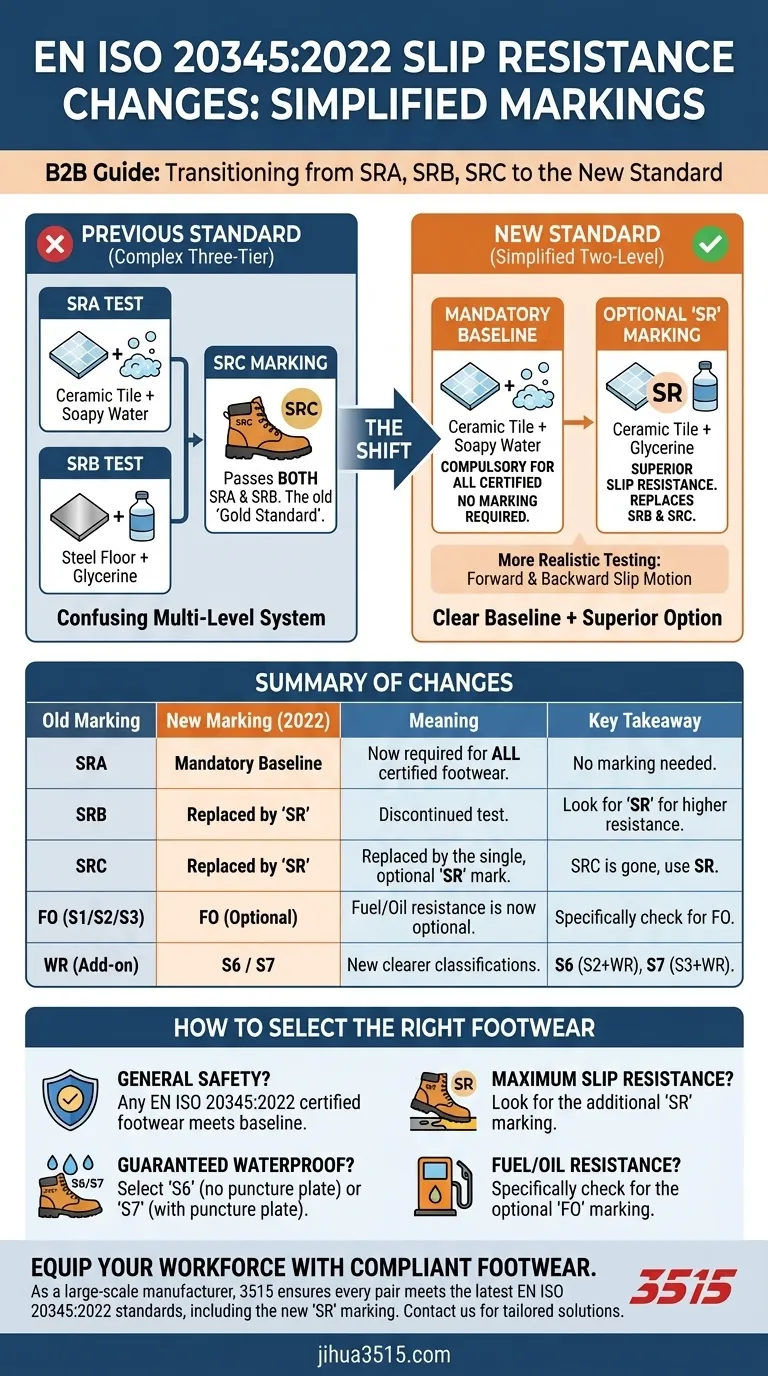
In short, the EN ISO 20345:2022 standard has completely abolished the old SRA, SRB, and SRC slip resistance markings. This change simplifies the system. All certified safety footwear now meets a mandatory basic slip resistance requirement, while a new, single SR marking is used to identify footwear that has passed an additional, more demanding test for superior slip resistance.
The core takeaway is the shift from a confusing three-tiered system (SRA, SRB, SRC) to a much simpler two-level model. Every certified shoe has baseline protection, and those with the optional 'SR' mark offer the highest certified level of slip resistance.
Deconstructing the Old Slip Resistance Ratings
To understand the significance of the change, it's important to recall what the old markings meant. They were based on tests performed on two different surfaces with two different contaminants.
The SRA Test
This test was performed on a ceramic tile surface wetted with a sodium lauryl sulphate solution, essentially soapy water.
The SRB Test
This test was performed on a smooth steel floor with glycerine, a contaminant used to simulate oily or greasy conditions.
The SRC Marking
A shoe was marked SRC if it passed both the SRA and SRB tests. This became the de facto standard for high-performance, anti-slip footwear.
The New Slip Resistance Standard in EN ISO 20345:2022
The 2022 revision streamlines this entire process, making it more practical and easier for users to understand.
A New Baseline for All Footwear
The test previously known as SRA (ceramic tile with soapy water) is now the mandatory minimum requirement for all safety footwear to be certified under EN ISO 20345:2022.
Because it is a compulsory test, it is no longer marked on the shoe. If a shoe is certified, you can be assured it has met this baseline standard.
The New 'SR' Marking
The SR marking is the new indicator for superior slip resistance. It signifies that the footwear has passed an additional, more rigorous test.
This optional test is conducted on a ceramic tile with glycerine. This provides a demanding test for environments where oily or greasy contaminants are present.
More Realistic Testing Methods
A crucial improvement is that the tests now better simulate a natural walking motion. The footwear is tested for both forward heel slip and backward forepart slip, providing a more accurate assessment of real-world performance than the previous flat-footed tests.
Key Implications and Other Changes
The new standard introduces several other changes that are important for anyone specifying or purchasing safety footwear.
The Disappearance of 'SRC'
Users who previously looked for the SRC marking as the gold standard must now shift their focus. The new top-tier indicator for slip resistance is simply SR.
Fuel/Oil Resistance (FO) is Now Optional
Under the old standard, fuel and oil resistance (FO) was a mandatory requirement for S1, S2, and S3 safety ratings. Under the 2022 update, FO is now an optional marking. If your environment requires this protection, you must specifically look for the FO marking.
New Waterproof Categories: S6 and S7
The standard now includes two new classifications for fully waterproof footwear, which are far clearer than the previous "WR" add-on.
- S6: Has all the features of S2 but also includes complete waterproof protection (WR).
- S7: Has all the features of S3 (including a puncture-resistant sole) and also includes complete waterproof protection (WR).
How to Select the Right Footwear Under the New Standard
Use this guide to choose footwear that aligns with the updated 2022 standard and your specific workplace needs.
- If your primary focus is general safety in standard wet or dry conditions: Any footwear certified to EN ISO 20345:2022 is sufficient, as it meets the mandatory baseline slip resistance.
- If your primary focus is maximum slip resistance in greasy or oily environments: You must look for footwear with the additional SR marking.
- If your primary focus is guaranteed waterproofness: Select footwear marked as S6 (if a puncture plate is not needed) or S7 (if a puncture plate is required).
- If you work with fuels or hydrocarbon oils: Do not assume resistance; you must specifically check for the optional FO marking on the product.
By understanding these key shifts, you can now confidently select safety footwear that is precisely aligned with your workplace hazards and compliance requirements.
Summary Table:
| Old Marking | New Marking (EN ISO 20345:2022) | Meaning |
|---|---|---|
| SRA | (Mandatory Baseline) | Baseline slip resistance (ceramic tile, soapy water) is now required for all certified footwear. |
| SRB | Replaced by 'SR' | The SRB test is discontinued. The new 'SR' marking indicates superior slip resistance. |
| SRC | Replaced by 'SR' | The top-tier SRC marking is replaced by the single, optional 'SR' marking. |
| FO (Mandatory for S1/S2/S3) | FO (Optional) | Fuel/oil resistance is now an optional feature, not mandatory. |
| WR (Add-on) | S6 / S7 | New classifications S6 and S7 clearly define fully waterproof footwear. |
Ensure Your Workforce is Equipped with the Latest Compliant Safety Footwear
Navigating the new EN ISO 20345:2022 standard is critical for safety and compliance. As a large-scale manufacturer, 3515 produces a comprehensive range of certified safety footwear for distributors, brand owners, and bulk clients. We ensure every pair meets the latest standards, including the new SR marking for superior slip resistance.
Our production capabilities encompass all types of safety shoes and boots, designed to protect your team.
Let us help you make the right choice. Contact our experts today for a consultation on compliant footwear solutions tailored to your specific hazards.
Visual Guide
Related Products
- Heavy-Duty Waterproof Nubuck Safety Boots Safety Shoes for Bulk Supply
- Wholesale Suede Chelsea Safety Boots for Custom & Private Label Manufacturing
- Wholesale Premium Waterproof Nubuck Safety Shoes Boots
- Premium Wholesale Tactical Style Safety Shoes Boots with Quick Lacing
- Premium Lightweight Safety Shoes for Wholesale & Bulk Orders
People Also Ask
- What primary protective functions do professional safety boots provide in urban solid waste recovery and waste picking processes? Discover Dual-Layer Protection.
- How do safety boots reduce cutting hazards? Essential Protection for Your Workforce
- Which organizations develop safety standards for work boots? Ensure Compliance & Worker Safety
- What are the common types of safety boots and their primary uses? A Guide to Industrial Footwear
- Why is ankle and arch support important in safety footwear? Prevent Injury & Fatigue