
Investing in high-quality materials for men's boots is a strategic decision that pays dividends in durability, comfort, and long-term financial value. Unlike their cheaper counterparts, well-made boots use superior components like full-grain leather and repairable sole constructions that provide lasting performance, protect your foot health, and ultimately lower the cost-per-wear over many years of use.
The choice is not merely between an expensive boot and a cheap one. It's an investment in a foundational tool that impacts your physical well-being, long-term finances, and daily performance.
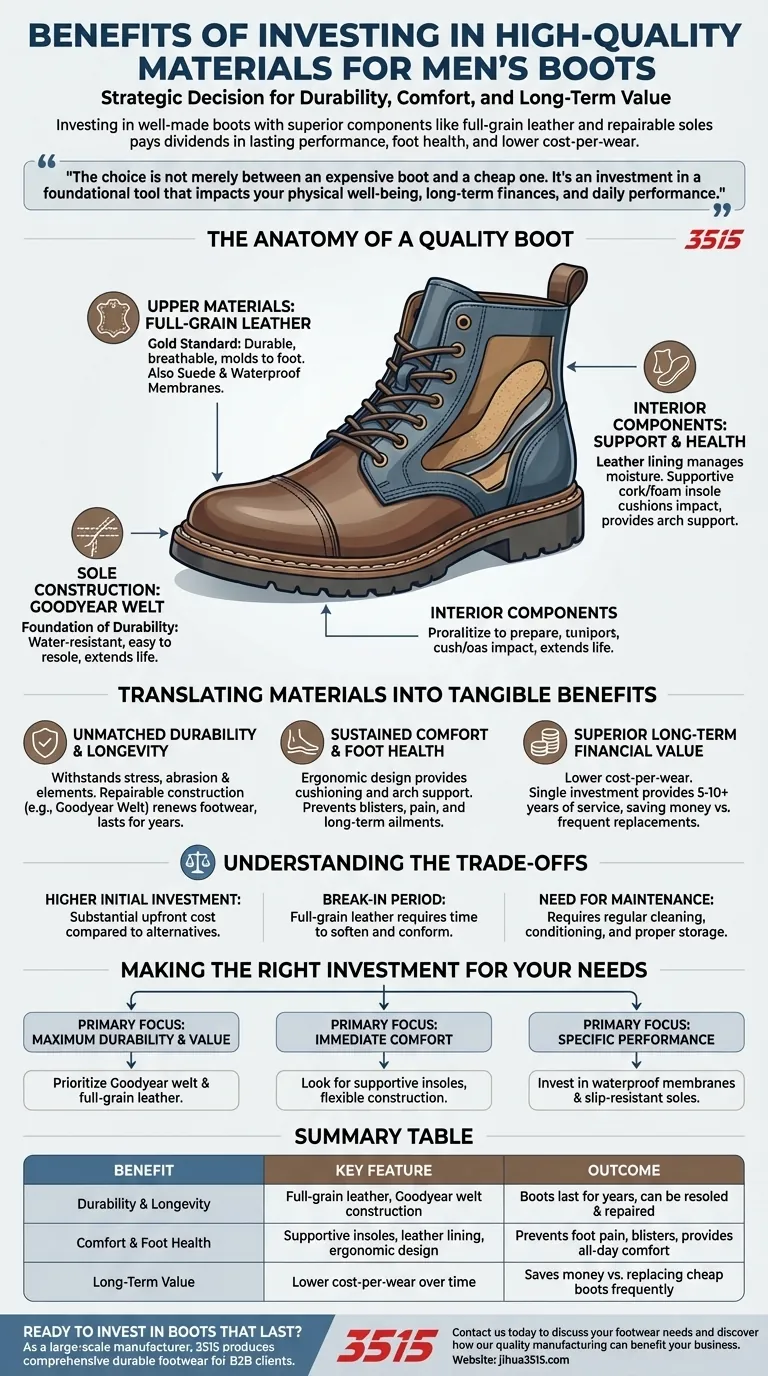
The Anatomy of a Quality Boot
Understanding why quality materials matter requires looking at the key components that separate a premium boot from a disposable one.
Upper Materials: Leather and Synthetics
The "upper" is the main body of the boot that covers your foot. High-quality full-grain leather is the gold standard, known for its exceptional durability, breathability, and ability to mold to your foot over time.
Other materials like suede offer a different aesthetic and flexibility, while advanced waterproof membranes provide crucial protection in wet environments.
Sole Construction: The Foundation of Durability
How the sole is attached to the upper is a critical indicator of quality. A Goodyear welt, for example, is a time-tested method that uses a strip of leather to stitch the upper and sole together, making the boot water-resistant and easy to resole.
This repairability is a hallmark of a quality boot, allowing you to replace a worn-out sole and dramatically extend the footwear's life.
Interior Components: Support and Health
The inside of the boot is just as important as the outside. Quality boots often feature a leather lining that helps manage moisture and a supportive insole or footbed (often made of cork or foam) that cushions impact.
This internal architecture provides proper arch support and prevents common foot problems that arise from wearing unsupportive, poorly constructed footwear.
Translating Materials into Tangible Benefits
The use of premium components and construction methods delivers three core advantages that justify the initial investment.
Unmatched Durability and Longevity
High-quality materials are chosen for their ability to withstand stress, abrasion, and exposure to the elements. This results in footwear that doesn't just last for a season, but for many years.
The ability to repair and resole a quality boot means its lifespan is not determined by its weakest point. Instead of being thrown away, it can be renewed.
Sustained Comfort and Foot Health
A well-made boot serves as a foundation for your entire body. Proper materials and ergonomic design provide the cushioning and arch support needed to prevent foot, leg, and even back pain over the long term.
They prevent blisters, discomfort, and more serious foot ailments, making them essential for anyone who spends significant time on their feet, from office workers to field professionals.
Superior Long-Term Financial Value
While the upfront cost is higher, the cost-per-wear of a quality boot is often significantly lower than that of its cheaper alternatives.
Instead of buying a new pair of low-cost boots every year, a single investment in a quality pair can provide five to ten years (or more) of reliable service, saving you money over time.
Understanding the Trade-offs
An objective assessment requires acknowledging the potential downsides and considerations.
The Initial Investment
The most significant barrier is the higher initial price. A quality boot is an investment, and the upfront cost can be substantial compared to mass-market alternatives.
The Break-in Period
Many high-quality boots, particularly those made from thick, full-grain leather, require a break-in period. The material needs time to soften and conform perfectly to the shape of your foot, which can cause some initial discomfort.
The Need for Maintenance
Premium materials, especially leather, require care to perform at their best. This includes regular cleaning, conditioning, and proper storage to prevent the material from drying out and cracking.
Making the Right Investment for Your Needs
Choosing the right boot depends on aligning its features with your primary goal.
- If your primary focus is maximum durability and long-term value: Prioritize boots with a Goodyear welt or similar resoleable construction and full-grain leather uppers.
- If your primary focus is immediate, all-day comfort: Look for boots known for their supportive insoles, flexible construction, and minimal break-in requirements.
- If your primary focus is performance in specific conditions: Invest in specialized materials like waterproof membranes and slip-resistant outsoles designed for your environment.
Ultimately, investing in quality boots is an investment in a more comfortable, capable, and cost-effective foundation for your daily life.
Summary Table:
| Benefit | Key Feature | Outcome |
|---|---|---|
| Durability & Longevity | Full-grain leather, Goodyear welt construction | Boots last for years, can be resoled and repaired |
| Comfort & Foot Health | Supportive insoles, leather lining, ergonomic design | Prevents foot pain, blisters, and provides all-day comfort |
| Long-Term Value | Lower cost-per-wear over time | Saves money vs. replacing cheap boots frequently |
Ready to invest in boots that last?
As a large-scale manufacturer, 3515 produces a comprehensive range of durable footwear for distributors, brand owners, and bulk clients. Our production capabilities encompass all types of high-quality men's boots designed for long-term performance and value.
Contact us today to discuss your footwear needs and discover how our quality manufacturing can benefit your business.
Visual Guide
Related Products
- Wholesale Leather Ankle Boots with Lug Soles for Custom Brand Manufacturing
- High-Traction Suede Tactical Boots Wholesale & Custom Manufacturing
- Durable Leather Tactical Boots Wholesale & Custom Manufacturing for Brands
- Factory Direct Wholesale Leather Comfort Shoes with Dial Closure
- Wholesale Tactical Boots High-Traction & Reflective for Bulk & Brand Orders
People Also Ask
- What is the difference between full-grain and top-grain leather? Premium Material Guide for Boot Manufacturers
- What are the key qualities of leather for work boots? Superior Durability, Breathability & Custom Fit
- What is the complete process for deep cleaning leather work boots? A Step-by-Step Guide to Preserve Your Investment
- What are the advantages of leather uppers in work boots? Unmatched Durability & Protection
- How should new leather work boots be broken in? A Guide to Comfort and Durability

















