At its core, the primary benefit of D-rings on hiking footwear is faster and more precise lacing. These small, durable metal rings allow your laces to slide through with minimal friction. This makes it significantly easier to achieve a secure, customized fit by tightening or loosening your shoes without struggling against stubborn fabric eyelets, especially on taller boots with more lacing points.
While D-rings offer a clear advantage in adjusting lace tension, their presence often signifies a more robust, supportive shoe designed for heavier loads and tougher terrain. Understanding this connection is key to choosing footwear that truly matches your hiking goals.
The Role of Lacing Systems in Hiking
The way you lace your shoes is fundamental to comfort, support, and injury prevention on the trail. Different lacing hardware is engineered for different purposes.
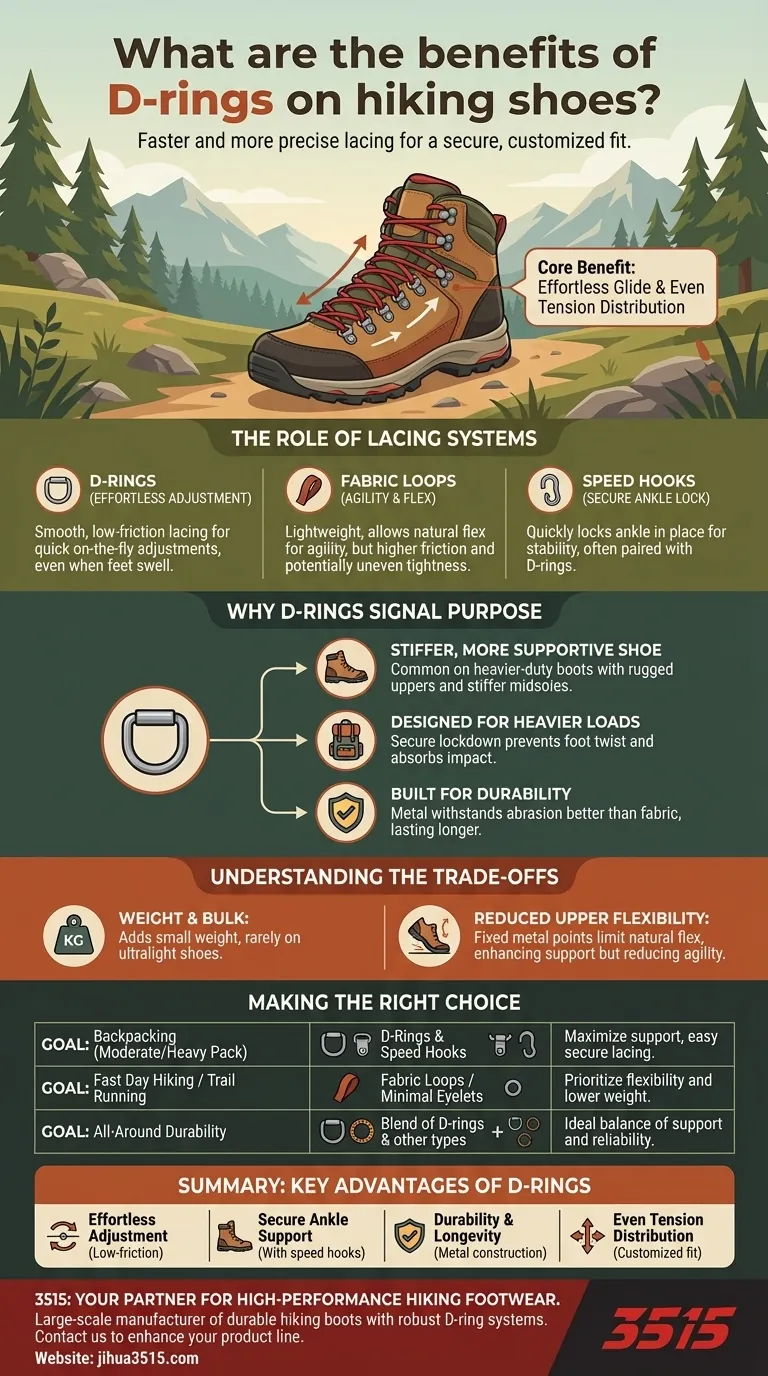
D-Rings for Effortless Adjustment
D-rings are the superior choice for smooth, low-friction lacing. This smooth glide allows you to evenly distribute tension from the bottom of the shoe to the top with a single pull.
This feature is invaluable for on-the-fly adjustments, such as when your feet swell during a long hike.
Fabric Loops for Agility and Flex
Lighter hiking shoes and trail runners often use fabric loops instead of metal hardware. These loops are lightweight and allow the shoe's upper to flex more naturally with your foot.
However, they can create more friction, making it harder to get a perfectly even tightness across the entire shoe.
Speed Hooks for Secure Ankle Lock
Often paired with D-rings on mid or high-cut boots, speed hooks are the open-faced metal hooks at the top of the boot.
They allow you to quickly wrap the laces to lock your ankle in place, providing critical support and stability without having to re-thread an eyelet.
Why D-Rings Are a Clue to a Shoe's Purpose
The presence of D-rings is not just a feature; it's a signal about the shoe's intended design and function.
A Sign of a Stiffer, More Supportive Shoe
D-rings are most common on heavier-duty hiking shoes and boots. These types of footwear typically have stiffer midsoles and more rugged uppers.
This entire system is built to protect your feet and provide stability on uneven ground and when carrying a pack.
Designed for Heavier Loads
When you're backpacking, your footwear must prevent your foot from twisting and absorb significant impact.
The secure, reliable lockdown provided by an easily-adjusted D-ring and speed hook system is critical for this level of performance. It ensures your foot is held firmly in place, reducing fatigue and the risk of blisters.
Built for Durability
Metal D-rings are inherently more durable than fabric loops, which can fray or break from the abrasion of dirty laces over hundreds of miles.
This aligns with the overall design philosophy of traditional hiking shoes, which are built to last longer than their lighter trail-running counterparts.
Understanding the Trade-offs
No single design is perfect for every situation. While D-rings offer clear benefits, they come with considerations.
Weight and Bulk
Metal hardware adds a small amount of weight and bulk compared to simple fabric loops or punched eyelets.
This is a key reason why they are rarely found on ultralight trail-running shoes, where every gram is accounted for.
Reduced Upper Flexibility
Because they are fixed metal points anchored to the shoe's upper, D-rings do not flex as much as fabric loops.
This contributes to the structured, supportive feel of a traditional hiking shoe, but it is a drawback for hikers who prioritize maximum agility and a "barely there" feel.
Making the Right Choice for Your Goal
Look at the lacing system as a key indicator of whether a shoe's design philosophy matches your hiking style.
- If your primary focus is backpacking with a moderate to heavy pack: Look for footwear with a combination of D-rings and speed hooks for maximum support and easy, secure lacing adjustments.
- If your primary focus is fast, light day hiking or trail running: Prioritize shoes with fabric loops or minimal eyelets that offer greater flexibility and lower weight.
- If your primary focus is all-around durability on varied trails: A classic hiking shoe that blends D-rings in high-tension areas with other eyelet types often provides an ideal balance of support and reliability.
Choosing the right footwear starts with understanding that every feature, down to the lacing hardware, is a deliberate choice designed for a specific purpose on the trail.
Summary Table:
| Benefit | Key Advantage |
|---|---|
| Effortless Adjustment | Low-friction lacing for quick, on-the-fly fit changes. |
| Secure Ankle Support | Ideal for locking the ankle in place with speed hooks. |
| Durability & Longevity | Metal construction withstands abrasion from dirty laces. |
| Even Tension Distribution | Provides a customized, secure fit from toe to ankle. |
Ready to equip your customers with high-performance hiking footwear?
As a large-scale manufacturer, 3515 produces a comprehensive range of durable hiking boots and shoes for distributors, brand owners, and bulk clients. Our production capabilities encompass all types of outdoor footwear, including models featuring robust D-ring lacing systems designed for support and longevity on the toughest trails.
Contact us today to discuss your specific needs and discover how we can enhance your product line with reliable, high-quality hiking footwear.
Visual Guide
Related Products
- Durable Rubber Sole Outdoor Shoes Wholesale & Custom Manufacturing
- Wholesale High-Traction Camo Boots - Custom Manufacturer for Brands
- Wholesale Durable Camouflage Canvas Shoes with High-Traction Cleated Rubber Sole
- Wholesale Durable Camo Canvas Shoes with High-Traction Rubber Soles
- Premium Lightweight Safety Shoes for Wholesale & Bulk Orders
People Also Ask
- What is the function of the sole in outdoor shoes? Find the Perfect Grip and Support
- What role do outdoor shoes and sneakers play in navigating external terrains? Engineered Stability for Every Surface
- How is AI utilized in the design of outdoor and safety footwear? Harnessing Big Data for Market-Driven Shoe Innovation
- Why is durability important when selecting outdoor shoes? A Guide to Safety & Long-Term Value
- What are the key components of outdoor shoes that affect comfort and sturdiness? A Guide to Durable, High-Performance Footwear