First, I've got to understand the core need here: it's not just "What are the different heights?", but "Which height is right for my type of hiking and how do I make the best decision for my safety, comfort, and performance?" I'll ensure I'm objective and empathetic, explaining in clear language with analogies. The final output must be scannable with a bold title, short paragraphs, and clear subheadings.
Thinking through the References
I've reviewed these references to get a grasp of different hiking footwear, their specific heights and applications. The key takeaway is: shoes are typically low cut, and boots can be mid or high cut. I'll need to synthesize this info. I'm taking the "use-case" into consideration.
I see the core trade-off – mobility versus stability – that I need to highlight. References also discuss the support that hiking shoes and boots offer.
Some references cover the different types of hiking footwear like trail-runners, approach shoes, multifunctional shoes, light hiking boots and trekking shoes. I'll need to bring this information into the article to add depth without derailing the core topic of cut/height.
Synthesizing and Structuring the Article
I'll start with a bold phrase like "Hiking footwear is categorized by three primary heights." and directly answer: The main options are low-cut, mid-cut, and high-cut models. Each is designed for a different balance of mobility and support. I'll include a core takeaway box at the beginning to summarize that the shoe height is a direct trade-off between ankle stability and freedom of movement depending on the terrain, weight, and your biomechanics.
My main body will decode the three core heights starting with low-cut (for maximum agility), mid-cut (the versatile hybrid) and high-cut (uncompromising stability), using clear descriptions and analogies for each.
Next, I'll dive into the critical trade-offs, like stability versus mobility, protection versus weight, and myth of "ankle support" to provide a nuanced expert point, as high-cut boots don't prevent an ankle roll with a magical forcefield. They limit the range of a roll, reducing its severity.
I'll conclude with a bulleted list to help the user make the right choice, whether it's speed and day hiking (low-cut), varied terrain/short trips (mid-cut), or rough, multi-day treks (high-cut).
I'll end with an empowering sentence: "By aligning your footwear's height with your specific goals, you transform a simple choice into a strategic advantage on the trail."
This structure, combined with super short and scannable paragraphs, should deliver a clear, actionable, and authoritative guide. Hiking footwear is defined by three primary heights, or "cuts." These are low-cut, mid-cut, and high-cut models, which are generally categorized as hiking shoes, hybrid boots, and full hiking boots, respectively. The fundamental difference between them is where the collar of the shoe ends in relation to your ankle bone, which directly impacts both mobility and stability.
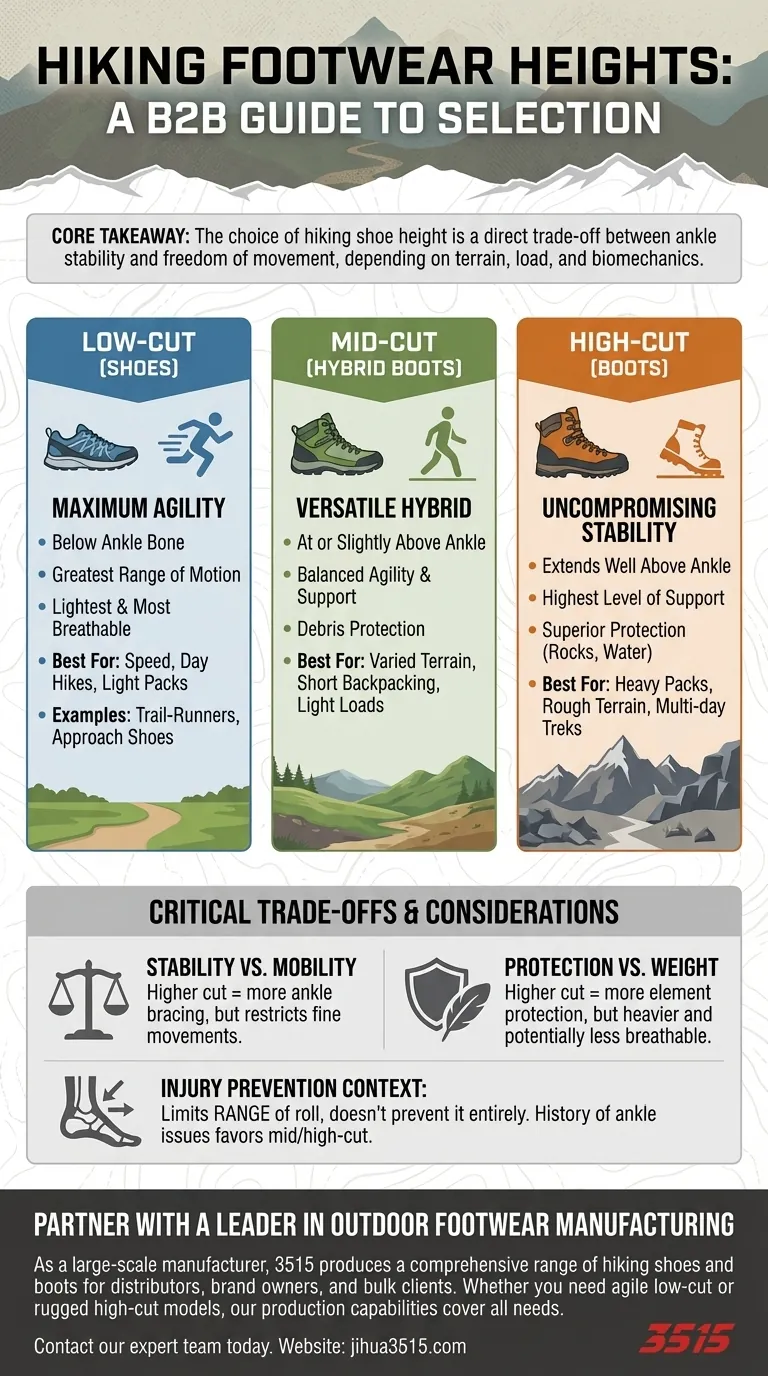
The choice of hiking shoe height is a direct trade-off between ankle stability and freedom of movement. Your ideal choice depends less on the label and more on the terrain you'll face, the weight you'll carry, and your personal history with ankle injuries.
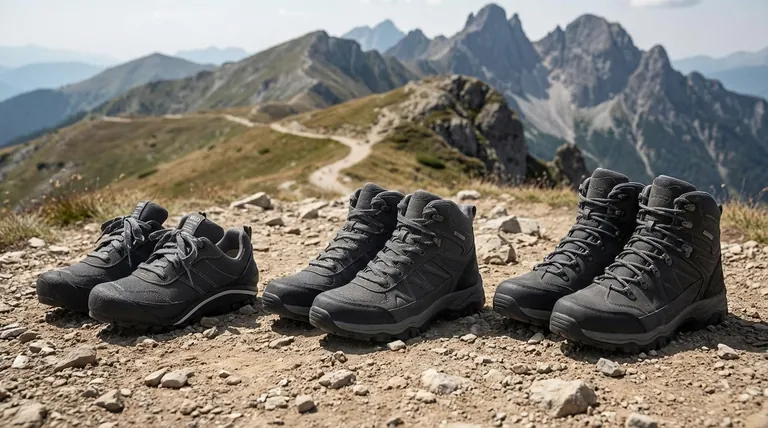
Decoding the Three Core Heights
Understanding the specific purpose behind each cut is the first step in selecting the right tool for the job. Each design prioritizes a different aspect of performance on the trail.
Low-Cut: For Maximum Agility
Low-cut shoes have a collar that sits below the ankle bone, similar to a standard running shoe. This design offers the greatest range of motion.
These models are the lightest and often most breathable option. Their flexibility makes them ideal for moving quickly.
Common examples include traditional hiking shoes, trail-running shoes, and approach shoes, all designed for scenarios where speed and a natural foot-feel are paramount.
Mid-Cut: The Versatile Hybrid
Mid-cut boots end right at, or slightly above, the ankle. They are designed to offer a balance between the agility of a shoe and the support of a full boot.
This height provides a degree of ankle support and better protection from trail debris without being overly restrictive or heavy.
This makes them an excellent all-around choice for hikers who tackle varied terrain or carry light-to-moderate pack weights.
High-Cut: For Uncompromising Stability
High-cut models, or traditional hiking boots, have a collar that extends well above the ankle. This design offers the highest level of support.
They are built to stabilize the ankle on rough, unpredictable terrain and are essential when carrying a heavy backpack that alters your center of gravity.
This robust construction also provides superior protection from rocks, water, and difficult weather conditions, making them the standard for serious treks and long-distance hiking.
Understanding the Critical Trade-offs
Selecting a shoe height is not about finding the "best" one, but about understanding the compromises inherent in each design.
Stability vs. Mobility
This is the central trade-off. As the height of the shoe increases, so does its ability to brace your ankle against twists and sprains.
However, this added stability comes at the cost of mobility. A high-cut boot restricts the fine movements of your ankle, which can feel cumbersome on simple, flat terrain.
Protection vs. Weight
Higher-cut footwear inherently offers more protection from the elements, whether that's rocks on the trail, intrusive brush, or water crossings.
The price for this protection is weight and bulk. Heavier boots require more energy to lift with every step, which can lead to significant fatigue over a long day. They also tend to be less breathable.
Injury Prevention Context
It's crucial to understand that a high-cut boot does not make you immune to ankle rolls. Instead, it works by limiting the range of motion during a misstep, often reducing a potentially severe sprain to a minor one.
Your personal history is a key factor. If you have a history of ankle instability, the added confidence and support of a mid- or high-cut boot is a logical choice, even on easier trails.
Making the Right Choice for Your Hike
Base your decision on the demands of your intended activity, not on the label of the shoe.
- If your primary focus is speed and day hiking on well-maintained trails: Choose a low-cut shoe for its lightweight agility and superior breathability.
- If your primary focus is versatility for varied terrain or short backpacking trips: A mid-cut boot offers the best balance of protective support and flexible comfort.
- If your primary focus is multi-day trekking with a heavy pack or navigating rough, off-trail terrain: A high-cut boot provides the essential stability and protection required for demanding conditions.
By aligning your footwear's height with your specific goals, you transform a simple choice into a strategic advantage on the trail.
Summary Table:
| Height / Cut | Best For | Key Characteristics |
|---|---|---|
| Low-Cut (Shoes) | Speed, day hikes, light packs | Maximum agility, lightweight, breathable |
| Mid-Cut (Hybrid Boots) | Versatility, varied terrain, light loads | Balanced support & mobility, good debris protection |
| High-Cut (Boots) | Heavy packs, rough terrain, multi-day treks | Maximum ankle stability, superior protection, durable |
Ready to equip your next adventure with the perfect footwear?
As a large-scale manufacturer, 3515 produces a comprehensive range of hiking shoes and boots for distributors, brand owners, and bulk clients. Whether you need agile low-cut shoes for fast-paced trails or rugged high-cut boots for demanding expeditions, our production capabilities cover all types of outdoor footwear to meet your specific market needs.
Contact our expert team today to discuss your footwear requirements and discover how we can support your business with quality, scale, and reliability.
Visual Guide
Related Products
- Durable Rubber Sole Outdoor Shoes Wholesale & Custom Manufacturing
- Wholesale High-Traction Camo Boots - Custom Manufacturer for Brands
- Wholesale Durable Camouflage Canvas Shoes with High-Traction Cleated Rubber Sole
- Wholesale Durable Camo Canvas Shoes with High-Traction Rubber Soles
- Wholesale Lightweight Tactical Boots Custom Manufacturer for Desert & Combat Use
People Also Ask
- What is the function of the sole in outdoor shoes? Find the Perfect Grip and Support
- What role do outdoor shoes and sneakers play in navigating external terrains? Engineered Stability for Every Surface
- How is AI utilized in the design of outdoor and safety footwear? Harnessing Big Data for Market-Driven Shoe Innovation
- Why is durability important when selecting outdoor shoes? A Guide to Safety & Long-Term Value
- What are the key components of outdoor shoes that affect comfort and sturdiness? A Guide to Durable, High-Performance Footwear