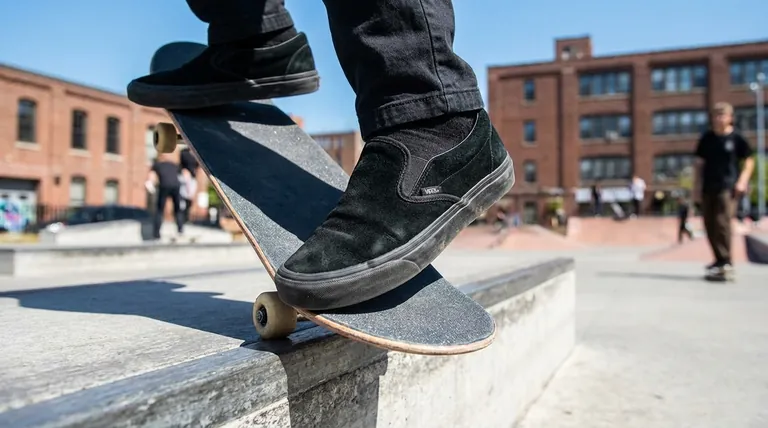
To put it simply, the primary advantages of slip-on skate shoes are their convenience and enhanced durability in specific areas. By eliminating laces, they remove a common failure point that rips during ollies and kickflips, offering a more streamlined and often longer-lasting upper.
The core decision is not just about convenience, but understanding how a slip-on's construction—often paired with specific sole types—aligns with your personal style of skateboarding. The real advantage emerges when its minimalist design meets your need for boardfeel and flick consistency.
Why Skaters Choose Slip-Ons
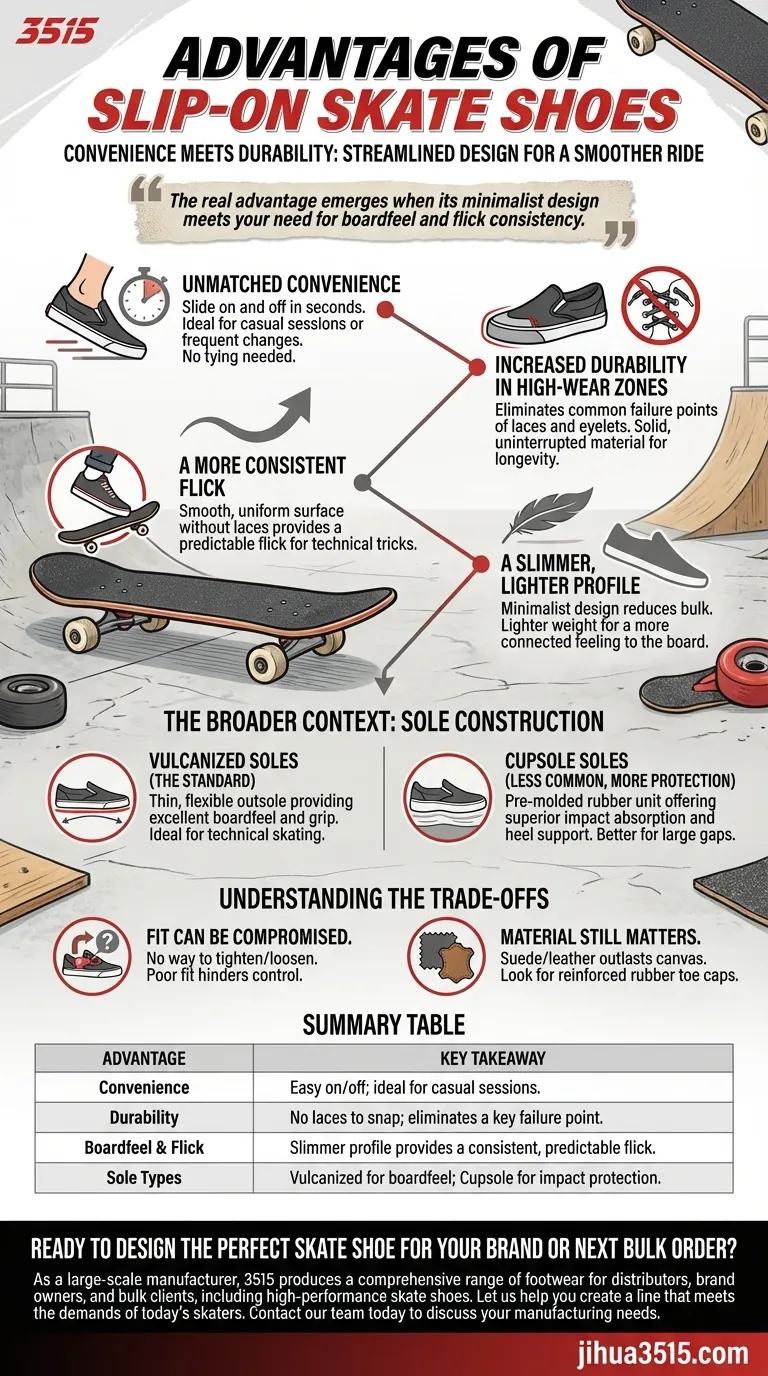
Unmatched Convenience
The most obvious benefit is the ease of use. You can slide them on and off in seconds without worrying about tying, adjusting, or replacing laces.
This simplicity is ideal for casual sessions or for skaters who are frequently taking their shoes on and off.
Increased Durability in High-Wear Zones
Traditional laced shoes have a critical weak point: the laces themselves and the eyelet stitching. These areas are directly in the path of griptape abrasion during ollies and flip tricks.
Slip-ons completely eliminate this problem. The solid, uninterrupted material across the top of the foot means there are no laces to snap or eyelets to rip out.
A More Consistent Flick
Without laces and extra panels, a slip-on provides a smooth, uniform surface for your foot.
This consistency can lead to a more predictable flick when performing flip tricks, as there are no laces or varying textures to catch the board unpredictably.
A Slimmer, Lighter Profile
Slip-on shoes often feature a minimalist design and a slimmer silhouette compared to bulkier, technical skate shoes.
This reduced weight and bulk can contribute to a feeling of being lighter on your feet and more connected to your board.
The Broader Context: Sole Construction
A shoe is more than its upper. The sole construction is arguably the most critical factor for performance, and slip-ons can feature either type. Understanding this is key to making an informed choice.
Vulcanized Soles (The Standard for Slip-Ons)
Most classic slip-ons use a vulcanized sole, where a strip of rubber is "taped" around the shoe and heat-cured.
This process results in a thin, flexible, and flat outsole that provides excellent boardfeel and grip. You can feel the concave of your board perfectly, which is ideal for technical skating that requires precise foot placement.
Cupsole Soles (Less Common, More Protection)
A cupsole is a single, pre-molded rubber unit that the shoe's upper is stitched or glued into.
Cupsoles offer far superior impact absorption and heel support. They are more durable and protective, making them better for skaters who jump down large gaps or stairs. However, this comes at the cost of boardfeel.
Understanding the Trade-offs
The Fit Can Be Compromised
The biggest drawback of a slip-on is the lack of adjustability. If the shoe doesn't fit your foot perfectly out of the box, there is no way to tighten or loosen it.
A poor fit can lead to heel lift or a sloppy feeling, which severely hinders board control and can even be dangerous.
Material Still Matters Most
While slip-ons remove a weak point, the durability of the shoe is still primarily determined by its material.
A suede or leather slip-on will always outlast a canvas one. Look for reinforced rubber toe caps on some models to drastically extend the life of the shoe against griptape abrasion.
Making the Right Choice for Your Goal
- If your primary focus is technical street skating: A classic suede slip-on with a vulcanized sole offers the best combination of boardfeel, consistent flick, and durability.
- If your primary focus is comfort and impact protection: A slip-on may not be your best choice. Look for a traditional laced shoe with a cupsole for better support and a customizable fit.
- If your primary focus is convenience for casual cruising: Any slip-on will work, but a canvas version is often lighter and more breathable for relaxed sessions.
Ultimately, choosing a slip-on is about prioritizing a clean feel and convenience over the adjustable security of a laced shoe.
Summary Table:
| Advantage | Key Takeaway |
|---|---|
| Convenience | Easy on/off; ideal for casual sessions. |
| Durability | No laces to snap; eliminates a key failure point. |
| Boardfeel & Flick | Slimmer profile provides a consistent, predictable flick. |
| Sole Types | Vulcanized for boardfeel; Cupsole for impact protection. |
Ready to design the perfect skate shoe for your brand or next bulk order?
As a large-scale manufacturer, 3515 produces a comprehensive range of footwear for distributors, brand owners, and bulk clients. Our production capabilities encompass all types of shoes and boots, including high-performance skate shoes built for durability and style.
Let us help you create a line that meets the demands of today's skaters. Contact our team today to discuss your manufacturing needs.
Visual Guide
Related Products
- Customizable Slip-On Safety Shoes Direct from the Factory for Wholesale
- Advanced KPU Athletic Safety Shoe with Steel Toe Cap Anti-Slip Rotary Lacing System
- Premium Suede Sport Safety Shoes for Wholesale & Bulk Orders
- Wholesale Breathable Perforated Slip-On Loafers Custom Manufacturing
- Men's Breathable Perforated Loafers Wholesale & OEM Manufacturing
People Also Ask
- What are Slip-Ons best used for? The Ultimate Guide to Effortless Casual Footwear
- What makes the Tecovas The Monterrey a good slip-on option? Unmatched Comfort & Style
- What features make slip-on shoes practical for retail workers or flight attendants? Unlock All-Day Comfort & Convenience
- What are the features of slip-on work shoes? Prioritize Convenience & Safety for Your Team
- What makes a safety shoe a safety shoe? Essential Protection for Hazardous Work