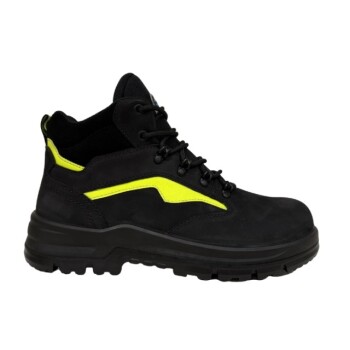
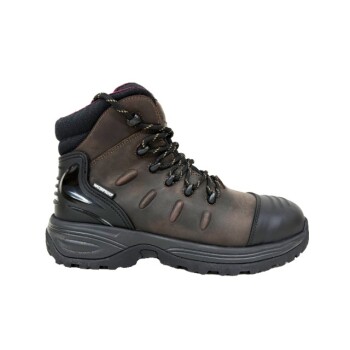
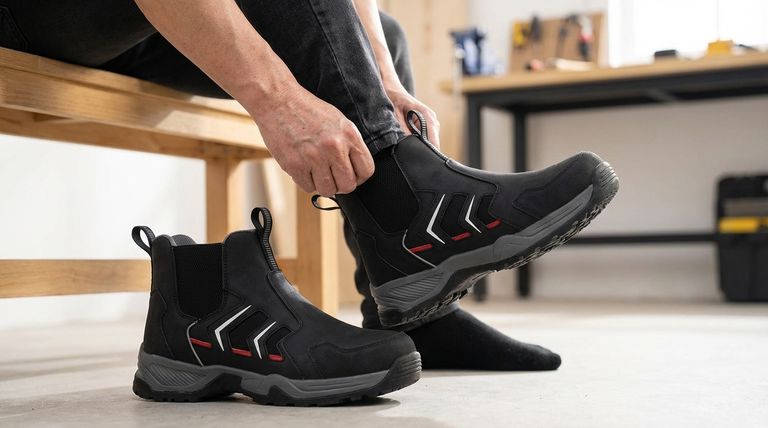
For professionals with physical limitations, the primary advantage of pull-on work boots is their fundamental accessibility. This design eliminates the need to bend, crouch, or use fine motor skills for lacing, which directly reduces strain on the back and joints. For individuals managing pain or mobility challenges, this simple change can make the daily act of preparing for work significantly easier and safer.
The core value of pull-on work boots for individuals with physical challenges is not just convenience, but the preservation of energy and the reduction of chronic pain. By removing the physical barrier of laces, these boots make daily routines more manageable and empower greater independence.
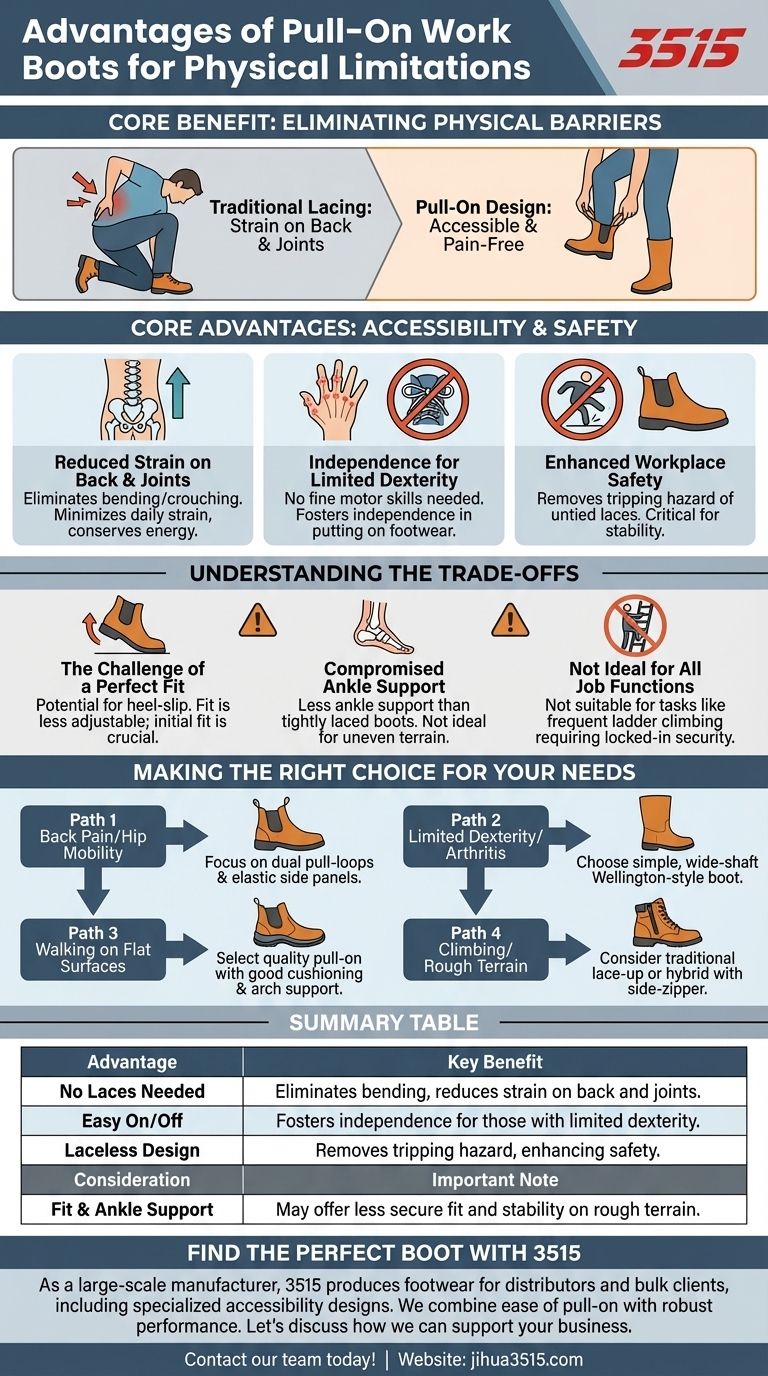
The Core Benefit: Eliminating Physical Barriers
The most significant advantage of a pull-on design is how it removes common physical obstacles present in traditional footwear. This has profound implications for anyone with mobility or dexterity limitations.
Reduced Strain on the Back and Joints
For individuals with lower back pain, sciatica, or hip mobility issues, the act of bending over to tie laces can be a source of significant discomfort or even injury.
Pull-on boots completely remove this step. This simple change minimizes daily strain on the spine and major joints, conserving energy and helping to prevent the aggravation of chronic conditions.
Independence for Limited Dexterity
Conditions like arthritis, carpal tunnel syndrome, or nerve damage can make manipulating laces difficult or impossible.
Pull-on boots offer a straightforward solution that requires no fine motor skills. This fosters independence, allowing the wearer to put on and remove their own footwear without assistance or struggle.
Enhanced Workplace Safety
An often-overlooked benefit is the elimination of a common tripping hazard: untied laces.
While this is a risk for any worker, it is especially critical for individuals who may already have challenges with balance or stability. A laceless design is an inherently safer design in this context.
Understanding the Trade-offs
To make an informed decision, you must weigh the benefits against the potential drawbacks. The laceless design of pull-on boots introduces specific compromises that are critical to understand.
The Challenge of a Perfect Fit
The most common issue with pull-on boots is achieving a secure fit. Without laces to adjust tightness, the boot can feel loose, particularly around the heel.
This can lead to heel-slip, where your heel lifts inside the boot as you walk. While this often lessens as boots break in, an initially poor fit will not improve.
Compromised Ankle Support
By their nature, pull-on boots typically offer less ankle support than a high-top boot that can be laced tightly.
This makes them less suitable for work environments with highly uneven terrain, where the risk of rolling an ankle is high.
Not Ideal for All Job Functions
The potential for a looser fit and reduced ankle stability means pull-on boots are not the best choice for certain tasks.
Specifically, any job that requires frequent climbing of ladders or poles demands the locked-in security that only a well-fitted, laced boot can provide.
Making the Right Choice for Your Needs
Choosing the right boot requires matching its design to your specific physical requirement and job function.
- If your primary limitation is back pain or hip mobility: Focus on boots with dual pull-loops and elastic side panels (gores) to minimize all bending and effort.
- If you struggle with hand dexterity or arthritis: A simple, wide-shaft Wellington-style boot is the most straightforward option, as it requires no manipulation.
- If your job involves walking on mostly flat surfaces: A quality pull-on with good cushioning and arch support is an excellent choice for all-day comfort.
- If your work involves climbing or navigating rough terrain: A traditional lace-up boot, or a hybrid with a side-zipper, may be a necessary compromise for your safety.
Ultimately, the right boot empowers you to perform your job safely and comfortably by accommodating your specific physical requirements.
Summary Table:
| Advantage | Key Benefit |
|---|---|
| No Laces Needed | Eliminates bending, reduces strain on back and joints. |
| Easy On/Off | Fosters independence for those with arthritis or limited hand dexterity. |
| Laceless Design | Removes tripping hazard, enhancing workplace safety. |
| Consideration | Important Note |
| Fit & Ankle Support | May offer less secure fit and stability than laced boots on rough terrain. |
Find the Perfect Boot for Your Needs with 3515
Struggling to find work boots that accommodate your physical requirements without compromising on safety or durability? As a large-scale manufacturer, 3515 produces a comprehensive range of footwear for distributors, brand owners, and bulk clients. Our production capabilities encompass all types of shoes and boots, including specialized designs for enhanced accessibility.
We can help you provide or source footwear that combines the ease of a pull-on design with the robust performance your customers demand. Let's discuss how we can support your business and end-users.
Contact our team today to explore your options!
Visual Guide
Related Products
- Wholesale Leather Work Boots with Customizable Wedge Sole for Brands
- Durable Leather Moc Toe Work Boots for Wholesale & Custom Manufacturing
- Durable Leather Work Boots for Wholesale & Custom Manufacturing
- Durable Moc-Toe Wedge Work Boots | Wholesale Manufacturing for Brands
- Durable Goodyear Welt Leather Work Boots for Wholesale & Private Label
People Also Ask
- What is the difference between full-grain and top-grain leather? Premium Material Guide for Boot Manufacturers
- What are the advantages of leather as an upper material for work boots? Unmatched Durability & Custom Comfort
- How can leather work boots be protected from environmental elements? A 3-Step Guide to Lasting Durability
- What is the complete process for deep cleaning leather work boots? A Step-by-Step Guide to Preserve Your Investment
- What are the key qualities of leather for work boots? Superior Durability, Breathability & Custom Fit