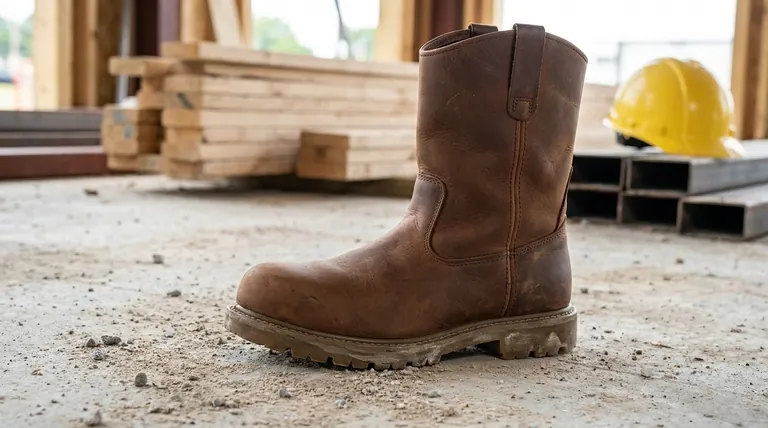
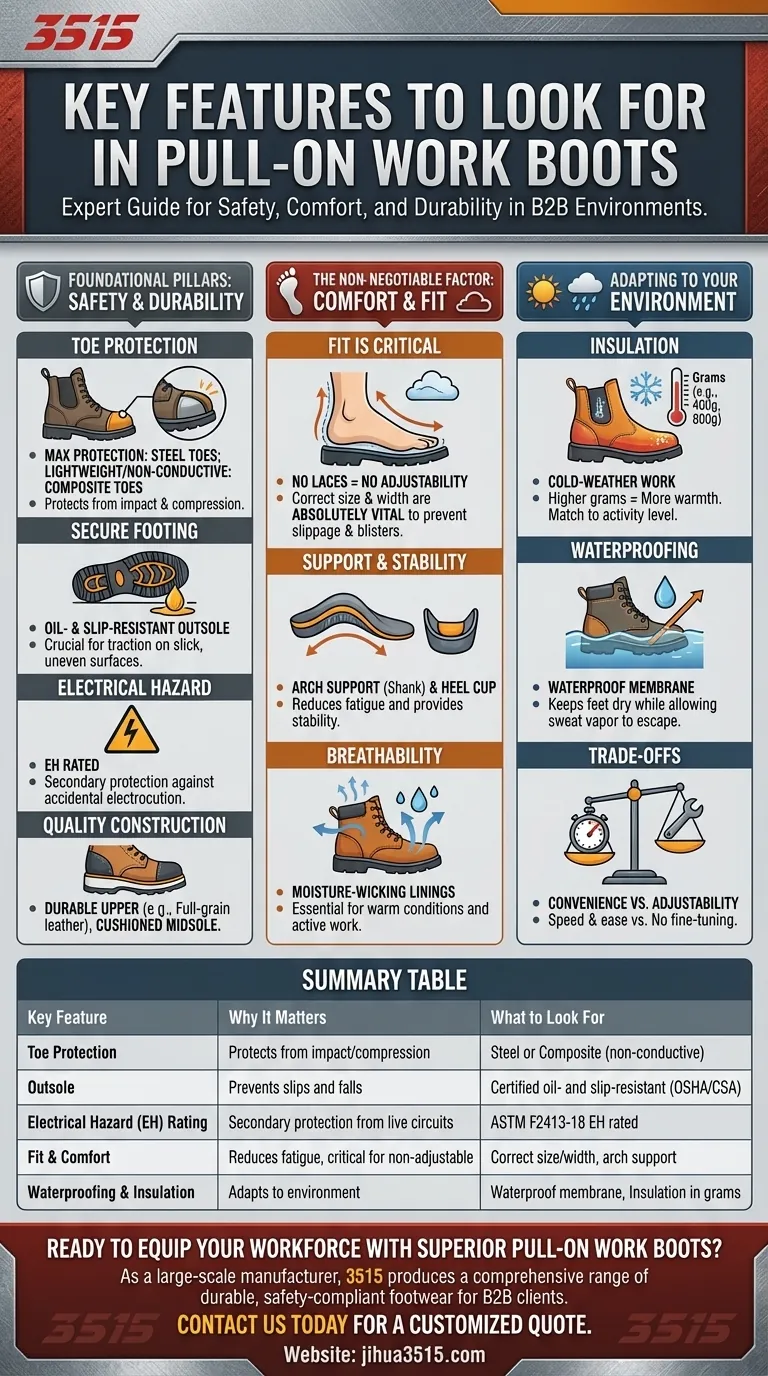
When selecting pull-on work boots, the key features to evaluate are those that directly impact your safety, comfort, and durability in your specific work environment. The most critical considerations include the type of toe protection, the slip- and oil-resistance of the outsole, electrical hazard ratings, and overall construction quality.
While convenience is the main draw of pull-on boots, their lack of laces makes a perfect initial fit the single most important factor. The right features are useless if the boot doesn't fit correctly from day one.
Foundational Pillars: Safety and Durability
Your work boots are a primary piece of personal protective equipment. Their construction and safety features should be your first point of analysis.
Prioritizing Toe Protection
Safety toes are non-negotiable in many industries, protecting you from impact and compression. You will typically choose between steel toes, which offer maximum protection, and composite toes, which are lighter, don't conduct electricity, and are better in extreme temperatures.
Ensuring a Secure Footing
The outsole is your connection to the ground. Look for boots with clearly stated oil- and slip-resistant properties, which are crucial for maintaining traction on slick or uneven surfaces and preventing falls.
Guarding Against Electrical Hazards
If you work near live electrical circuits, an Electrical Hazard (EH) rated boot is essential. This feature provides a secondary source of protection against accidental electrocution.
The Importance of Quality Construction
Durability comes from the materials and methods used to build the boot. Pay attention to the upper material (like full-grain leather for abrasion resistance) and the midsole, which provides cushioning and support.
The Non-Negotiable Factor: Comfort and Fit
Safety features protect you from accidents, but comfort and fit protect you from the daily grind of long hours on your feet.
Why Fit is Different for Pull-On Boots
Unlike lace-up boots, you cannot fine-tune the tightness of a pull-on. This makes selecting the correct size and width absolutely critical. An improper fit can lead to heel slippage, blisters, and a lack of support.
The Role of Support and Stability
A good work boot provides essential arch and ankle support to reduce fatigue. Look for features like a supportive shank (a rigid piece between the insole and outsole) and a well-structured heel cup for stability.
Considering Breathability
If you work in warm conditions or are highly active, breathability is key. Linings that wick moisture away from your feet help prevent discomfort and the growth of bacteria.
Adapting to Your Environment
Beyond the core features, your specific worksite dictates which additional protections you'll need.
Selecting the Right Insulation
For cold-weather work, insulation is a must. It is measured in grams, with higher numbers providing more warmth. Your activity level matters; stationary workers need heavier insulation than those who are constantly moving.
The Value of Waterproofing
If you work outdoors or in wet conditions, a waterproof membrane is essential. This feature keeps your feet dry from external moisture while still allowing sweat vapor to escape.
Understanding the Trade-offs of Pull-On Boots
While pull-on boots offer significant advantages, you must understand their inherent limitations to make an informed decision.
Convenience vs. Adjustability
The primary benefit is speed and ease—no laces to tie or trip over. The trade-off is the complete lack of adjustability. You cannot tighten the boot for more support during a specific task or loosen it if your feet swell.
The Risk of an Improper Fit
The standardized fit of pull-on boots means they either work for your foot shape or they don't. If there's too much room, your heel will slip; if it's too tight, there is no way to relieve the pressure. This makes trying them on in person highly advisable.
Making the Right Choice for Your Work
Filter your options by matching the boot's features to your daily tasks and environment.
- If your primary focus is maximum safety in a hazardous environment: Prioritize the specific type of safety toe (steel or composite), EH rating, and certified slip-resistance required for your job.
- If your primary focus is all-day comfort on hard surfaces: Emphasize getting the exact size right, a supportive midsole, and good arch support to prevent fatigue.
- If your primary focus is working outdoors in varied climates: Look first for robust waterproofing and then select the appropriate level of insulation for your region's temperatures.
Ultimately, choosing the right work boot is an investment in your safety and daily well-being.
Summary Table:
| Key Feature | Why It Matters | What to Look For |
|---|---|---|
| Toe Protection | Protects from impact/compression | Steel toe (max protection) or Composite toe (lightweight, non-conductive) |
| Outsole | Prevents slips and falls | Certified oil- and slip-resistant (OSHA/CSA) |
| Electrical Hazard (EH) Rating | Secondary protection from live circuits | ASTM F2413-18 EH rated |
| Fit & Comfort | Reduces fatigue; critical for non-adjustable pull-ons | Correct size/width, arch support, cushioned midsole |
| Waterproofing & Insulation | Adapts to environment | Waterproof membrane (e.g., Gore-Tex); insulation in grams (e.g., 400g, 800g) |
Ready to equip your workforce with superior pull-on work boots?
As a large-scale manufacturer, 3515 produces a comprehensive range of durable, safety-compliant footwear for distributors, brand owners, and bulk clients. Our production capabilities encompass all types of work boots, ensuring you get the perfect combination of safety features, comfort, and value.
Contact us today to discuss your specific needs and receive a customized quote.
Visual Guide
Related Products
- Wholesale Leather Work Boots with Customizable Wedge Sole for Brands
- Durable Leather Moc Toe Work Boots for Wholesale & Custom Manufacturing
- Durable Moc-Toe Wedge Work Boots | Wholesale Manufacturing for Brands
- Durable Goodyear Welt Leather Work Boots for Wholesale & Private Label
- Durable Leather Work Boots for Wholesale & Custom Manufacturing
People Also Ask
- What is the difference between full-grain and top-grain leather? Premium Material Guide for Boot Manufacturers
- What are the advantages of leather as an upper material for work boots? Unmatched Durability & Custom Comfort
- How can leather work boots be protected from environmental elements? A 3-Step Guide to Lasting Durability
- What is the complete process for deep cleaning leather work boots? A Step-by-Step Guide to Preserve Your Investment
- What are the key qualities of leather for work boots? Superior Durability, Breathability & Custom Fit