The most cost-effective ways to buy high-quality winter boots involve a two-part strategy: timing your purchase to maximize discounts and focusing on essential quality features over brand names. Strategic shopping during the off-season (spring and summer), targeting clearance sales, and seeking out last year's models will yield the most significant price reductions.
The goal is not simply to find the cheapest boots, but to secure the best possible value. This means first understanding the key features that define a durable, warm boot, and then applying smart shopping tactics to acquire that quality for the lowest price.
What Defines a "High-Quality" Winter Boot?
Before you can find a good deal, you must know what you're looking for. Price doesn't always equal quality. A truly effective winter boot excels in four key areas.
Insulation: The Non-Negotiable Core
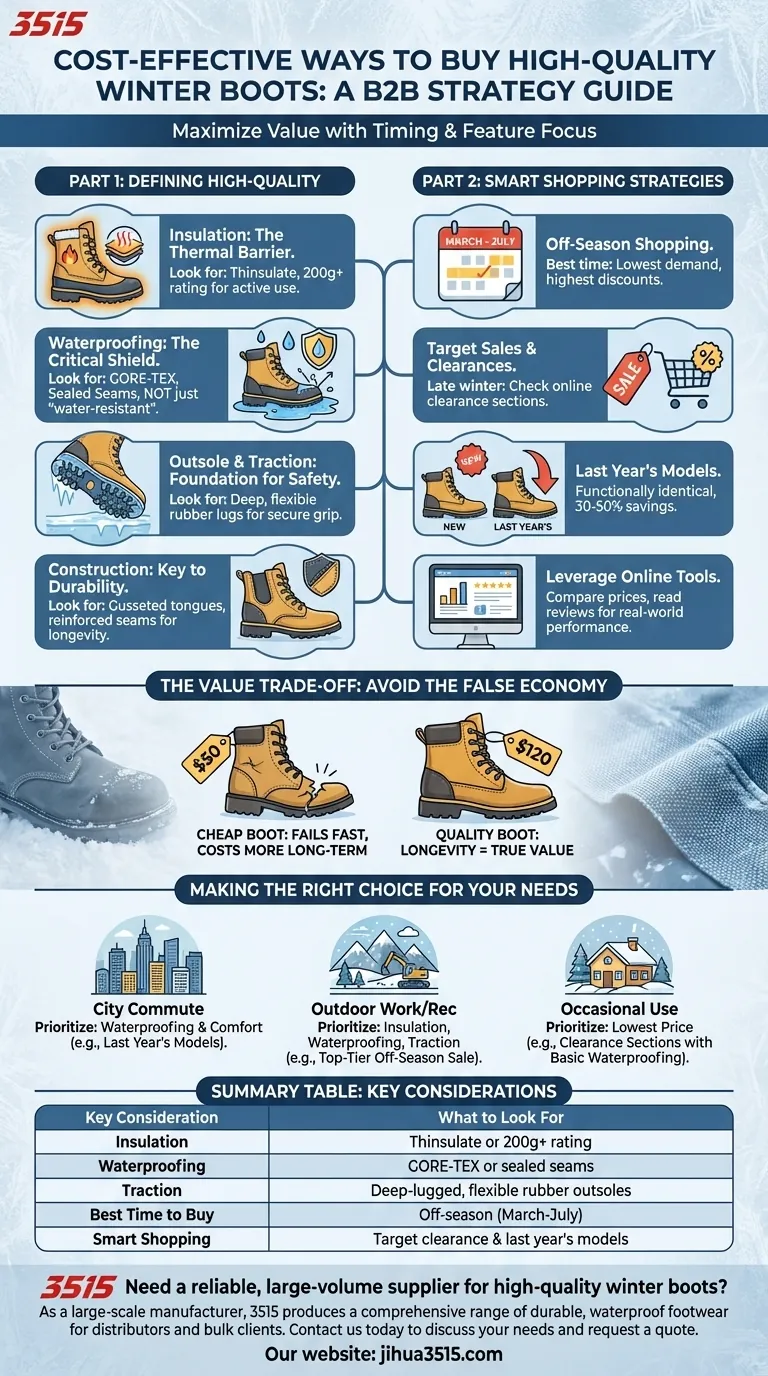
Insulation is the single most important factor. It creates a thermal barrier that keeps your feet warm. Look for boots with specifications like Thinsulate or a stated gram weight of insulation (200g is standard for active use, while 400g+ is for more extreme cold).
Waterproofing: The Critical Shield
Wet feet get cold instantly, no matter how much insulation you have. Look for boots with a truly waterproof construction, such as a GORE-TEX membrane or rubber-sealed seams, not just "water-resistant" leather or nylon.
Outsole and Traction: Your Foundation for Safety
A high-quality boot has a deep, aggressive tread pattern (lugs) made from a soft rubber compound that stays flexible in the cold. This is essential for maintaining a secure grip on snow and ice.
Construction: The Key to Durability
Look for boots with gusseted tongues (attached to the sides) to keep snow out and reinforced seams. The way the upper part of the boot is joined to the sole is a major indicator of longevity.
Proven Strategies for Reducing Cost
Once you can identify a well-made boot, you can apply specific tactics to avoid paying full price.
The Power of Off-Season Shopping
Retailers need to clear out seasonal inventory. The best time to buy winter boots is often from March to July, when demand is at its lowest and discounts are at their highest.
Targeting Sales and Clearances
Look for end-of-season sales in late winter. Check the online clearance sections of major outdoor retailers, which are often a goldmine for heavily discounted but perfectly functional boots.
Seeking Out Last Year's Models
A boot model from the previous year is often functionally identical to the current one, aside from a minor color change. These older models are frequently marked down by 30-50% to make room for new stock.
Leveraging Online Retailers and Reviews
Use online shopping platforms to easily compare prices across multiple stores. More importantly, read customer reviews to validate a boot's real-world performance on warmth and waterproofing before you buy.
Understanding the Trade-offs
A cost-effective decision requires balancing initial price against long-term performance and durability.
The False Economy of Cheap Boots
An inexpensive, poorly made boot might save you money upfront, but it often fails after a single season. A $50 boot that lasts one year is far more expensive than a $120 boot that lasts five.
Matching the Boot to Your Actual Needs
You don't need an Arctic-expedition boot for walking through a cleared city parking lot. Overbuying is also not cost-effective. Be honest about your typical use case and buy a boot with the appropriate level of insulation and durability.
Making the Right Choice for Your Needs
Use your primary goal to guide your final purchasing decision.
- If your primary focus is daily commuting in a cool city: You can prioritize waterproofing and comfort over extreme insulation. Last year's models from reputable lifestyle brands offer fantastic value.
- If your primary focus is outdoor work or recreation in heavy snow: Do not compromise on insulation, waterproofing, or traction. Your best strategy is to buy a top-tier brand during an off-season sale.
- If your primary focus is the absolute lowest price for occasional use: Target clearance sections from major retailers, but be vigilant about reading reviews to ensure the boots have the basic waterproof qualities you need.
Ultimately, an informed purchase is always the most cost-effective one.
Summary Table:
| Key Consideration | What to Look For |
|---|---|
| Insulation | Thinsulate or 200g+ rating for warmth |
| Waterproofing | GORE-TEX membrane or sealed seams |
| Traction | Deep-lugged, flexible rubber outsoles |
| Best Time to Buy | Off-season (March-July) for biggest discounts |
| Smart Shopping | Target clearance sales & last year's models |
Need a reliable, large-volume supplier for high-quality winter boots?
As a large-scale manufacturer, 3515 produces a comprehensive range of durable, waterproof footwear for distributors, brand owners, and bulk clients. Our production capabilities encompass all types of insulated boots, ensuring you get the quality and value your customers demand.
Contact us today to discuss your winter boot needs and request a quote.
Visual Guide
Related Products
- Premium Insulated Safety Boots and Shoes for Wholesale & Bulk Orders
- Factory Direct Wholesale Rain Boots Durable Waterproof & Fully Customizable
- Durable Waterproof Rain Boots | Custom Manufacturer for Wholesale & Brands
- Wholesale Waterproof Tactical Boots Custom Suede & High-Traction Soles
- Premium Waterproof High-Cut Industrial Safety Boots for Wholesale and Bulk Orders
People Also Ask
- What are the recommended insulation ratings for mild winter conditions? A Guide for Active & Stationary Workers
- How does insulation thickness correlate with temperature ranges? A Guide to Choosing the Right Warmth
- What insulation level is needed for severe cold and stationary work? 1200g or Higher is Essential
- What safety advantages do insulated boots offer beyond warmth? Dielectric Protection & Superior Grip
- How does fleece lining contribute to the warmth of insulated boots? Trapping Air for Superior Cold Protection