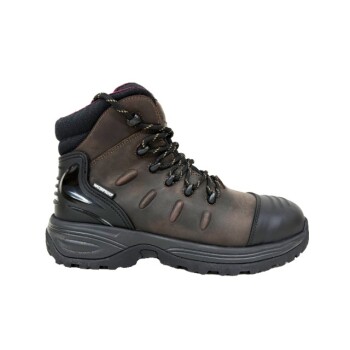
At their core, police boots are best suited for law enforcement, military, and tactical professionals who require a unique combination of durability, comfort, and protection. They are engineered to perform reliably through long, unpredictable shifts across a wide range of demanding environments, from urban patrols to rugged outdoor conditions.
The defining purpose of a police boot is not just to be a durable piece of footwear, but to serve as a critical tool that provides uncompromising support and safety without sacrificing the comfort essential for maintaining peak performance over extended periods.
The Anatomy of a Police Boot: Core Design Principles
To understand what police boots are best suited for, you must first understand how they are built. They are not simply rugged boots; they are a system of features designed to meet the specific challenges of a demanding profession.
Unwavering Durability for Harsh Conditions
Police boots are constructed to withstand daily abuse in all weather conditions, including rain, snow, and extreme heat. They are built from robust synthetic materials and leathers that resist wear and tear while providing a stable platform for the user.
All-Day Comfort for Extended Wear
An officer can spend 12 hours or more on their feet. Because of this, modern police boots are surprisingly lightweight, often under 25 ounces per boot. They incorporate crucial comfort features like cushioned insoles, shock absorption, and enhanced arch and heel support to reduce fatigue during long shifts.
Comprehensive Protection as a Priority
Protection is non-negotiable. Boots come in various heights, with 8-inch shafts offering maximum lower-leg protection and ankle stability, while shorter 5-6 inch designs provide greater flexibility. Features like slip-resistant outsoles are standard for navigating unpredictable surfaces.
Specialized Features for Tactical Environments
Beyond the fundamentals, police boots include specialized features that are critical for safety and performance in high-stakes situations. These elements are what separate them from standard work or hiking boots.
Resistance to Workplace Hazards
Many models include reinforced or steel safety toes to protect against impact and compression. They are often rated for Electrical Hazards (EH) and may offer resistance to oil and even blood-borne pathogens, ensuring a barrier against unseen dangers.
Performance in All Conditions
Waterproof yet breathable materials are common, keeping feet dry from external moisture while allowing sweat to escape. This is supported by quick-dry and moisture-wicking linings, which are essential for maintaining comfort and foot health year-round.
Understanding the Trade-offs
Choosing the right boot involves balancing competing needs. No single boot is perfect for every single task, and understanding the inherent compromises is key to making an informed decision.
Protection vs. Flexibility
An 8-inch, heavily armored boot provides maximum ankle support and protection, which is ideal for tactical entries or unstable terrain. However, this comes at the cost of flexibility and can feel restrictive during tasks that require more agility, like running or driving for long periods.
Waterproofing vs. Breathability
While modern waterproof membranes are designed to be breathable, there is always a trade-off. In extremely hot and dry climates, even the most advanced waterproof boot may feel warmer than a non-waterproof, highly ventilated alternative.
Versatility vs. Specialization
A police boot is a master of versatility, designed to handle walking, standing, running, and climbing. However, it is not a specialized running shoe or a dedicated long-distance hiking boot. It performs all of these tasks well, but a specialized boot will always outperform it in a single, specific discipline.
Making the Right Choice for Your Role
Your specific mission dictates your ideal boot. Consider what your daily tasks demand most.
- If your primary focus is patrol and general duty: Prioritize a lightweight, flexible boot with excellent cushioning and certified slip resistance for varied urban surfaces.
- If your primary focus is tactical operations or high-risk scenarios: Select a boot with maximum protection, including a taller shaft for ankle stability, a safety toe, and durable construction.
- If your primary focus is demanding civilian work like security or EMS: Focus on the core features of durability, all-day comfort, and reliable, all-weather traction.
Ultimately, the right boot is a foundational piece of equipment that enhances your safety, endurance, and overall effectiveness on the job.
Summary Table:
| Key Feature | Primary Benefit | Ideal For |
|---|---|---|
| Durability | Withstands harsh conditions, daily wear & tear | Long shifts in all weather |
| Comfort | Lightweight (<25 oz), cushioned insoles, arch support | Extended patrols & standing |
| Protection | Slip resistance, safety toes, EH ratings, ankle support | Tactical ops & high-risk scenarios |
| Specialization | Waterproof, breathable, quick-dry linings | All environments & unpredictable surfaces |
As a leading manufacturer, 3515 produces a comprehensive range of tactical footwear for distributors, brand owners, and bulk clients. Our police boots are engineered to meet the exacting demands of law enforcement, military, and security professionals, combining superior durability, all-day comfort, and critical safety features. Enhance your team's performance and safety with boots built for the job. Contact us today to discuss your specific needs and explore our full production capabilities.
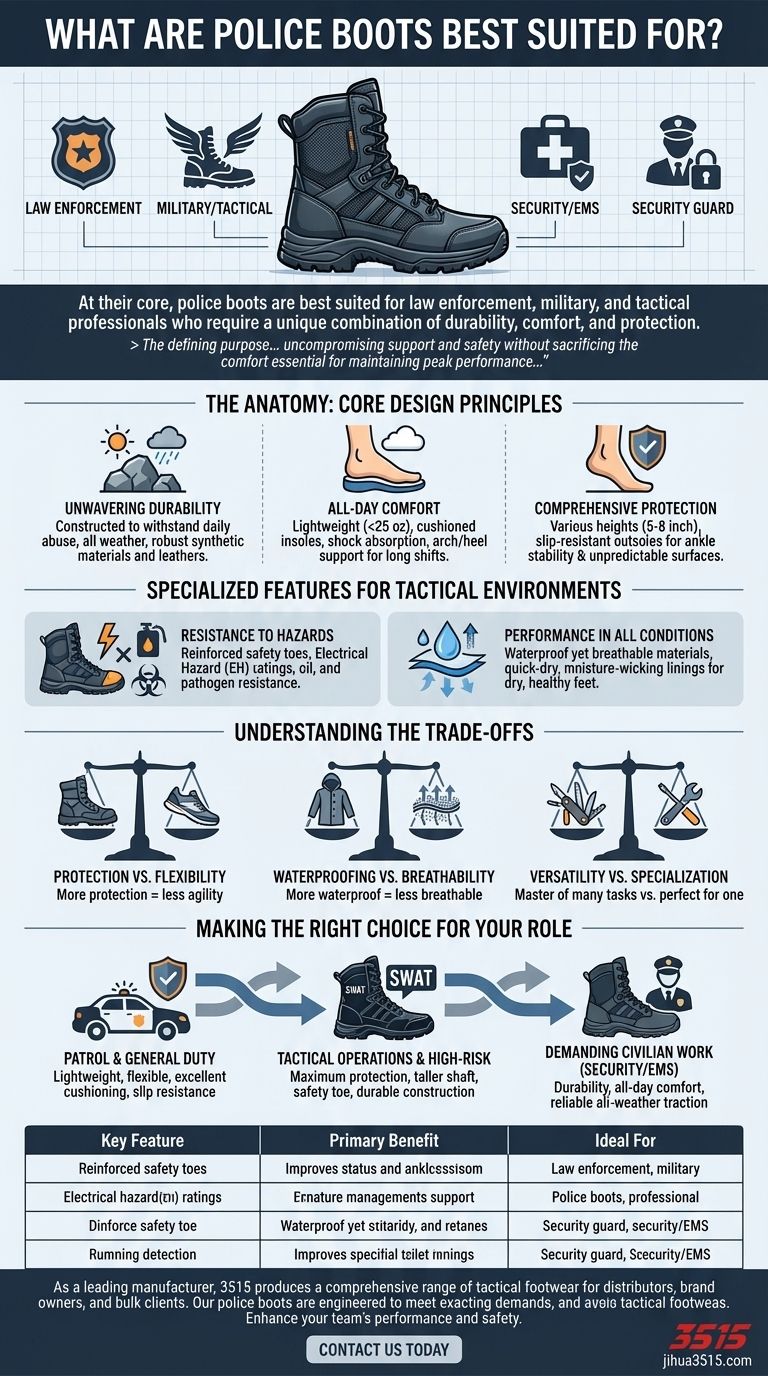
Visual Guide
Related Products
- Durable High-Ankle Tactical Boots for Wholesale & Custom Manufacturing
- Wholesale Durable Mid-Cut Tactical Boots for Custom & Private Label Brands
- Durable Mid-Cut Tactical Boots for Wholesale & Private Label
- High-Traction Suede Tactical Boots Wholesale & Custom Manufacturing
- Durable Leather Tactical Boots Wholesale & Custom Manufacturing for Brands
People Also Ask
- How do tactical boots protect against injuries? Discover the Integrated Safety System
- What are the different types of tactical boots available? Find the Right Boot for Your Mission
- How does additive manufacturing equipment reduce environmental risks? Sustainable Tactics for Modern Footwear Production
- How is the compatibility of polymer materials demonstrated in smart footwear? Enhancing Tactical & Training Performance
- What are the main construction similarities between tactical boots and tactical sneakers? Built for Performance & Durability