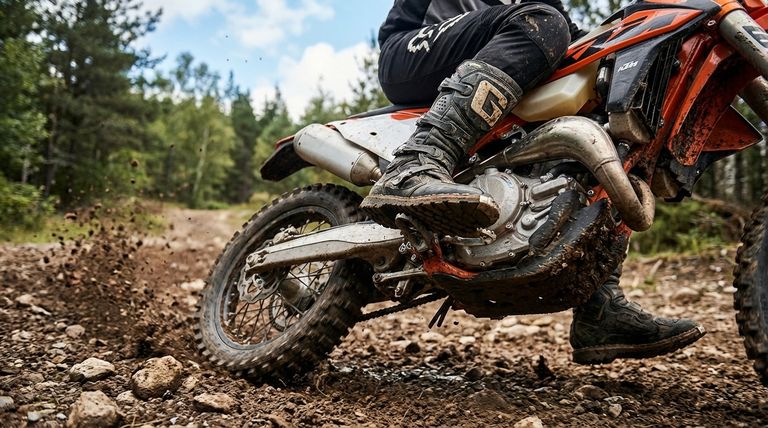
Dirt bike boots are specialized protective footwear engineered specifically to withstand the unique rigors of off-road motorcycle riding. Unlike standard hiking or work boots, they feature a highly rigid construction, full-height shin coverage, and hard soles designed to lock the foot in place and shield the lower leg from high-impact debris, crush injuries, and torsional forces.
The Core Insight: While most footwear is designed for mobility and walking comfort, dirt bike boots are designed for immobilization and impact isolation. They function effectively as a cast or "roll cage" for your lower leg, sacrificing walking ease to prevent broken bones and hyperextended ankles during a crash.
The Anatomy of Off-Road Protection
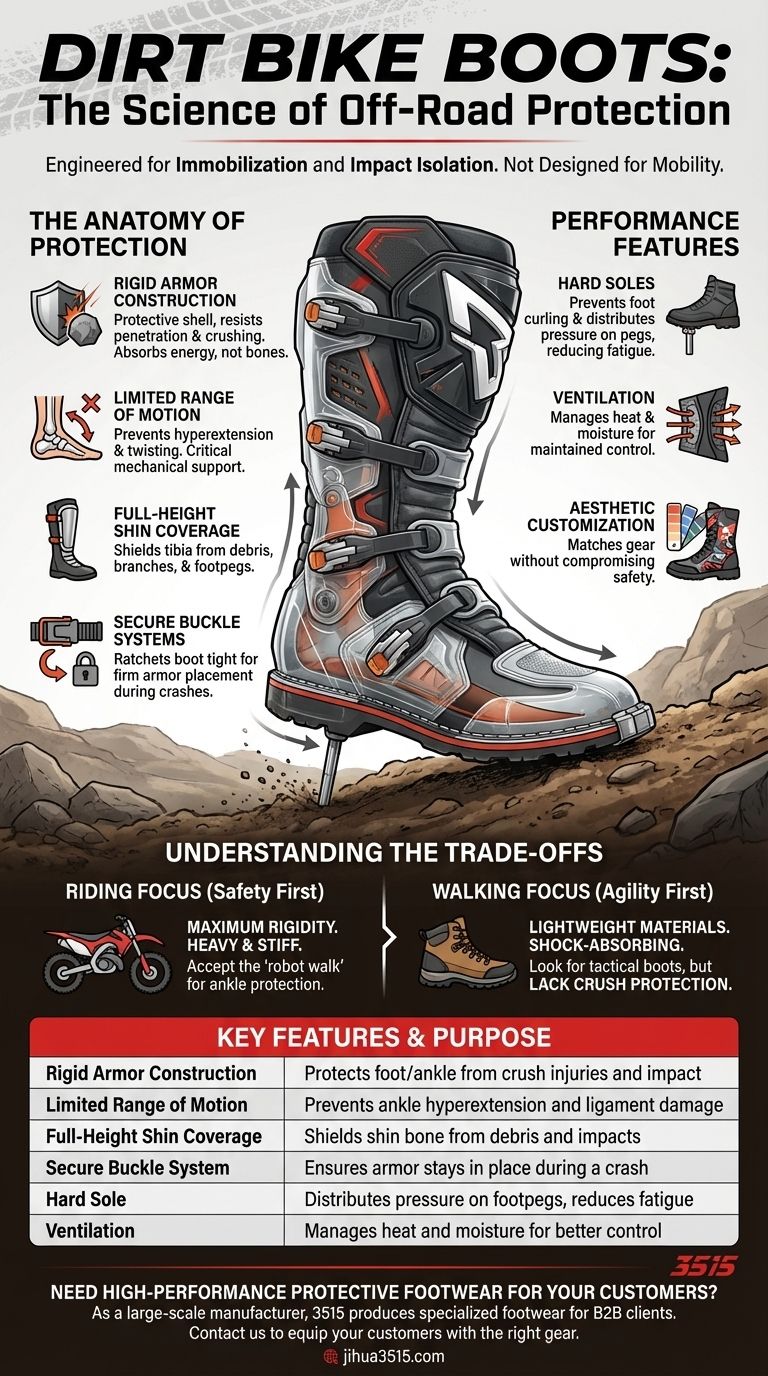
To understand the value of a dirt bike boot, you must look beyond its appearance and understand its structural engineering. These features are not aesthetic; they are functional requirements for safety.
Rigid Armor Construction
The defining characteristic of these boots is their stiffness. They are constructed from heavy, durable materials designed to resist penetration and crushing.
This rigid construction serves a specific purpose: it creates a protective shell around the foot and ankle. If the bike falls on your leg, or if you strike a rock at speed, the boot absorbs the energy rather than your bones.
Limited Range of Motion
You will notice immediately that these boots restrict how much you can move your ankle. This is an intentional safety feature.
By limiting motion range, the boot prevents the ankle from twisting or hyper-extending beyond its natural limits. This mechanical support is critical for preventing ligament damage during awkward landings or falls.
Full-Height Coverage
Dirt bike boots are almost exclusively full-height, reaching up the shin to just below the knee.
This design accommodates extensive armor panels that protect the shin bone (tibia) from debris thrown by other riders, branches on the trail, or the footpegs of the bike itself.
Secure Buckle Systems
Instead of laces, which can snag or loosen, these boots utilize multiple buckles.
This system allows you to ratchet the boot tight, securing the armor panels firmly against the leg. This ensures that the protection stays exactly where it needs to be, even during the chaos of a crash.
Performance Features
Beyond safety, these boots are designed to interface with the motorcycle control surfaces.
Hard Soles
The boots feature extremely hard soles. This stiffness prevents the foot from curling over the narrow metal footpegs of a dirt bike.
A hard sole reduces foot fatigue by distributing pressure evenly across the bottom of the boot, rather than focusing it on the arch of your foot.
Ventilation
Despite their heavy construction, many modern dirt bike boots are well-ventilated.
Off-road riding is physically demanding. Integrated airflow systems help manage heat and moisture, preventing the foot from becoming slippery inside the boot, which maintains control.
Aesthetic Customization
While function is paramount, these boots are available in various graphics and colors. This allows riders to match their gear to their bike or personal style without compromising safety.
Understanding the Trade-offs
Because these boots are hyper-specialized for riding, they perform poorly in other contexts. It is important to set your expectations correctly.
Not Ideal for Walking
The features that make these boots safe—rigidity and hard soles—make them not ideal for walking.
The lack of ankle flex makes a normal gait impossible. You will likely walk stiffly, often described as a "robot walk." They are designed for riding, not hiking or general wear.
Weight and Stiffness
These boots are significantly heavy and stiff compared to any other footwear.
New riders often find them uncomfortable initially. They require a "break-in" period to gain even a small amount of flexibility, and the weight can feel burdensome until you are seated on the bike.
Making the Right Choice for Your Goal
When selecting footwear, you must align your gear with your primary activity.
- If your primary focus is off-road safety: Prioritize boots with maximum rigidity and secure buckle systems. Accept that they will be heavy and stiff, as this is the price of ankle protection.
- If your primary focus is agility and walking comfort: Do not choose dirt bike boots. You should look for tactical boots, which offer lightweight materials and shock-absorbing soles, though they lack the crush protection required for motocross.
True protection requires specialized equipment; the right boot is the one that addresses your highest risk factors.
Summary Table:
| Key Feature | Purpose |
|---|---|
| Rigid Armor Construction | Protects foot/ankle from crush injuries and impact |
| Limited Range of Motion | Prevents ankle hyperextension and ligament damage |
| Full-Height Shin Coverage | Shields shin bone from debris and impacts |
| Secure Buckle System | Ensures armor stays in place during a crash |
| Hard Sole | Distributes pressure on footpegs, reduces fatigue |
| Ventilation | Manages heat and moisture for better control |
Need High-Performance Protective Footwear for Your Customers?
As a large-scale manufacturer, 3515 produces a comprehensive range of durable, safety-focused boots for distributors, brand owners, and bulk clients. Our production capabilities encompass all types of specialized footwear, including rugged designs built for demanding environments.
Let us help you equip your customers with the right gear. Contact our team today to discuss your manufacturing needs and explore how we can add value to your product line.
Visual Guide
Related Products
- Durable Goodyear Welt Leather Work Boots for Wholesale & Private Label
- Durable Spiked Camouflage Boots Wholesale & Factory Production
- Wholesale Tactical Boots High-Traction & Reflective for Bulk & Brand Orders
- Wholesale Lightweight Tactical Boots Custom Manufacturer for Desert & Combat Use
- Wholesale Lightweight Tactical Boots with Dial Closure OEM & Bulk Orders
People Also Ask
- What is the difference between full-grain and top-grain leather? Premium Material Guide for Boot Manufacturers
- What are the advantages of leather as an upper material for work boots? Unmatched Durability & Custom Comfort
- Why is it important to waterproof leather work boots? Protect Your Investment and Performance
- How should new leather work boots be broken in? A Guide to Comfort and Durability
- What are the advantages of leather uppers in work boots? Unmatched Durability & Protection