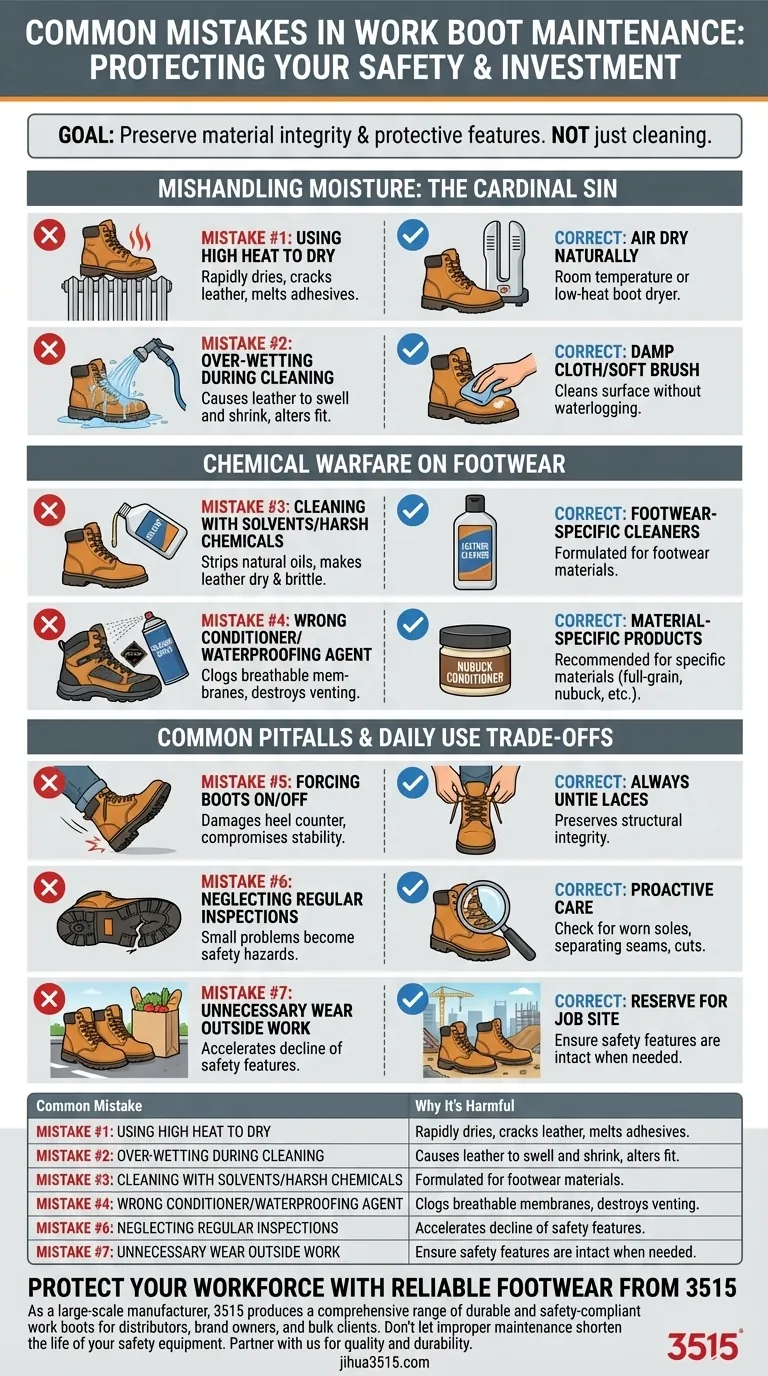
The most common mistakes in work boot maintenance involve using direct heat, harsh chemicals, and brute force. Practices like placing boots on a radiator, cleaning them with solvents, or kicking them off without untying the laces are the fastest ways to destroy their structural integrity and compromise your safety.
Your work boots are a piece of essential safety equipment. The primary goal of maintenance is not just to clean them, but to preserve the material integrity and protective features that keep you safe on the job.
The Cardinal Sin: Mishandling Moisture
How you handle wet boots is the single most important factor in their longevity. The wrong approach can cause irreversible damage in a single drying cycle.
Mistake #1: Using High Heat to Dry Boots
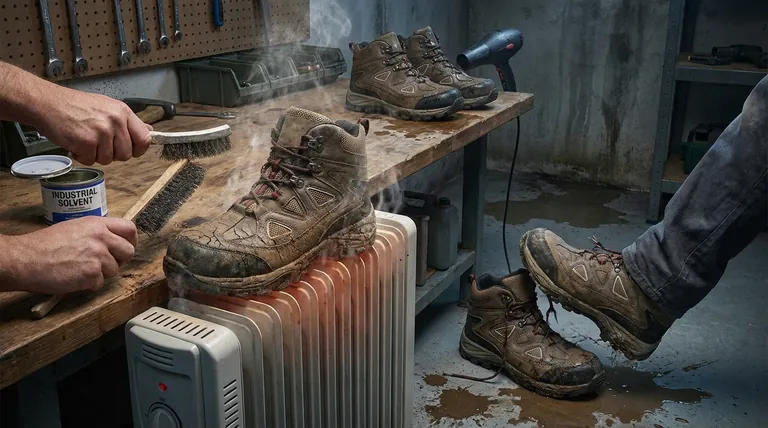
Drying wet boots on a radiator, in front of a heater, or with a hairdryer is incredibly destructive.
High, direct heat rapidly draws moisture out of leather, causing it to crack and become brittle. It can also melt the adhesives that bond the sole to the upper, leading to delamination.
The correct method is to allow them to air dry naturally at room temperature. A dedicated boot dryer, which uses gentle, low-temperature air circulation, is a safe and effective alternative.
Mistake #2: Over-Wetting During Cleaning
While it's tempting to hose down muddy boots, completely soaking them can be detrimental.
Leather is a porous material. Saturating it can cause it to swell and then shrink as it dries, permanently altering its shape and fit.
Instead, use a damp cloth or a soft brush to remove dirt and debris. This cleans the surface without waterlogging the material.
Chemical Warfare on Your Footwear
The products you use on your boots are just as important as your cleaning technique. The wrong chemical can strip away essential properties.
Mistake #3: Cleaning with Solvents or Harsh Chemicals
Never use household cleaners, degreasers, or industrial solvents to clean your boots.
These aggressive chemicals strip the natural oils from leather, leaving it dry, stiff, and prone to cracking. This compromises both its flexibility and its water resistance.
Stick to cleaners specifically formulated for footwear leather.
Mistake #4: Using the Wrong Conditioner or Waterproofing Agent
Not all care products are created equal, and some can harm specific materials.
For example, many silicone-based waterproofing sprays can clog the pores of modern breathable membranes like Gore-Tex, destroying their ability to vent moisture.
Always use products recommended for the specific materials in your boots, whether it's full-grain leather, nubuck, or a synthetic with a waterproof membrane.
Common Pitfalls and Daily Use Trade-offs
How you wear and handle your boots every day has a cumulative effect on their lifespan and performance.
Mistake #5: Forcing Boots On and Off
Repeatedly putting on or kicking off your boots without untying the laces is a destructive habit.
This action places immense stress on the heel seam and crushes the heel counter, the rigid piece that supports your heel. A damaged heel counter compromises the boot's stability and support.
The trade-off for a few seconds saved is a significant reduction in your boot's structural lifespan.
Mistake #6: Neglecting Regular Inspections
Small problems become big problems when they are ignored.
Failing to regularly check for worn soles, separating seams, or cuts in the leather means you might not notice a safety failure until it's too late. A compromised sole can reduce grip, and a small tear can eliminate waterproofing.
Proactive care preserves the boot's integrity and ensures it can still perform its protective function.
Mistake #7: Unnecessary Wear
Wearing your specialized work boots for activities outside of work accelerates their decline.
The soles are often designed for specific surfaces and can wear down quickly on pavement. This wears out the grip and support needed for the job site.
Reserve your work boots for work to ensure their safety features are intact when you need them most.
Making the Right Choice for Your Goal
Your maintenance strategy should align with your primary objective.
- If your primary focus is maximum lifespan: The key is rotating between two pairs, allowing each to dry completely for at least 24 hours while using a gentle boot dryer.
- If your primary focus is maintaining safety and performance: The key is to perform regular inspections for wear and tear and immediately repair or replace boots with compromised structural integrity.
- If your primary focus is preserving warranty: The key is to avoid all harsh cleaning methods and use only manufacturer-approved care products, as improper care can void your right to a claim.
Ultimately, treating your boot maintenance as part of your safety routine is the best way to protect your investment and yourself.
Summary Table:
| Common Mistake | Why It's Harmful | Correct Practice |
|---|---|---|
| Using High Heat to Dry | Cracks leather, melts adhesives | Air dry naturally or use a gentle boot dryer |
| Over-Wetting During Cleaning | Causes leather to swell/shrink, alters fit | Use a damp cloth or soft brush |
| Cleaning with Harsh Chemicals | Strips natural oils, dries out leather | Use cleaners formulated for footwear |
| Wrong Conditioner/Waterproofer | Can clog breathable membranes | Use products recommended for your boot's materials |
| Forcing Boots On/Off | Damages heel counter and seams | Always untie laces |
| Neglecting Regular Inspections | Small issues become safety hazards | Check for wear, tears, and sole separation |
| Unnecessary Wear Outside Work | Accelerates decline of safety features | Reserve work boots for the job site |
Protect Your Workforce with Reliable Footwear from 3515
As a large-scale manufacturer, 3515 produces a comprehensive range of durable and safety-compliant work boots for distributors, brand owners, and bulk clients. Our production capabilities encompass all types of industrial and safety footwear designed to withstand tough conditions.
Don't let improper maintenance shorten the life of your safety equipment. Partner with a manufacturer that prioritizes quality and durability from the start.
Contact 3515 today to discuss your footwear needs and ensure your team is equipped with reliable, long-lasting boots.
Visual Guide
Related Products
- Durable Leather Work Boots for Wholesale & Custom Manufacturing
- Durable Leather Work Boots for Wholesale & Custom OEM Manufacturing
- Durable Leather Work Boots Wholesale Manufacturer & Custom Factory
- Durable Leather Moc Toe Work Boots for Wholesale & Custom Manufacturing
- Wholesale Leather Work Boots with Customizable Wedge Sole for Brands
People Also Ask
- What is the difference between full-grain and top-grain leather? Premium Material Guide for Boot Manufacturers
- What are the common workplace hazards that can be mitigated with the right work boots? Protect Your Workforce
- What are the common foot issues workers face due to uncomfortable work boots? Prevent Pain & Deformities
- What are the advantages of leather versus synthetic work boots? A Guide to Choosing the Right Material
- What are the key components of modern work boots? Engineered for Ultimate Durability and Comfort