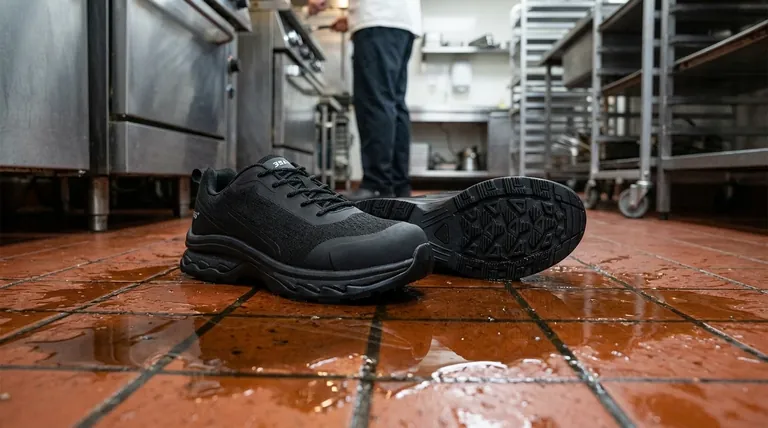
In addition to the standard tests, some specialized footwear brands test their slip-resistant shoes against more demanding contaminants like grease. These tests go beyond the minimum ASTM (American Society for Testing and Materials) standards to ensure safety in more extreme, real-world conditions often found in professional kitchens and industrial environments.
The core issue isn't just meeting a laboratory standard, but ensuring footwear remains effective against the specific, and often more challenging, slippery substances encountered in a particular workplace.
Why Go Beyond the Standard?
The standard ASTM tests for slip resistance, such as ASTM F2913, often use controlled surfaces with common contaminants like water or soapy water. This provides a crucial baseline for safety.
However, many professional environments present more severe challenges that these basic tests don't fully replicate.
The Problem with Everyday Contaminants
In environments like commercial kitchens, automotive shops, or manufacturing facilities, floors are frequently contaminated with substances far more slippery than water.
These include cooking oils, animal fats, and industrial lubricants, which have different properties and create a much higher risk of slips and falls.
Grease: The Real-World Test
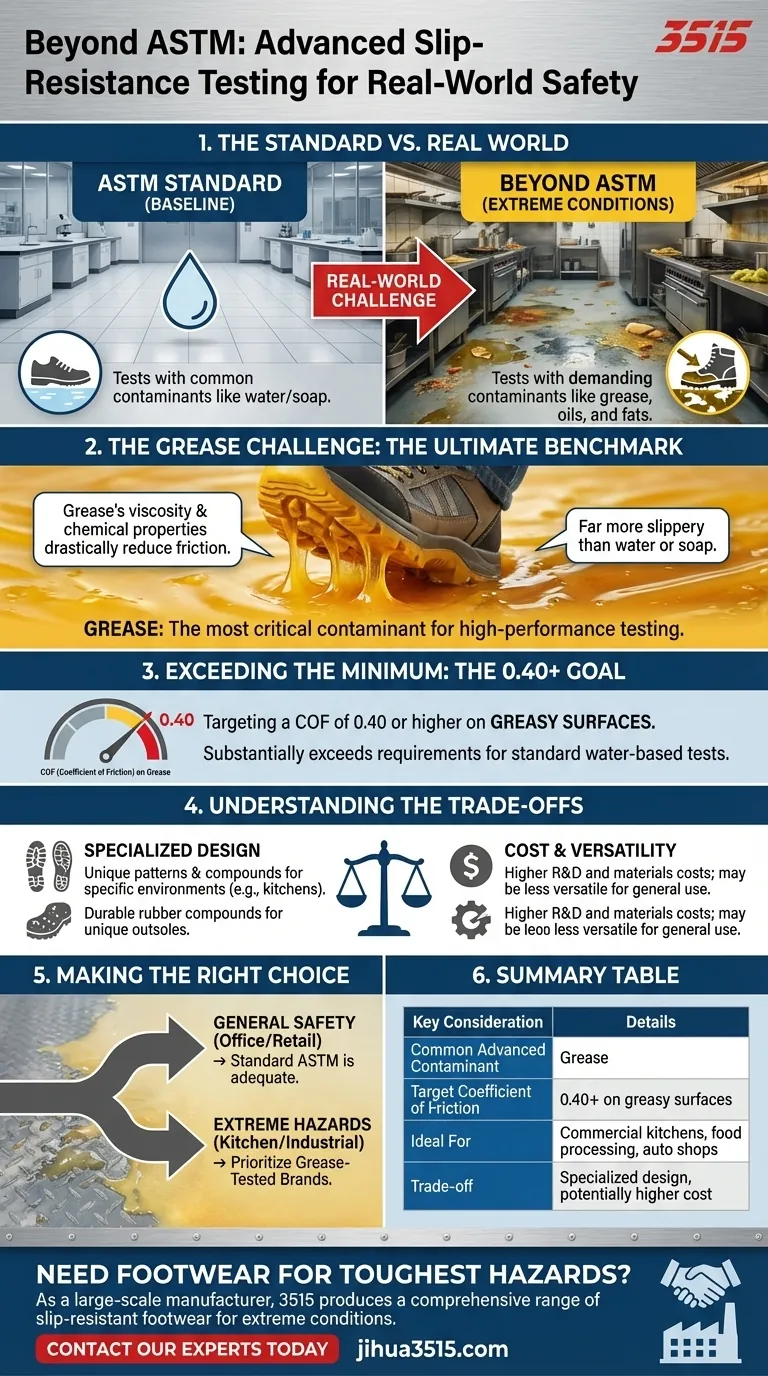
Grease is the most common and critical contaminant that high-performance brands test for beyond the ASTM baseline.
Its viscosity and chemical properties dramatically reduce the friction between a shoe's outsole and the floor surface, making it an excellent measure of a shoe's true slip-resistance capability.
Exceeding the Minimum Threshold
Brands conducting these advanced tests often aim for a coefficient of friction of 0.40 or higher even on greasy surfaces.
This is a significant benchmark, as it demonstrates a level of performance that substantially exceeds the requirements for passing a standard water-based test.
Understanding the Trade-offs
Choosing footwear based on advanced testing isn't always straightforward. There are practical considerations to weigh.
Specialized Design vs. General Use
Shoes designed to excel on greasy surfaces often have unique outsole patterns and rubber compounds.
While incredibly effective in their target environment (like a kitchen), they may not offer the same durability or comfort for general-purpose use on standard dry or wet surfaces.
The Cost Factor
Developing and testing footwear to perform under extreme conditions involves more research, higher-quality materials, and more rigorous quality control.
This investment typically results in a higher price point compared to shoes that only meet the minimum ASTM standards.
Making the Right Choice for Your Goal
The key is to match the footwear's tested capabilities with the specific hazards of your environment.
- If your primary focus is general safety in an office or retail setting: Footwear meeting standard ASTM slip-resistance tests is perfectly adequate.
- If your primary focus is safety in a commercial kitchen, food processing plant, or auto shop: Prioritize brands that explicitly state they test against grease and other oily contaminants.
Ultimately, understanding what a shoe is tested against empowers you to choose the right level of protection for your specific needs.
Summary Table:
| Key Consideration | Details |
|---|---|
| Common Advanced Contaminant | Grease |
| Target Coefficient of Friction | 0.40 or higher on greasy surfaces |
| Ideal For | Commercial kitchens, food processing, auto shops |
| Trade-off | Specialized design, potentially higher cost |
Need footwear that tackles your toughest workplace hazards?
As a large-scale manufacturer, 3515 produces a comprehensive range of safety footwear for distributors, brand owners, and bulk clients. Our production capabilities encompass all types of slip-resistant shoes and boots, including models designed to perform in extreme conditions. Let us help you equip your team with the right protection. Contact our experts today to discuss your specific needs and find the perfect solution.
Visual Guide
Related Products
- Premium Suede Sport Safety Shoes for Wholesale & Bulk Orders
- Wholesale Durable 6-Inch Work Boots | Custom & Private Label Manufacturer
- Heavy-Duty Waterproof Nubuck Safety Boots Safety Shoes for Bulk Supply
- Durable Leather Moc Toe Work Boots for Wholesale & Custom Manufacturing
- Durable Goodyear Welt Leather Work Boots for Wholesale & Private Label
People Also Ask
- What industries have specific OSHA footwear requirements? Ensure Compliance & Protect Your Workforce
- What are the primary functions of professional safety shoes? Maximize Safety in Water Supply Confined Spaces
- What role do specialized safety shoes play in preventing falls? Engineering Stability in Industrial Environments
- What are the main components of safety shoes? A Guide to Protective Footwear Design
- What are the main safety features of S1-S5 shoes? The 3 Essential Protections Explained