
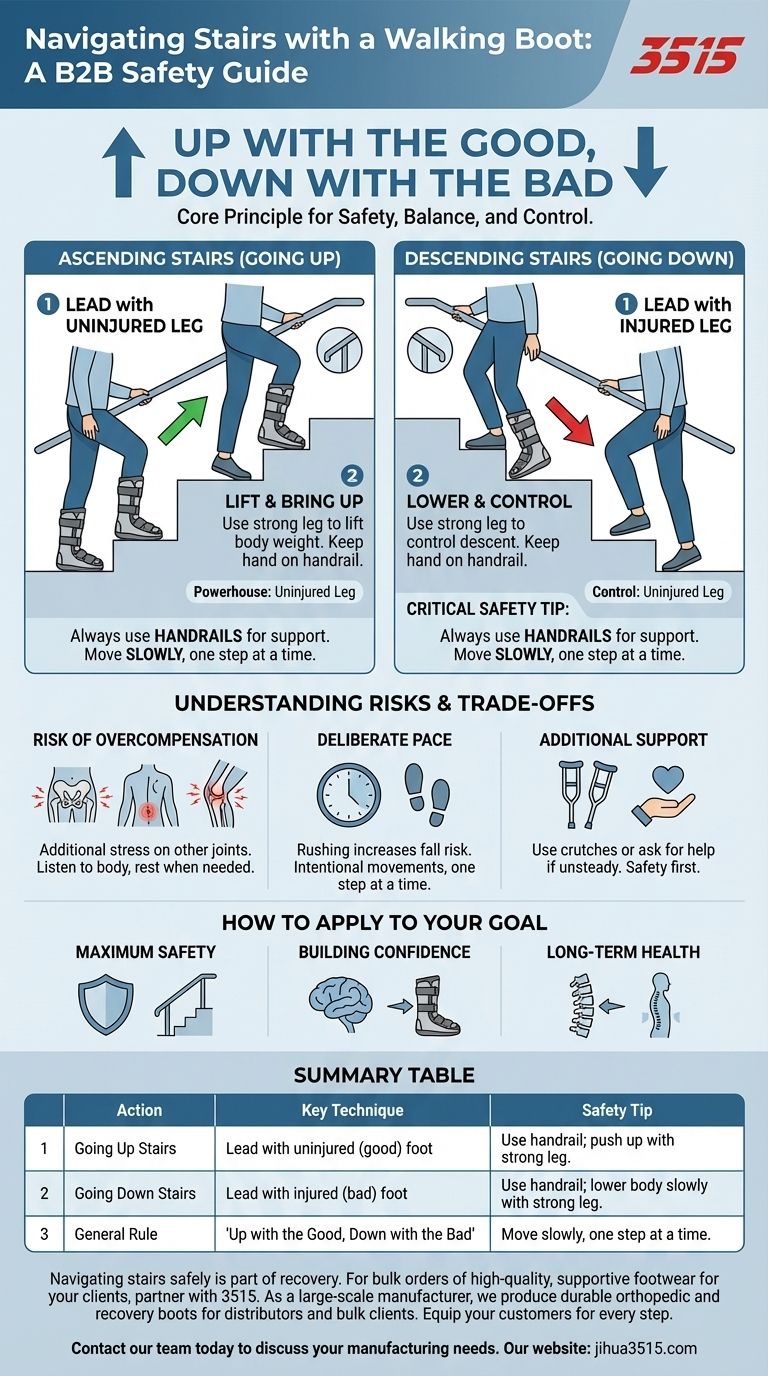
To safely navigate stairs with a walking boot, remember this simple rule: go up with your uninjured foot first, and go down with your injured foot first. Always use handrails for support and move slowly and deliberately, one step at a time, to maintain balance and prevent further injury.
The core principle is to use your strong, uninjured leg to lift your body weight when going up, and to use it as a stable anchor to control your descent when coming down. Safety, balance, and control are your primary goals.
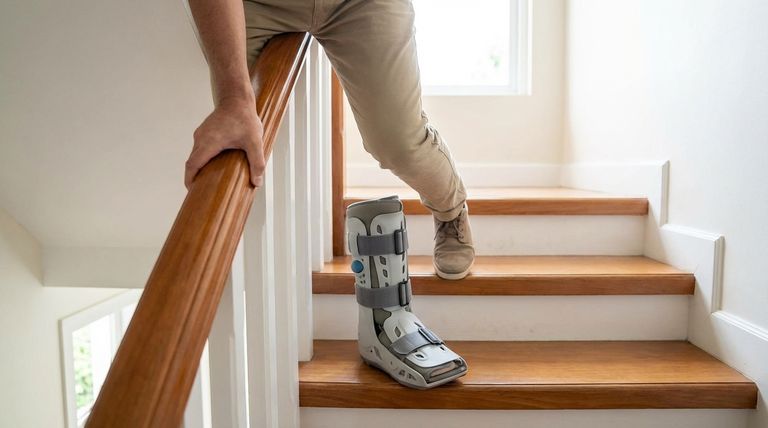
The Core Principle: "Up with the Good, Down with the Bad"
This memorable phrase is the key to safely navigating stairs. It’s a technique that minimizes strain on your injured leg and maximizes stability by leveraging your uninjured leg's strength.
Ascending Stairs (Going Up)
When you go up stairs, you need to lift your entire body weight. Your uninjured leg is the powerhouse for this movement.
Place your uninjured foot on the step above you. Use the handrail for support as you straighten your uninjured leg, lifting your body and bringing your injured, booted foot up to the same step.
Descending Stairs (Going Down)
Going down stairs requires control more than power. Leading with your injured foot allows your uninjured leg to manage the descent safely.
While holding the handrail, lower your injured foot down to the next step. Then, use your uninjured leg to slowly lower the rest of your body, bringing it down to meet your injured foot on the same step.
The Role of Handrails
Handrails are not optional; they are a critical tool for safety. Always keep at least one hand firmly on a handrail to provide a constant point of stability and support throughout the movement.
Understanding the Risks and Trade-offs
Wearing a walking boot changes your body's mechanics. Being aware of the secondary effects is crucial for preventing other issues during your recovery.
The Risk of Overcompensation
Your body will naturally try to compensate for the immobilized ankle. This places additional stress on other joints, particularly the hips, back, and the knee of your uninjured leg.
Be mindful of this new strain. These joints may fatigue more quickly than you are used to, so listen to your body and rest when needed.
The Importance of a Deliberate Pace
Rushing is the single biggest risk factor for a fall. Move slowly and with controlled movements. Each step should be a distinct, intentional action. Never try to take more than one step at a time.
When to Use Additional Support
If you feel unsteady, tired, or unsure, do not hesitate to use crutches for extra stability. If crutches aren't an option, ask someone for help. Prioritizing safety over speed is essential for a smooth recovery.
How to Apply This to Your Goal
Your approach should always be dictated by your immediate goal: maintaining safety and promoting a complete recovery.
- If your primary focus is maximum safety: Always use a handrail, go one step at a time, and strongly consider using crutches for additional points of contact and stability.
- If your primary focus is building confidence: Practice the "up with the good, down with the bad" method slowly and deliberately, focusing on the feeling of control with each step.
- If your primary focus is long-term health: Pay close attention to your posture and be mindful of any new aches in your back, hips, or uninjured knee, as these are signs of overcompensation.
Ultimately, mastering this skill is about moving with intention to protect your body as it heals.
Summary Table:
| Action | Key Technique | Safety Tip |
|---|---|---|
| Going Up Stairs | Lead with your uninjured (good) foot. | Use handrail; push up with strong leg. |
| Going Down Stairs | Lead with your injured (bad) foot. | Use handrail; lower body slowly with strong leg. |
| General Rule | 'Up with the Good, Down with the Bad' | Move slowly, one step at a time. |
Navigating stairs safely is just one part of recovery. For bulk orders of high-quality, supportive footwear for your clients, partner with 3515.
As a large-scale manufacturer, 3515 produces a comprehensive range of durable and comfortable footwear, including orthopedic and recovery boots, for distributors, brand owners, and bulk clients. Our production capabilities encompass all types of shoes and boots designed for safety and wellness.
Let us help you equip your customers with the right footwear for every step of their journey. Contact our team today to discuss your manufacturing needs.
Visual Guide
Related Products
- Wholesale Durable Camouflage Canvas Shoes with High-Traction Cleated Rubber Sole
- Durable Rubber Sole Outdoor Shoes Wholesale & Custom Manufacturing
- Durable Goodyear Welt Leather Work Boots for Wholesale & Private Label
- Wholesale High-Traction Camo Boots - Custom Manufacturer for Brands
- Heavy-Duty Waterproof Nubuck Safety Boots Safety Shoes for Bulk Supply
People Also Ask
- Why is the selection of high-strength fabric materials necessary in the production of canvas shoes and training shoes?
- What are the properties of canvas as a shoe material? A Guide to Lightweight Comfort & Style
- Can canvas shoes be worn in rainy conditions? The Truth About Water Resistance
- What are some examples of vulcanized shoes? Discover the Flexibility and Board Feel of Classic Sneakers
- What are the characteristics of canvas as a shoe material? A Guide to Lightweight, Breathable Footwear



















