To evaluate casual sneakers for price and value, you must look beyond the initial cost. True value is determined by a combination of the sneaker's material durability, its comfort for your specific needs, and its style versatility, all of which contribute to a lower cost-per-wear over the shoe's lifespan.
The most crucial metric for sneaker value isn't the price tag; it's the cost-per-wear. A more expensive, durable, and versatile sneaker you wear 300 times is a far better investment than a cheap one that's uncomfortable or falls apart after 30 wears.
Beyond the Price Tag: The Core Pillars of Sneaker Value
A smart evaluation goes past the initial sticker shock and assesses the fundamental attributes that give a sneaker its long-term worth.
Durability and Material Quality
The materials directly dictate how long a sneaker will last. Uppers made of full-grain leather or high-quality canvas will typically outlast cheaper synthetic alternatives.
Pay close attention to the construction. A stitched sole is often a sign of higher quality and greater longevity compared to a sole that is merely glued on.
Comfort and Fit
An uncomfortable sneaker has no value because it will go unworn. Prioritize an ergonomic design that fits your foot shape correctly.
Look for features like padded insoles and breathable materials, as these directly impact how wearable the shoe will be for extended periods.
Style and Versatility
A sneaker's value increases dramatically if it can be worn in multiple settings. A clean, minimalist design in a solid, neutral color can work for casual weekends and even business-casual offices.
This versatility means you get more use out of a single pair, drastically lowering its effective cost each time you wear it.
Brand Reputation and Reviews
While brand isn't everything, an established reputation often serves as a baseline for quality and consistency.
However, always verify with recent customer reviews. They provide unbiased, real-world insight into a sneaker's true durability and long-term comfort.
A Practical Framework: Calculating Cost-Per-Wear
The most effective way to conceptualize value is to move from thinking about purchase price to thinking about the cost of each use.
The Initial Price Fallacy
A $40 sneaker that lasts for six months of regular wear is more expensive than a $120 sneaker that lasts for three years.
Focusing only on the upfront cost is a common mistake that often leads to spending more money over time.
The Cost-Per-Wear Formula
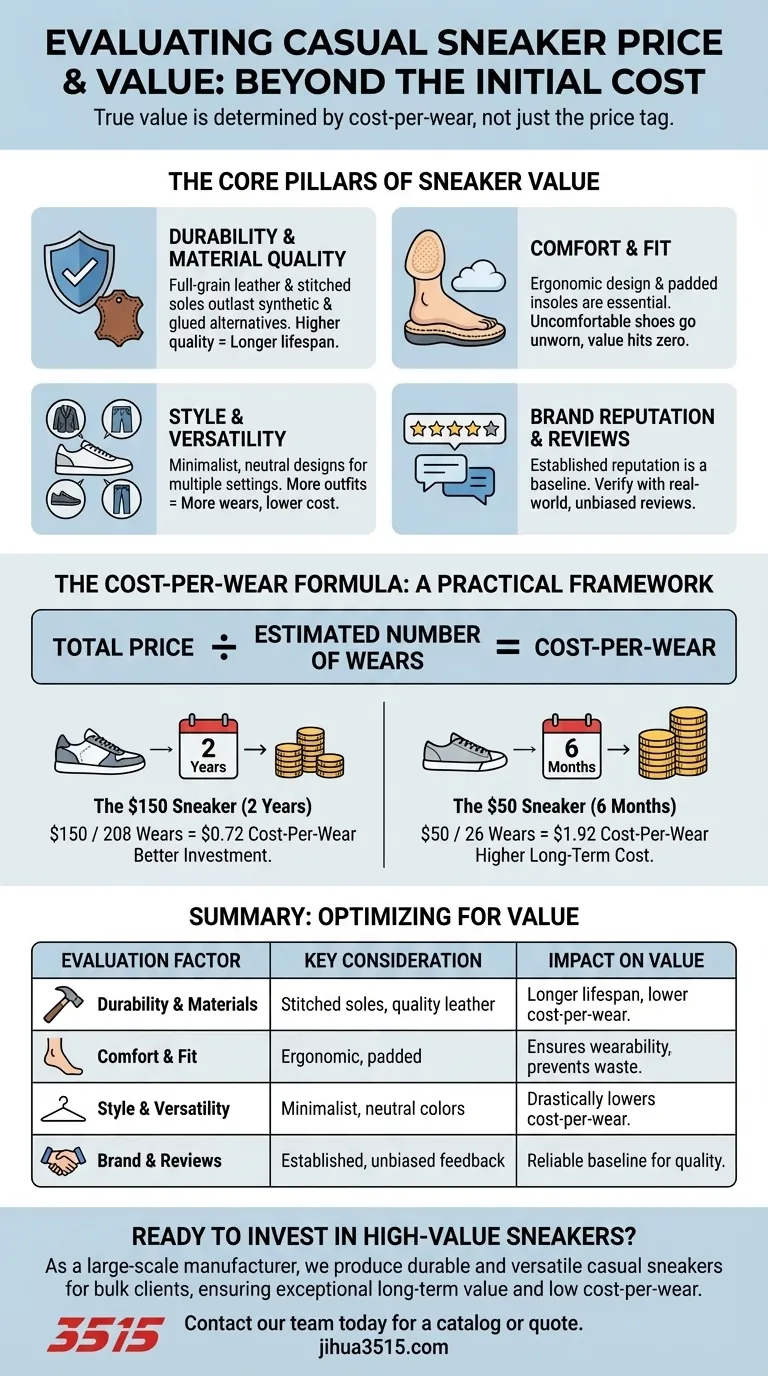
The calculation is simple: Total Price ÷ Estimated Number of Wears = Cost-Per-Wear.
A $150 sneaker worn twice a week for two years (208 wears) has a cost-per-wear of just 72 cents. A $50 sneaker worn once a week for six months (26 wears) has a cost-per-wear of $1.92.
Factoring in Maintenance
Value is also tied to upkeep. Materials that are easy to clean and maintain their appearance extend the sneaker's usable life, further improving its value proposition.
Understanding the Trade-offs
Making an informed decision requires acknowledging the compromises inherent in any purchase.
Price vs. Brand Hype
A high price does not always guarantee high quality. Sometimes, you are paying a premium for a logo or a temporary trend, not for superior materials or construction.
Fashion Trends vs. Timeless Style
A highly fashionable, "of-the-moment" sneaker may seem valuable now but can look dated in a single season, causing its wearability to plummet.
Timeless, classic designs hold their value for years because their style is enduring.
Material Choices
There is no single "best" material. Leather is durable but can be less breathable than canvas. Advanced synthetic materials might offer great comfort but have a shorter lifespan. Choose based on your primary need.
Making the Right Choice for Your Goal
Use your primary objective to guide your evaluation.
- If your primary focus is maximum longevity: Prioritize sneakers with durable materials like quality leather and stitched soles, even if the upfront cost is higher.
- If your primary focus is versatility: Choose minimalist designs in solid, neutral colors that can be easily cleaned and dressed up or down.
- If your primary focus is a strict budget: Compare prices aggressively but cross-reference with customer reviews on durability to avoid a pair that will fail prematurely.
Ultimately, a valuable sneaker is an investment in your daily comfort and personal style that pays dividends with every step.
Summary Table:
| Evaluation Factor | Key Consideration | Impact on Value |
|---|---|---|
| Durability & Materials | Full-grain leather, stitched soles | Higher quality = longer lifespan, lower cost-per-wear |
| Comfort & Fit | Ergonomic design, padded insoles | Uncomfortable shoes go unworn, reducing value to zero |
| Style & Versatility | Minimalist design, neutral colors | More outfits = more wears, drastically lowering cost-per-wear |
| Brand & Reviews | Established reputation, unbiased feedback | Serves as a baseline for quality and real-world performance |
Ready to Invest in High-Value Sneakers?
As a large-scale manufacturer, 3515 produces a comprehensive range of durable and versatile casual sneakers for distributors, brand owners, and bulk clients. We combine high-quality materials with expert construction to ensure your sneakers deliver exceptional long-term value and a low cost-per-wear.
Let's discuss how our production capabilities can meet your needs: Contact our team today to request a catalog or get a quote.
Visual Guide
Related Products
- Wholesale Smart Casual Sneakers with Dial Closure | Factory Direct Manufacturing
- Wholesale Leather Business Casual Shoes with Dial Closure - Manufacturer of Comfort Dress Sneakers
- Wholesale Comfortable Business Casual Shoes Custom Manufacturing
- Dial Closure Leather Business Casual Shoes for Wholesale & Private Label
- Lightweight Breathable Sneakers with Wet-Traction Grip for Wholesale & Private Label
People Also Ask
- What should be considered regarding the materials used in casual sneakers? Choose for Comfort, Durability & Style
- What are the key factors to consider when choosing casual sneakers? Find Your Perfect Fit & Style
- What steps can be taken to ensure the best selection of casual sneakers? A Guide to Comfort, Style & Durability
- How does style and versatility factor into choosing casual sneakers? Build a Timeless Wardrobe Foundation
- Why is comfort and fit important when selecting casual sneakers? The Key to All-Day Wear and Foot Health