
The correct fit for a motorcycle boot is a precise balance between security and all-day function. Your boots should feel snug throughout, especially around the ankle and heel, to eliminate any side-to-side or forward sliding of your foot. However, they must not be so tight that they cause pain, cut off circulation, or cramp your toes against the front of the boot.
A proper motorcycle boot fit is not about casual comfort; it's a critical component of your safety equipment. The goal is to make the boot a seamless extension of your leg, providing unwavering support and control without creating dangerous pressure points or distractions.
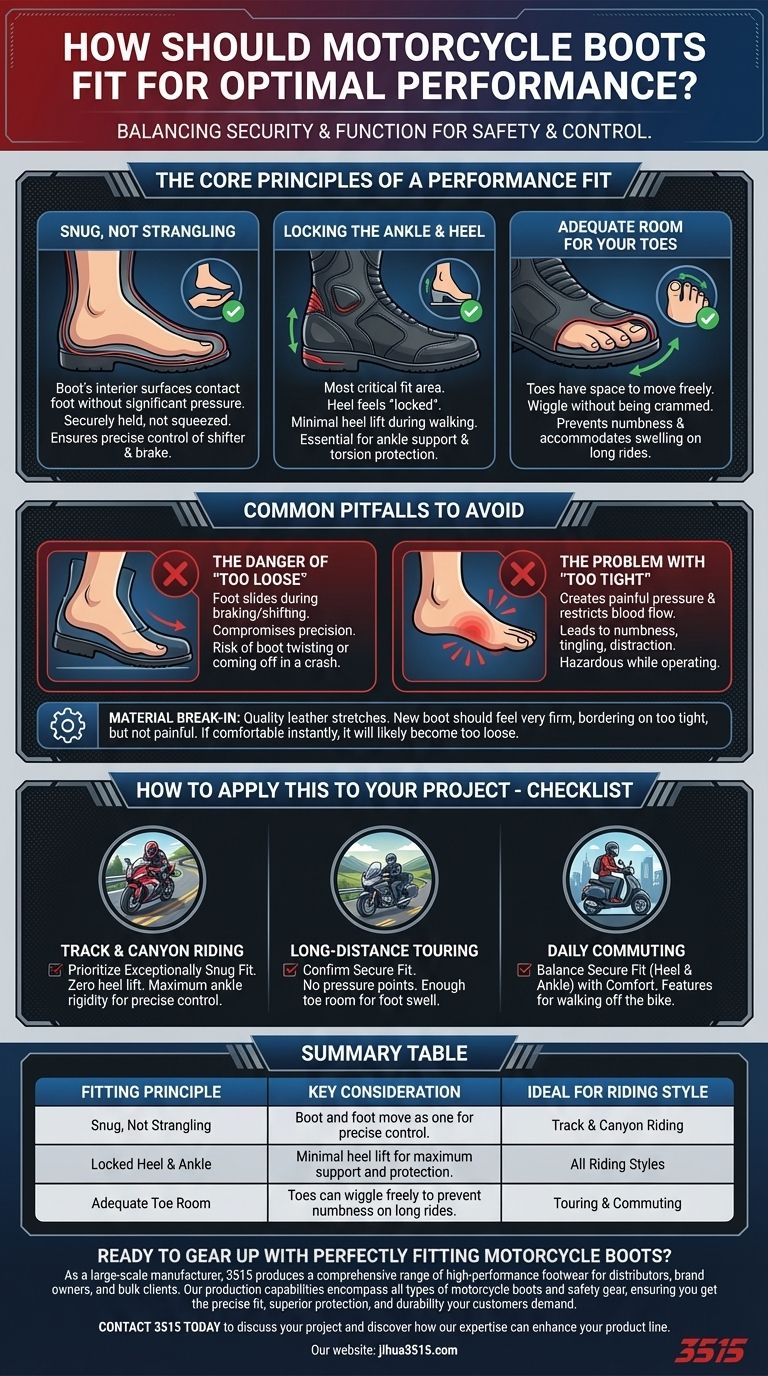
The Core Principles of a Performance Fit
Understanding why a specific fit is necessary is the key to selecting the right boot. It’s about creating a stable platform that protects you in a crash and connects you to your machine.
Snug, Not Strangling
A snug fit means the boot's interior surfaces are in contact with your foot, but without significant pressure. You should feel securely held, but not squeezed.
This ensures your foot and the boot move as one, which is essential for precise inputs to the gear shifter and rear brake.
Locking the Ankle and Heel
This is the most critical area for fit. Your heel should feel "locked" into the back of the boot.
When you walk, you should experience minimal heel lift. If your heel rises more than a tiny fraction of an inch, the boot is too large, compromising ankle support and protection against torsional injuries.
Adequate Room for Your Toes
While the mid-foot and heel should be secure, your toes need space to move freely.
You should be able to wiggle your toes without them being crammed against the front or top of the boot. This prevents discomfort and numbness, especially on longer rides where your feet may swell slightly.
Common Pitfalls to Avoid
An improper fit isn't just uncomfortable; it's a direct liability that compromises both safety and control. Many riders make critical mistakes during the selection process.
The Danger of 'Too Loose'
A boot that is too loose allows your foot to slide inside during braking or shifting. This can cause you to miss a gear or apply the brake with less precision.
More importantly, in a crash, a loose boot can twist or even come off your foot entirely, rendering its protective features useless.
The Problem with 'Too Tight'
Boots that are too tight will create painful pressure points and restrict blood flow.
This leads to numbness, tingling, and distraction—all of which are hazardous while operating a motorcycle. A boot that feels overly tight in the store will only feel worse after an hour on the road.
Forgetting About Material Break-In
Most high-quality motorcycle boots, especially those made of leather, will stretch and conform to your foot over time.
A new leather boot should feel very firm, almost bordering on too tight, without being painful. If it feels perfectly comfortable and "broken-in" from the very first moment, it will likely become too loose after a few weeks of riding.
How to Apply This to Your Project
Use this checklist in the store to verify you have the correct fit before you make a purchase.
- If your primary focus is track or canyon riding: Prioritize an exceptionally snug fit with zero heel lift and maximum ankle rigidity to ensure precise control.
- If your primary focus is long-distance touring: Confirm that a secure fit does not create any specific pressure points, with enough toe room to accommodate foot swell over many hours.
- If your primary focus is daily commuting: Balance a non-negotiable secure fit at the heel and ankle with features that allow for more comfort when walking off the bike.
Ultimately, a well-fitted boot disappears on the ride, allowing you to focus completely on the road ahead.
Summary Table:
| Fitting Principle | Key Consideration | Ideal For Riding Style |
|---|---|---|
| Snug, Not Strangling | Boot and foot move as one for precise control. | Track & Canyon Riding |
| Locked Heel & Ankle | Minimal heel lift for maximum support and protection. | All Riding Styles |
| Adequate Toe Room | Toes can wiggle freely to prevent numbness on long rides. | Touring & Commuting |
Ready to gear up with perfectly fitting motorcycle boots?
As a large-scale manufacturer, 3515 produces a comprehensive range of high-performance footwear for distributors, brand owners, and bulk clients. Our production capabilities encompass all types of motorcycle boots and safety gear, ensuring you get the precise fit, superior protection, and durability your customers demand.
Contact 3515 today to discuss your project and discover how our expertise can enhance your product line.
Visual Guide
Related Products
- Wholesale Tactical Boots High-Traction & Reflective for Bulk & Brand Orders
- High Performance Fire-Retardant Waterproof Safety Boots
- Durable Goodyear Welt Leather Work Boots for Wholesale & Private Label
- Wholesale High-Traction Camo Boots - Custom Manufacturer for Brands
- Heavy-Duty Waterproof Nubuck Safety Boots Safety Shoes for Bulk Supply
People Also Ask
- How do tactical boots protect against injuries? Discover the Integrated Safety System
- What are the weight and breathability characteristics of the boots? Find the Perfect Fit for Your Mission
- What types of boots are used by Bravo in SEAL Team? Salomon & Merrell for Elite Performance
- How do manufacturing processes for electronic textiles balance durability with wearing comfort? Innovation in Footwear
- What factors should be considered when choosing tactical boots for different terrains? Match Your Boot to the Mission.



















