
The definitive sign of a well-fitting cowboy boot is a snug feel across the top of your foot—the instep—and a slight lift in your heel when you walk. Your toes should lie flat with enough room to wiggle, but the rest of the boot should feel like a firm, reassuring handshake. This initial heel slip, typically between a quarter and a half-inch, is not a flaw; it's a hallmark of a proper fit that will diminish as the leather sole breaks in and conforms to your foot.
The most common mistake is buying cowboy boots that are too large to compensate for a tight instep. The correct fit hinges on a snug instep, as this is what holds your foot in place, not the boot's length.
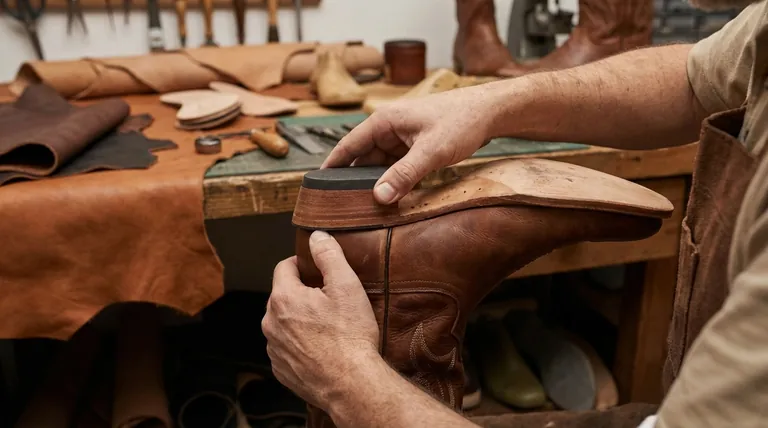
The Anatomy of a Proper Cowboy Boot Fit
Unlike sneakers or dress shoes, cowboy boots have a unique construction that requires a different approach to fitting. Understanding the four key contact points is essential to avoid a purchase you'll regret.
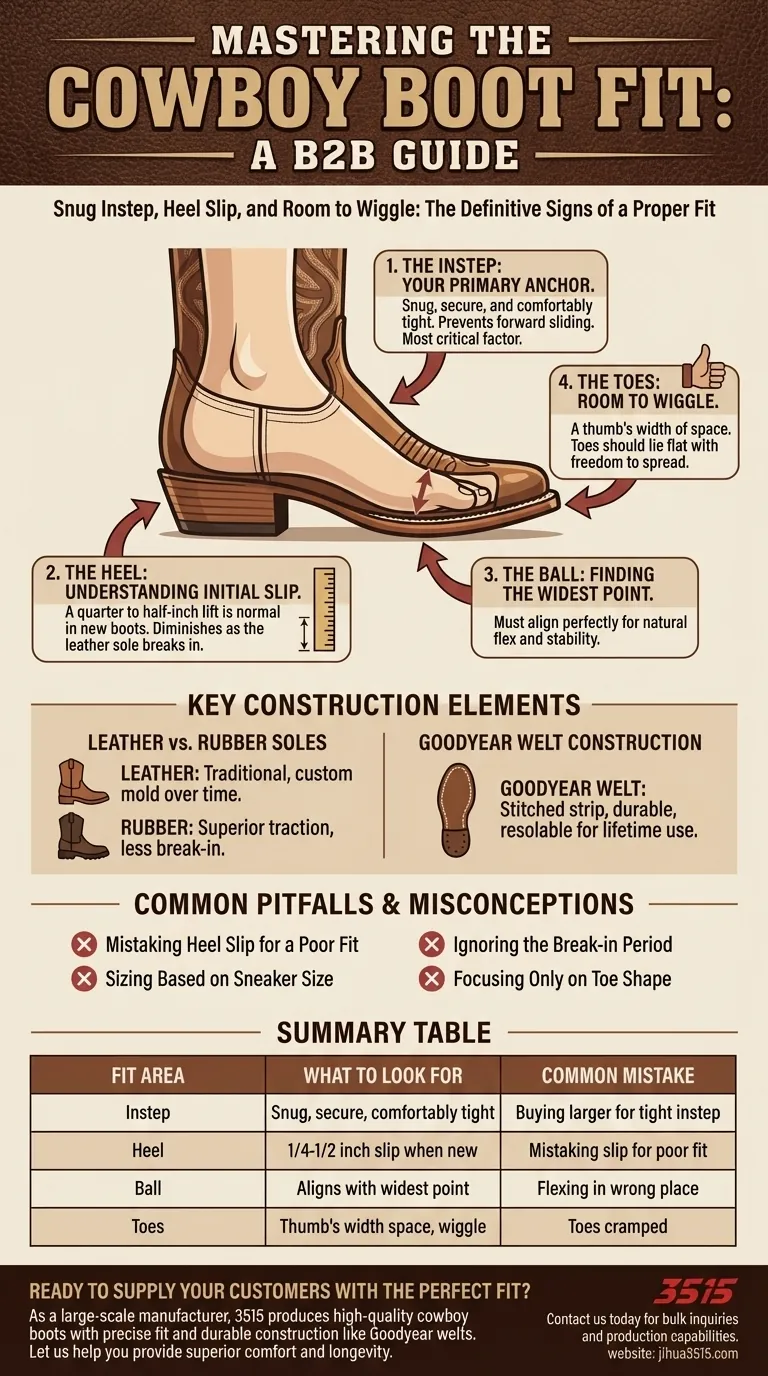
The Instep: Your Primary Anchor
The fit over the instep—the arched top part of your foot—is the single most critical factor. This area should be snug, secure, and comfortably tight.
A properly fitted instep is what prevents your foot from sliding forward and jamming your toes into the front of the boot. It acts as the primary anchor for your entire foot.
The Heel: Understanding Initial Slip
A brand new pair of cowboy boots with a quality leather sole will be stiff. This stiffness prevents the boot from flexing with your foot, causing your heel to lift slightly with each step.
This slip is temporary and necessary. As you wear the boots, the sole will break in and the leather insole will mold to your foot, dramatically reducing the initial heel movement. No slip in a new boot often means it's too short.
The Ball: Finding the Widest Point
The ball of your foot, its widest part, should sit perfectly at the widest part of the boot's sole.
This alignment ensures your foot can flex naturally at its intended pivot point, providing comfort and stability for walking. If it's misaligned, you'll feel pressure and discomfort.
The Toes: Room to Wiggle
Regardless of whether the boot has a pointed, round, or square toe, your own toes should never be cramped.
You should have about a thumb's width of space between the end of your longest toe and the end of the boot. Your toes should lie flat and have the freedom to spread out slightly.
Key Construction Elements That Define the Fit
The materials and manufacturing methods used to build the boot directly impact its break-in period, long-term comfort, and overall durability.
The Sole: Leather vs. Rubber
Leather soles are the traditional choice. They are initially stiff but will gradually mold to the exact shape of your foot, offering a custom-like fit over time.
Rubber soles provide superior traction and durability from day one and require less of a break-in period. However, they are less flexible and don't offer the same custom molding as leather.
The Welt: Why Goodyear Construction Matters
A Goodyear welt is a strip of leather stitched around the bottom edge of the boot, attaching the upper to the sole.
This technique, a hallmark of high-quality footwear, creates an exceptionally durable boot that can be easily resoled multiple times, extending its life for years or even decades.
Common Pitfalls and Misconceptions
Navigating the unique feel of cowboy boots can be counterintuitive. Avoiding these common mistakes is crucial for finding the right pair.
Mistaking Heel Slip for a Poor Fit
This is the number one error. As covered, a slight heel slip is a positive sign in a new boot, indicating it has the correct length and structure to break in properly.
Sizing Based on Other Shoes
Do not assume your sneaker or dress shoe size will translate directly to a cowboy boot. The unique shape, known as the "last," varies significantly between brands. Always start with your measured size and adjust from there.
Ignoring the Break-in Period
A quality leather boot requires time to conform to your foot. It should be snug, but not painfully tight, when new. Expect a period of slight discomfort as the leather stretches and the insole molds.
Focusing Only on Toe Shape
A pointed toe box does not mean your toes should be pointed. The boot's design provides ample space for your toes before the taper begins. Judge the fit by where the ball of your foot lands, not by the shape of the toe.
Making the Right Choice for Your Purpose
Before you buy, get your feet professionally measured. Always try on boots at the end of the day when your feet are at their largest, and wear the same type of socks you plan to use with them.
- If your primary focus is all-day walking comfort: Prioritize a boot with a rubber sole and a lower, broader "walking" heel for better shock absorption and stability.
- If your primary focus is a traditional feel or horseback riding: Choose a classic leather sole with an angled "riding" heel designed to lock into a stirrup.
- If your primary focus is longevity and value: Insist on a boot with a Goodyear welt construction, as this ensures it can be repaired and resoled for a lifetime of use.
Ultimately, the right cowboy boot provides support and becomes a true extension of your foot.
Summary Table:
| Key Fit Area | What to Look For | Common Mistake |
|---|---|---|
| Instep | Snug, secure, and comfortably tight. | Buying a larger size to compensate for a tight instep. |
| Heel | A quarter to half-inch of slip when new. | Mistaking this necessary slip for a poor fit. |
| Ball of Foot | Aligns with the boot's widest point. | Foot flexing in the wrong place, causing discomfort. |
| Toes | About a thumb's width of space; able to wiggle freely. | Toes feeling cramped or jammed against the front. |
Ready to Find Your Perfect Fit?
As a large-scale manufacturer, 3515 produces a comprehensive range of high-quality cowboy boots for distributors, brand owners, and bulk clients. Our expertise ensures every pair is crafted with the precise fit and durable construction—like Goodyear welts and premium leather soles—detailed in this guide.
Let us help you provide your customers with boots that offer superior comfort and longevity.
Contact us today to discuss your footwear needs and explore our full production capabilities.
Visual Guide
Related Products
- High-Traction Suede Tactical Boots Wholesale & Custom Manufacturing
- Wholesale High-Traction Camo Boots - Custom Manufacturer for Brands
- Wholesale Lightweight Tactical Boots Custom Manufacturer for Desert & Combat Use
- Durable Leather Tactical Boots Wholesale & Custom Manufacturing for Brands
- Wholesale Durable Mid-Cut Tactical Boots for Custom & Private Label Brands
People Also Ask
- Why is sequential analysis utilized to evaluate tactical boots? Master Dynamic Boot Development and Ergonomic Performance
- How does the material of tactical boots affect their performance? Choose the Right Material for Your Mission
- How do tactical boots differ from regular boots? Performance, Durability & Design Explained
- How do military uniforms and tactical boots impact the prediction of thermal risk? Essential Safety Insights
- What are the benefits of integrating FES and sEMG into tactical boots? Safety, Reliability & Field-Ready Performance


















