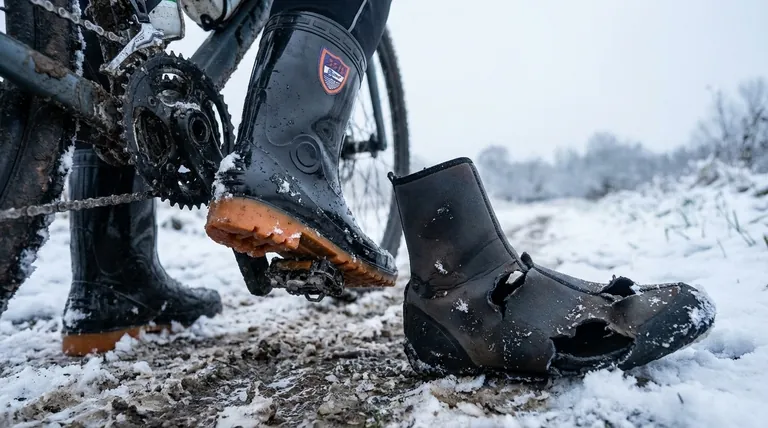
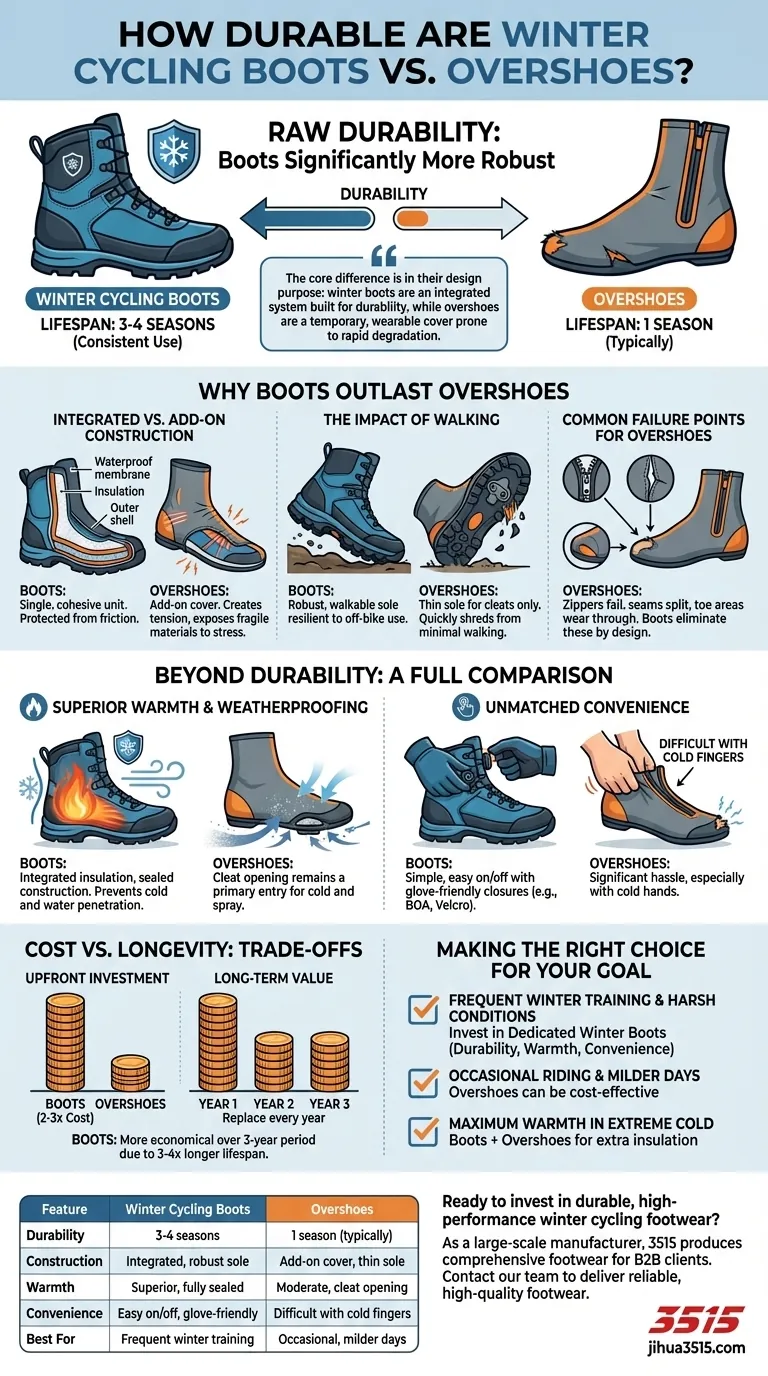
In terms of raw durability, dedicated winter cycling boots are significantly more robust than overshoes. A quality pair of winter boots can be expected to last three to four seasons of consistent use, whereas most overshoes will typically need replacement after just one winter due to wear and tear.
The core difference is in their design purpose: winter boots are an integrated system built for durability and performance, while overshoes are a temporary, wearable cover prone to rapid degradation from walking and exposure.
Why Boots Outlast Overshoes
The durability gap isn't accidental; it's a direct result of fundamental differences in construction, materials, and intended use. Understanding these factors makes the choice between them much clearer.
Integrated vs. Add-On Construction
Winter boots are designed as a single, cohesive unit. The waterproof membrane, insulation, and outer protective layer are all built into the shoe's structure, protecting them from external friction.
Overshoes are, by definition, an add-on. They stretch over a regular cycling shoe, creating tension and exposing fragile materials like neoprene and zippers to constant stress, abrasion, and the elements.
The Impact of Walking
Even minimal walking is the primary cause of overshoe failure. The thin material on the sole, designed only to accommodate a cleat, quickly shreds and rips when walking from your bike to a cafe or up a short, unrideable climb.
Winter boots, conversely, feature a robust, walkable sole similar to a standard shoe, making them far more resilient to off-the-bike use.
Common Failure Points for Overshoes
Overshoes have several common points of failure. Zippers can fail under tension or clog with grime, seams can split from being stretched, and the toe area often wears through from accidental scuffs. Boots eliminate these vulnerabilities by design.
Beyond Durability: A Full Comparison
While durability is a key factor, the performance and convenience differences are just as critical for anyone serious about riding through the cold.
Superior Warmth and Weatherproofing
A dedicated winter boot is fundamentally warmer and more weatherproof than a shoe-and-overshoe combination. The integrated insulation and sealed construction prevent wind and water from penetrating in ways an overshoe simply cannot.
While an overshoe adds a layer of protection, it can't seal the large cleat opening on the bottom of a summer shoe, which remains a primary entry point for cold air and road spray.
Unmatched Convenience
Putting on tight overshoes with cold, numb fingers is a significant hassle. Winter boots offer the simple convenience of a standard shoe, often with easy-to-use closures like BOA dials or Velcro straps that are manageable even with gloves on.
This ease of use means you're more likely to get out the door and less likely to struggle with gear at the beginning or end of a cold ride.
Understanding the Trade-offs: Cost vs. Longevity
The most significant barrier to winter boots for most riders is the initial cost. However, a purely financial view often overlooks the long-term value.
The Upfront Investment
Winter cycling boots represent a considerable upfront investment, often costing two to three times as much as a high-quality pair of overshoes.
Calculating Long-Term Value
When you factor in that boots last 3-4 times longer, the cost-per-season becomes much more favorable. Replacing overshoes every single year can quickly add up, often making the boots the more economical choice over a three-year period.
Making the Right Choice for Your Goal
Your decision should be based on your commitment to winter riding and your performance expectations.
- If your primary focus is consistent training through winter: Invest in dedicated winter boots. Their durability, warmth, and convenience are essential for frequent riding in harsh conditions.
- If your primary focus is occasional riding on milder winter days: Overshoes can be a cost-effective solution to take the edge off the cold for infrequent use.
- If your primary focus is maximum warmth in extreme cold: A pair of winter boots is the best foundation, and you can even add overshoes on top for an extra layer of insulation on the coldest days.
Ultimately, choosing dedicated boots is an investment in comfort, performance, and long-term value for any serious winter cyclist.
Summary Table:
| Feature | Winter Cycling Boots | Overshoes |
|---|---|---|
| Durability | 3-4 seasons | 1 season (typically) |
| Construction | Integrated, robust sole | Add-on cover, thin sole |
| Warmth | Superior, fully sealed | Moderate, cleat opening remains |
| Convenience | Easy on/off, glove-friendly | Difficult with cold fingers |
| Best For | Frequent winter training, harsh conditions | Occasional riding, milder days |
Ready to invest in durable, high-performance winter cycling footwear?
As a large-scale manufacturer, 3515 produces a comprehensive range of footwear for distributors, brand owners, and bulk clients. Our production capabilities encompass all types of durable and weatherproof shoes and boots, including specialized cycling models built for long-term value.
Contact our team today to discuss your specific needs and discover how we can deliver reliable, high-quality footwear for your customers.
Visual Guide
Related Products
- Premium Insulated Safety Boots and Shoes for Wholesale & Bulk Orders
- Factory Direct Wholesale Rain Boots Durable Waterproof & Fully Customizable
- Durable Waterproof Rain Boots | Custom Manufacturer for Wholesale & Brands
- Heavy-Duty Waterproof Nubuck Safety Boots Safety Shoes for Bulk Supply
- Wholesale Waterproof Tactical Boots Custom Suede & High-Traction Soles
People Also Ask
- What are the recommended insulation ratings for mild winter conditions? A Guide for Active & Stationary Workers
- How does insulation thickness correlate with temperature ranges? A Guide to Choosing the Right Warmth
- What insulation level is needed for severe cold and stationary work? 1200g or Higher is Essential
- What safety advantages do insulated boots offer beyond warmth? Dielectric Protection & Superior Grip
- How does fleece lining contribute to the warmth of insulated boots? Trapping Air for Superior Cold Protection