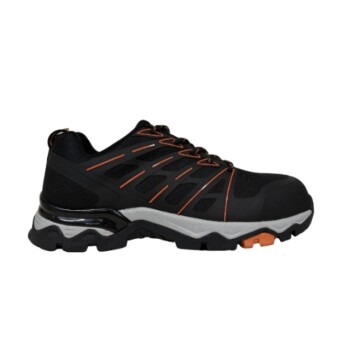
Precision in industrial cutting acts as the blueprint for structural integrity in safety shoe manufacturing. By utilizing high-precision molds to process leather or synthetic materials, these machines ensure absolute dimensional consistency across every upper component. This initial accuracy is the prerequisite for perfect alignment during assembly, preventing the physical deviations that compromise the shoe's protective capabilities.
Core Takeaway High-precision cutting is not merely about aesthetic uniformity; it is a critical quality control measure. By guaranteeing exact component geometry at the start of production, manufacturers prevent misalignment during sewing, thereby securing the mechanical strength required to meet strict industrial safety standards.
The Role of Precision in Manufacturing Logic
Achieving Dimensional Consistency
Industrial-grade cutting machines rely on precision molds to shape the shoe's upper components. This technology ensures that every piece of leather or synthetic material is cut to exact specifications, eliminating the variance found in manual or low-grade processing.
Facilitating Seamless Assembly
The quality of the final product relies heavily on how well these components fit together downstream. High-precision cutting creates a consistent measurement plane, ensuring that parts align perfectly during the subsequent sewing process.
Reducing Manufacturing Defects
When components vary in size even slightly, forcing them together creates stress. Precision cutting prevents common defects such as wrinkles or uneven structural strength, significantly lowering the overall defect rate of the production line.
Impact on Safety and Structural Integrity
Preventing Structural Weakness
A safety shoe is a protective system, and the upper provides necessary support. Deviations in cutting lead to weak points where components join. Precision ensures the structural integrity remains uniform, preventing failures under stress.
Ensuring Standard Compliance
Safety shoes must meet rigorous industrial standards for protection. The accuracy provided by these machines reduces deviations that could otherwise lead to safety risks or wearer discomfort, ensuring every pair performs reliably in harsh environments.
Understanding the Trade-offs
Dependency on Mold Accuracy
While precision machines offer consistency, they are entirely dependent on the quality of the molds used. If a mold contains a flaw, that error will be replicated perfectly across thousands of units, potentially ruining entire batches before the error is detected.
The Rigidity of the Process
High-precision cutting relies on specific tooling for specific designs. Unlike manual cutting, which allows for on-the-fly adjustments, industrial machines require significant setup time and tooling changes to switch between shoe models or sizes, potentially reducing flexibility for small, custom runs.
Making the Right Choice for Your Goal
To maximize the value of industrial cutting technology, consider your specific production priorities:
- If your primary focus is Structural Durability: Prioritize the maintenance of cutting molds to ensure that component alignment remains flawless during the sewing phase.
- If your primary focus is Cost Efficiency: Leverage the high precision to reduce the defect rate, minimizing material waste and the need for rework.
Precision at the cutting stage is the single most effective way to guarantee the final reliability of industrial footwear.
Summary Table:
| Key Factor | Impact on Quality | Manufacturing Benefit |
|---|---|---|
| Dimensional Consistency | Absolute alignment of components | Eliminates manual variance and assembly errors |
| Assembly Precision | Seamless fit during sewing | Prevents wrinkles and uneven structural stress |
| Defect Reduction | Lower material waste and rework | Maximizes cost efficiency and output reliability |
| Safety Compliance | Uniform mechanical strength | Guarantees protection against harsh industrial stresses |
Partner with 3515 for High-Precision Footwear Solutions
As a large-scale manufacturer serving global distributors and brand owners, 3515 leverages advanced industrial-grade cutting technology to ensure every pair of shoes meets the highest structural standards. Our flagship Safety Shoes series is built on a foundation of precision, ensuring durability and compliance for the most demanding environments.
Beyond safety footwear, our comprehensive production capabilities extend to:
- Tactical & Work Boots for rugged performance
- Outdoor & Training Shoes for versatility
- Sneakers & Dress Shoes for diverse bulk requirements
Take advantage of our precision-driven manufacturing to enhance your brand's reputation for quality. Contact us today to discuss your bulk requirements and see how our expertise can streamline your supply chain.
References
- Eko Fandra Winata, Sugiyono Sugiyono. Analysis of Safety Shoes Product Quality Control at PT. BINA USAHA SEJAHTERA With Statistical Quality Control (SQC) Method Case Study of PT Bina Usaha Sejahtera (BINUSA). DOI: 10.55927/ijba.v4i1.8323
This article is also based on technical information from 3515 Knowledge Base .
Related Products
- Premium Suede Sport Safety Shoes for Wholesale & Bulk Orders
- Premium Lightweight Safety Shoes for Wholesale & Bulk Orders
- Wholesale Anti-Smash & Puncture-Proof Safety Shoes Custom Manufacturing for Brands
- Premium KPU Injection Athletic Style Safety Shoes
- Premium Safety Shoes with Rotating Buckle Safety Sneakers
People Also Ask
- What are the primary functions of professional safety shoes? Maximize Safety in Water Supply Confined Spaces
- What industries have specific OSHA footwear requirements? Ensure Compliance & Protect Your Workforce
- What role do specialized safety shoes play in preventing falls? Engineering Stability in Industrial Environments
- How do complex outsole tread designs in safety shoes work with coated floors? Master Slip Resistance Engineering
- What are the technical advantages of integrating sensors into safety shoes? Achieve Superior Motion Capture Precision