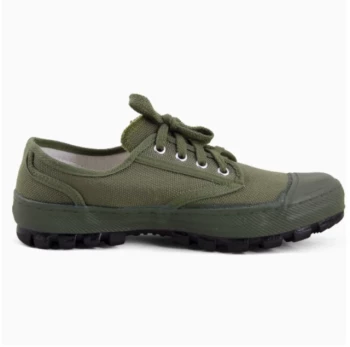
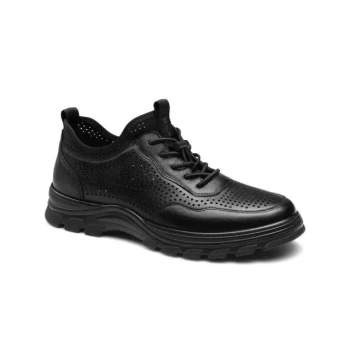
Rocker sole shoes fundamentally alter human balance by replacing the stable base of a standard shoe with a curved, arc-shaped sole geometry. Unlike flat shoes, which maximize ground contact, this design intentionally reduces the contact area to create an unstable support environment, forcing the wearer’s body to adapt mechanically and neurologically.
By introducing controlled instability, rocker sole shoes trigger a defensive gait that restricts ankle movement and heightens sensory feedback, effectively acting as a balance training tool rather than a passive support device.
The Geometry of Instability
The Arc-Shaped Sole
The defining feature of a rocker bottom is its curved profile. Instead of the foot landing and pushing off a flat plane, the shoe creates a continuous rolling motion.
This geometry prevents the foot from finding a static resting point.
Reduced Contact Area
Flat shoes are designed to provide a wide, stable platform by maximizing the surface area touching the ground.
Rocker soles do the opposite; they significantly reduce the contact area between the shoe and the floor. This lack of a solid base is the primary mechanism that induces instability.
The Physiological Response
Adopting a Defensive Gait
When the body senses the instability caused by the rocker sole, it automatically shifts strategy.
To maintain balance, the wearer adopts a cautious, defensive gait. This is a protective mechanism where the body prioritizes stability over speed or stride length.
Decreased Ankle Range of Motion (ROM)
A critical difference compared to flat shoes is how the ankle joint behaves.
The rocker design significantly decreases the Range of Motion (ROM) of the ankle, specifically in dorsiflexion (pulling toes up) and plantarflexion (pointing toes down). Because the shoe provides the "roll," the ankle joint itself is required to move less, effectively locking into a more rigid position to maintain control.
Enhanced Proprioceptive Feedback
The instability forces the body’s sensory systems to wake up.
The mechanism enhances proprioceptive feedback—the body's ability to sense its position in space. Because the ground feels "uncertain," the nervous system sends more frequent signals regarding posture control, which is the core of the shoe's value as a training tool.
Understanding the Trade-offs
Passive vs. Active Stability
Flat shoes provide passive stability. They do the work of balancing for you by providing a solid foundation.
Rocker shoes demand active stability. They force your muscles and nervous system to do the work, which can be fatiguing but is beneficial for strengthening dynamic stability.
The Learning Curve
Because the shoe induces a defensive gait, walking feels different immediately.
Users moving from flat shoes to rocker soles must anticipate an adjustment period where their natural stride is interrupted by the mechanical constraint of the curved sole.
Making the Right Choice for Your Goal
Rocker soles are not universally superior to flat shoes; they are specialized tools with a specific biomechanical purpose.
- If your primary focus is balance training: These shoes serve as an effective tool to improve dynamic stability by forcing your body to actively manage posture.
- If your primary focus is joint offloading: The reduction in ankle Range of Motion can be beneficial if you need to limit ankle movement due to injury or fatigue.
- If your primary focus is maximum immediate stability: Flat shoes remain the superior choice as they provide the largest base of support without requiring gait adaptation.
The rocker sole proves that sometimes the best way to improve balance is to challenge it.
Summary Table:
| Feature | Rocker Sole Shoes | Flat Shoes |
|---|---|---|
| Sole Geometry | Curved/Arc-shaped profile | Flat, horizontal plane |
| Ground Contact | Reduced; creates controlled instability | Maximized; provides a stable base |
| Ankle Movement | Decreased Range of Motion (ROM) | Full natural Range of Motion |
| Stability Type | Active (requires muscle engagement) | Passive (foundation-driven) |
| Gait Style | Defensive and cautious | Natural and unrestricted |
| Primary Use | Balance training and joint offloading | Maximum stability and everyday use |
Elevate Your Product Line with Advanced Footwear Solutions
As a large-scale manufacturer serving distributors and brand owners, 3515 offers comprehensive production capabilities for all footwear types, anchored by our flagship Safety Shoes series. Whether you are looking for specialized rocker sole designs to enhance dynamic stability or traditional flat soles for maximum safety, our expert engineering team delivers unmatched quality.
Our extensive portfolio covers work and tactical boots, outdoor shoes, training shoes, and sneakers, as well as Dress & Formal shoes to meet your diverse bulk requirements. Partner with a leader in footwear innovation to provide your customers with superior biomechanical support and durability.
Ready to scale your inventory with high-performance footwear? Contact 3515 Today to Discuss Your Bulk Requirements
References
- Miao Tian, Shu Yuan. Kinematic Strategies for Sustainable Well-Being in Aging Adults Influenced by Footwear and Ground Surface. DOI: 10.3390/healthcare10122468
This article is also based on technical information from 3515 Knowledge Base .
Related Products
- Durable Rubber Sole Outdoor Shoes Wholesale & Custom Manufacturing
- Durable Rubber-Soled Utility Shoes for Wholesale & Custom Brand Manufacturing
- Wholesale Breathable Training Shoes Custom Athletic Footwear Manufacturer
- Wholesale Durable Camouflage Canvas Shoes with High-Traction Cleated Rubber Sole
- Durable High-Traction Canvas Sneakers Wholesale & Custom Manufacturing
People Also Ask
- What is the function of the sole in outdoor shoes? Find the Perfect Grip and Support
- What role do outdoor shoes and sneakers play in navigating external terrains? Engineered Stability for Every Surface
- How is AI utilized in the design of outdoor and safety footwear? Harnessing Big Data for Market-Driven Shoe Innovation
- Why is durability important when selecting outdoor shoes? A Guide to Safety & Long-Term Value
- What are the key components of outdoor shoes that affect comfort and sturdiness? A Guide to Durable, High-Performance Footwear