
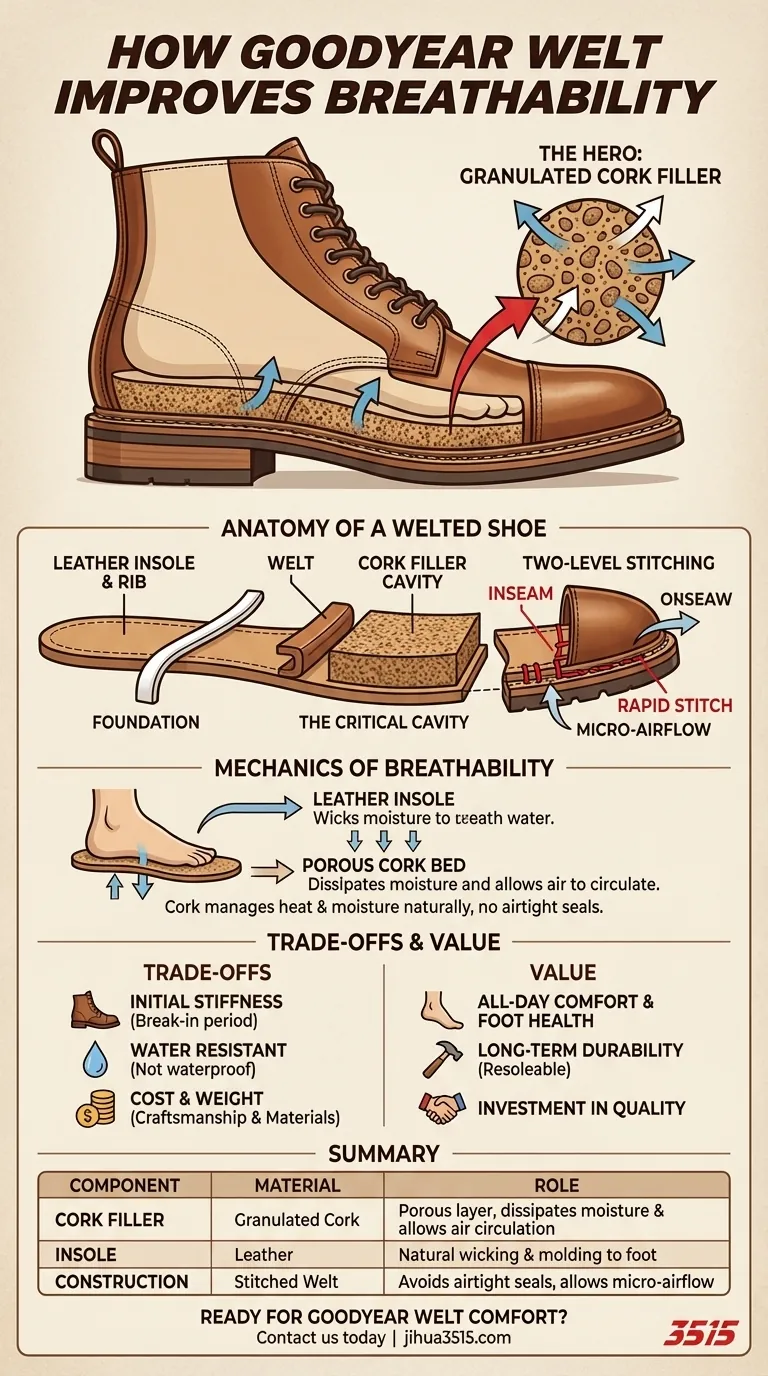
At its core, Goodyear welt construction improves breathability through its use of natural, porous materials and a multi-layered structure that avoids impermeable synthetic adhesives. The key is the cavity between the insole and outsole, which is filled with granulated cork—a material that allows air to circulate and moisture to dissipate.
While often praised for durability, the Goodyear welt's true advantage for foot health lies in its construction. It creates a breathable ecosystem for your foot, not by adding vents, but by using materials that naturally manage heat and moisture.
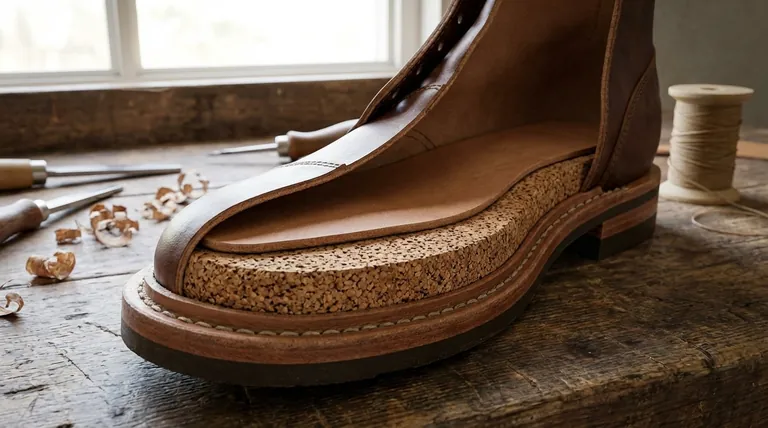
Anatomy of a Welted Shoe
To understand how a Goodyear welt breathes, you must first understand its core components. This method is fundamentally different from modern, cheaper techniques that rely on simply gluing the shoe's upper to its sole.
The Foundation: Insole and Rib
The entire shoe is built upon a leather insole. A "rib"—a perpendicular flange of material—is attached to the underside of this insole, creating a sturdy anchor point for the subsequent stitching.
The Connecting Piece: The Welt
The welt is a dedicated strip of leather that runs along the perimeter of the shoe. It acts as the crucial intermediary, connecting the shoe's upper to the sole without directly puncturing either one from the outside.
The Critical Cavity: The Cork Filler
Stitching the welt to the upper and the insole rib creates a distinct cavity. This space is filled with a layer of granulated cork, a natural, lightweight, and porous material.
The Two-Level Stitching
Two independent stitches are used. The first, an inseam, attaches the insole, upper, and welt together. The second, a rapid stitch, attaches the welt to the outsole. This two-level system is the source of the shoe's strength and repairability.
The Mechanics of Breathability
The breathability of a Goodyear welted shoe is not an accident; it's an inherent benefit of its materials and assembly. It's a system that works together to manage the in-shoe climate.
The Role of the Cork Bed
The cork filler is the hero of breathability. Unlike a synthetic foam or rubber filler, cork is naturally porous and antimicrobial. It allows moisture wicked down through the leather insole to dissipate, preventing it from becoming trapped against your foot. This micro-air circulation keeps the foot cooler and drier.
The Power of Natural Materials
Goodyear welt construction almost exclusively uses leather for the insole, welt, and upper. Leather is a naturally breathable material that conforms to the wearer's foot. Over time, the leather insole and cork bed mold together, creating a personalized footbed that supports your foot while allowing it to breathe.
How Stitching Promotes Airflow
A stitched construction, unlike a cemented one, does not create an airtight chemical seal around the sole. While this makes the shoe highly water-resistant rather than fully waterproof, it also means that microscopic air exchange can occur along the welt, contributing to the overall breathability of the shoe.
Understanding the Trade-offs
While highly beneficial, the Goodyear welt method is a specific choice with distinct characteristics you should be aware of.
Initial Stiffness vs. Long-Term Comfort
A brand new Goodyear welted shoe is often stiff. This is because the sturdy leather insole and cork bed require a break-in period to mold to the unique shape of your foot. The initial firmness is the trade-off for a future personalized fit.
Water Resistance, Not Waterproofing
The stitched construction provides excellent resistance to moisture from the ground. However, because it is not a perfect seal, it is not inherently waterproof. Submerging the shoe in water will eventually lead to penetration.
Cost and Weight
The complexity of the process—involving over 150 steps—and the quality of the materials make Goodyear welted footwear more expensive and typically heavier than shoes with cemented soles. You are paying for craftsmanship, durability, and superior materials.
Making the Right Choice for Your Goal
Deciding if a Goodyear welt is right for you depends on your priorities.
- If your primary focus is all-day comfort and foot health: The unparalleled breathability and custom-molding properties of a Goodyear welt are ideal for you.
- If your primary focus is long-term value and durability: The ability to resole the shoe multiple times makes this construction an excellent long-term investment.
- If your primary focus is immediate comfort, light weight, and affordability: You may be better served by a shoe with a different construction, such as a cemented or Blake-stitched sole.
Ultimately, choosing a Goodyear welt is an investment in a time-tested construction that prioritizes the health and comfort of your feet.
Summary Table:
| Component | Material | Role in Breathability |
|---|---|---|
| Cork Filler | Granulated Cork | Porous layer that dissipates moisture and allows air circulation. |
| Insole | Leather | Natural material that wicks moisture and molds to the foot. |
| Construction | Stitched Welt | Avoids airtight seals, allowing for micro-airflow. |
Ready to experience the superior comfort and durability of Goodyear welt construction?
As a large-scale manufacturer, 3515 produces a comprehensive range of footwear for distributors, brand owners, and bulk clients. Our production capabilities encompass all types of shoes and boots, including premium Goodyear welted styles designed for optimal breathability and long-term value.
Contact our team today to discuss your footwear needs and discover how we can deliver quality and comfort at scale.
Visual Guide
Related Products
- Durable Goodyear Welt Leather Work Boots for Wholesale & Private Label
- Wholesale Durable Leather Work Boots | 8-Inch Goodyear Welt Manufacturer
- Durable Leather Work Boots Wholesale Manufacturer & Custom Factory
- Durable Leather Work Boots for Wholesale & Custom Manufacturing
- Durable Leather Work Boots for Wholesale & Custom OEM Manufacturing
People Also Ask
- What is the difference between full-grain and top-grain leather? Premium Material Guide for Boot Manufacturers
- What are the advantages of leather as an upper material for work boots? Unmatched Durability & Custom Comfort
- Why is it important to waterproof leather work boots? Protect Your Investment and Performance
- How should new leather work boots be broken in? A Guide to Comfort and Durability
- What are the advantages of leather uppers in work boots? Unmatched Durability & Protection
















