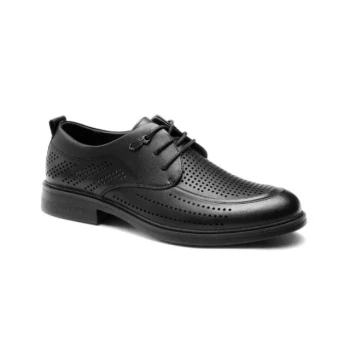
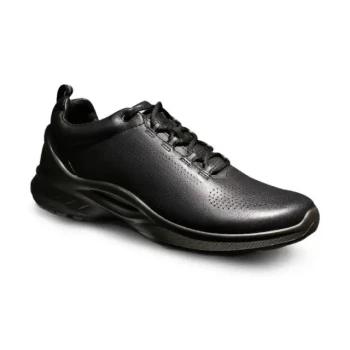
At its core, a shoe's shank acts as a rigid backbone, and in Goodyear welted footwear, this is often a dual system of leather and metal. Located between the heel and the ball of the foot, these shanks are the primary source of structural integrity, preventing the shoe from collapsing under your arch and ensuring it flexes only where your foot naturally bends.
The shank is the unseen engineering that transforms a shoe from a simple covering into a supportive platform. Its true purpose isn't to make the shoe stiff, but to provide controlled flexibility, which is the foundation of stability and long-term comfort.
What is a Shoe Shank?
The Hidden Backbone
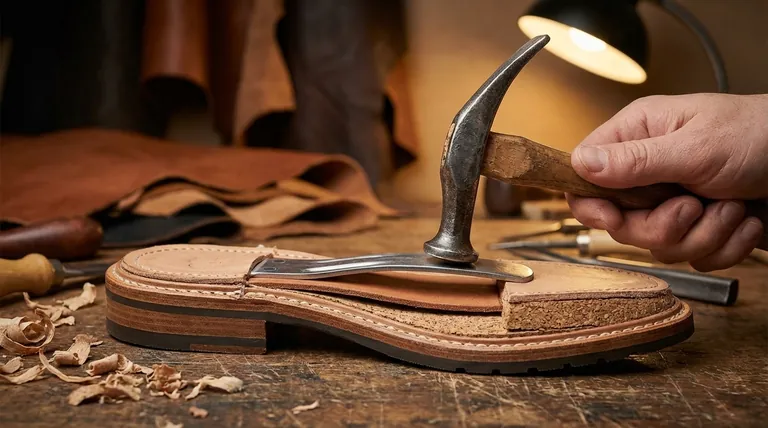
A shoe shank is a small, semi-rigid piece of material inserted into the midsole of the shoe, directly under the arch of your foot.
Think of it as the chassis of a car or the support beam in a bridge. It provides the fundamental structure upon which the rest of the shoe depends for its shape and resilience.
A Dual-Material System
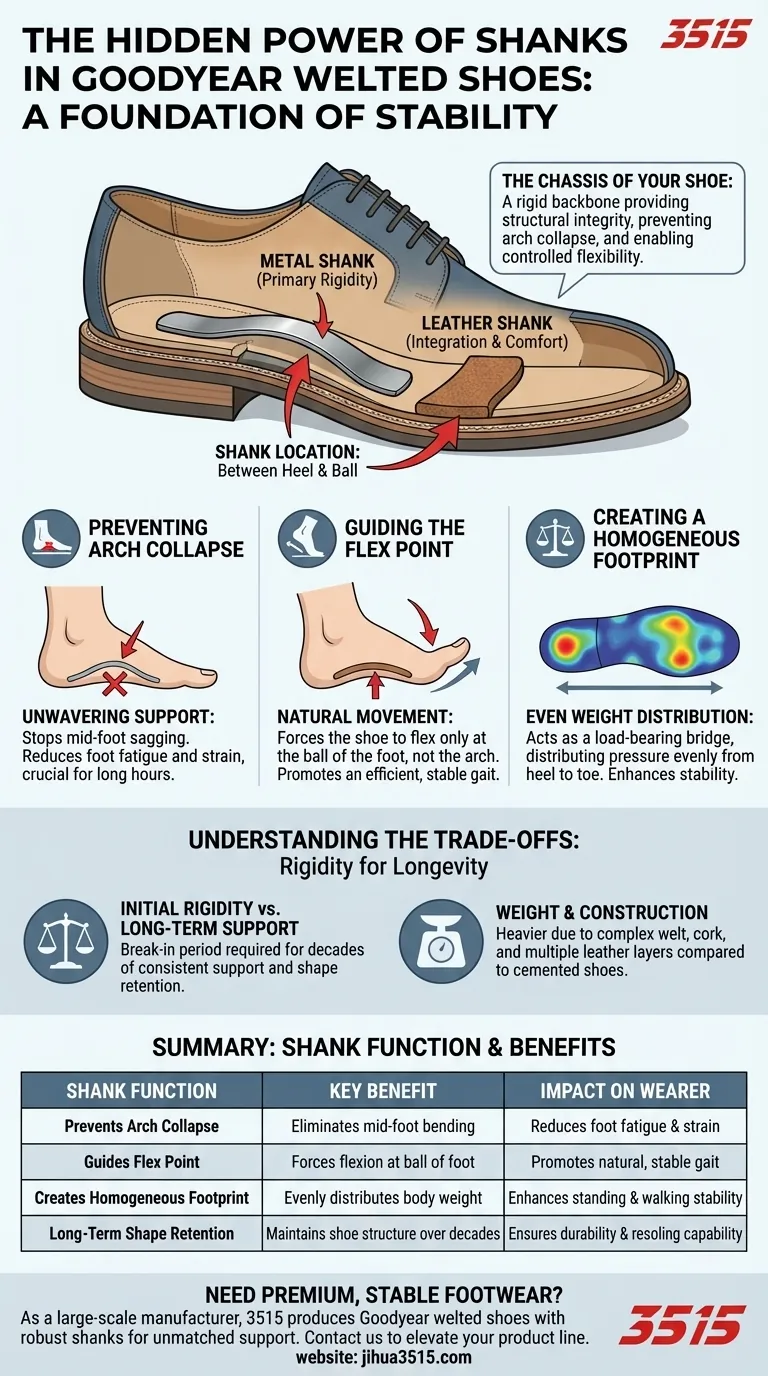
Goodyear welted shoes often utilize a sophisticated dual-shank system. A primary metal shank provides uncompromising rigidity, while a surrounding leather shank or shank board helps integrate this structure smoothly into the rest of the sole's layers.
This combination offers robust support without creating sharp pressure points, balancing strength with comfort.
The Biomechanics of Stability
Preventing Arch Collapse
The most critical function of the shank is to provide unwavering support to your foot's arch. Without it, the shoe would sag and bend in the middle with every step.
This support prevents arch strain and foot fatigue, which is especially critical for individuals who spend long hours on their feet.
Guiding the Flex Point
A stable shoe must flex in harmony with the human foot. The rigid shank ensures the shoe does not bend at the arch.
This forces the shoe to flex at its intended point: the ball of the foot. This guided motion promotes a natural, efficient, and stable walking gait.
Creating a "Homogeneous Footprint"
The term "homogeneous footprint" refers to the even distribution of your body weight across the entire sole of the shoe.
The shank acts as a load-bearing bridge, ensuring pressure is distributed evenly from heel to toe. This creates a solid, stable platform for standing and walking, reducing stress on any single part of your foot.
Understanding the Trade-offs
Initial Rigidity vs. Long-Term Support
The structural integrity provided by a shank, particularly a steel one, adds to the initial stiffness of a new pair of Goodyear welted shoes.
This is a key reason these shoes require a "break-in" period. This initial rigidity is the necessary trade-off for the decades of consistent arch support and shape retention the shank provides.
Weight and Construction
A robust shank system is an integral part of a complex construction method involving welts, cork filling, and multiple layers of leather.
This results in a heavier, more substantial shoe compared to a lighter, more flexible cemented or Blake-stitched shoe that may lack a comparable shank.
How to Apply This to Your Choice
A shank is a non-negotiable component for anyone seeking genuine support and longevity from their footwear. Understanding its function allows you to assess the true quality of a shoe far beyond its surface appearance.
- If your primary focus is all-day comfort and support: The shank's ability to prevent arch collapse is the single most important feature for reducing foot fatigue.
- If your primary focus is longevity and value: A strong shank ensures the shoe maintains its foundational shape for years, making resoling possible and protecting your investment.
- If your primary focus is a stable and healthy gait: The shank guarantees the shoe flexes correctly, promoting better biomechanics with every step you take.
By recognizing the role of this hidden component, you are better equipped to choose footwear that is engineered to support you.
Summary Table:
| Shank Function | Key Benefit | Impact on Wearer |
|---|---|---|
| Prevents Arch Collapse | Eliminates mid-foot bending | Reduces foot fatigue and strain |
| Guides Flex Point | Forces flexion at ball of foot | Promotes natural, stable gait |
| Creates Homogeneous Footprint | Evenly distributes body weight | Enhances standing and walking stability |
| Long-Term Shape Retention | Maintains shoe structure over decades | Ensures durability and resoling capability |
Need premium, stable footwear for your customers? As a large-scale manufacturer, 3515 produces a comprehensive range of Goodyear welted shoes and boots with robust shank systems that deliver unmatched arch support and longevity. Our production capabilities are tailored for distributors, brand owners, and bulk clients seeking high-quality, durable footwear. Contact us today to discuss your manufacturing needs and elevate your product line with footwear built on a foundation of stability.
Visual Guide
Related Products
- Durable Goodyear Welt Leather Work Boots for Wholesale & Private Label
- Wholesale Durable & Breathable Training Shoes for Custom Brands
- Wholesale Breathable Training Shoes Custom Athletic Footwear Manufacturer
- Custom OEM Training Shoes Wholesale Manufacturer Durable & Breathable
- Lightweight Breathable Training Shoes for Wholesale & Custom OEM Manufacturing
People Also Ask
- What is the difference between full-grain and top-grain leather? Premium Material Guide for Boot Manufacturers
- What are the advantages of leather as an upper material for work boots? Unmatched Durability & Custom Comfort
- Why is it important to waterproof leather work boots? Protect Your Investment and Performance
- How should new leather work boots be broken in? A Guide to Comfort and Durability
- What are the advantages of leather uppers in work boots? Unmatched Durability & Protection