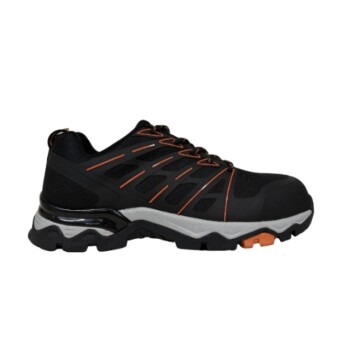
Design characteristics like sole hardness and thickness fundamentally dictate vibration transmission by defining the stiffness and damping coefficients in biodynamic models. In these simulations, the interface connecting the footwear, foot skin, and foot segment is represented as a translational spring-damper system. By altering physical attributes such as midsole cushioning and material density, engineers change the viscoelastic properties of this coupling node, effectively controlling how vibration energy transfers from a vehicle floor or pedal to the human body.
Footwear acts as a tunable mechanical filter within biodynamic systems, where specific material choices directly alter the mathematical coupling between the occupant and the vibration source. Optimizing these viscoelastic properties is essential for isolating high-frequency vibrations and minimizing physical fatigue.
Modeling the Foot-Shoe Interface
The Spring-Damper Analogy
In biodynamic modeling, the complex interaction between a shoe and the human foot is simplified into a translational spring-damper system.
This mechanical equivalent represents the "coupling node" where external forces enter the body.
Defining the Coupling Node
The model treats the footwear, the skin of the foot, and the foot segment as a unified transmission path.
The vibration characteristics of this path are not fixed; they are variable based entirely on the mechanical properties of the shoe being worn.
Key Design Variables and Their Impact
Sole Material Hardness
The hardness of the sole material is a primary determinant of the stiffness coefficient in the model.
A harder sole creates a stiffer spring representation, which generally allows more vibration transmission, whereas a softer sole lowers this stiffness.
Thickness and Geometry
The physical thickness of the sole contributes to the overall geometry of the coupling.
Changes in thickness alter the distance over which forces are applied, influencing both the spring rate and the damping potential of the system.
Midsole Energy Absorption
The cushioning properties of the midsole define the damping coefficient.
This represents the shoe's ability to dissipate energy rather than transmit it, playing a critical role in the "viscoelastic design" of the footwear.
The Functional Outcome: Vibration Filtering
Attenuating High Frequencies
The primary goal of optimizing these design characteristics is to filter out specific vibration frequencies.
The reference highlights that effective design specifically targets high-frequency vibrations originating from vehicle pedals or floors.
Reducing Biological Impact
By tuning the stiffness and damping to block these frequencies, the model predicts a reduction in foot fatigue.
This direct alteration of transmission mechanics leads to enhanced overall occupant comfort.
Understanding the Trade-offs in Optimization
The Necessity of Viscoelastic Balance
Optimizing a shoe is not simply about making it as soft as possible; it requires a precise viscoelastic balance.
The design must possess the right combination of stiffness to support the foot and damping to absorb energy.
Material Property Interdependence
Changing one characteristic, such as increasing thickness for better damping, may inadvertently alter the stiffness.
Designers must understand that these variables are coupled; you cannot alter the physical material without simultaneously shifting both the spring and damper coefficients in the model.
Making the Right Choice for Your Goal
To effectively utilize biodynamic models for footwear and vibration analysis, consider the following applications:
- If your primary focus is Occupant Comfort: Prioritize increasing the damping coefficient through midsole cushioning to filter high-frequency vibrations and reduce fatigue.
- If your primary focus is Model Accuracy: Ensure your simulation accurately reflects the specific stiffness and damping coefficients derived from the exact sole hardness and thickness of the shoe in question.
- If your primary focus is Vibration Isolation: Manipulate the viscoelastic design to create a "softer" coupling node that minimizes energy transfer from vehicle floors or pedals.
The most effective safety and training shoes are those where material science is translated directly into optimized mechanical filtering properties.
Summary Table:
| Design Feature | Biodynamic Model Parameter | Impact on Vibration Transmission |
|---|---|---|
| Sole Hardness | Stiffness Coefficient | Higher hardness increases stiffness and energy transmission. |
| Midsole Cushioning | Damping Coefficient | Enhanced cushioning increases energy dissipation (damping). |
| Sole Thickness | Geometric Spring Rate | Greater thickness provides more volume for vibration attenuation. |
| Material Density | Viscoelastic Property | Determines the efficiency of high-frequency filtering. |
Optimize Footwear Performance with 3515
As a large-scale manufacturer serving distributors and brand owners, 3515 offers comprehensive production capabilities for all footwear types, anchored by our flagship Safety Shoes series. We understand the complex biodynamics of footwear design, from stiffness coefficients to damping efficiency.
Whether you need work and tactical boots, outdoor shoes, training shoes, or sneakers, our expert engineering team can help you develop products that minimize fatigue and maximize vibration isolation. Partner with 3515 for bulk requirements and benefit from our advanced material science and manufacturing scale.
Ready to elevate your footwear line? Contact us today to discuss your production needs!
References
- Abeeb Opeyemi Alabi, Namcheol Kang. Development of a 7-DOF Biodynamic Model for a Seated Human and a Hybrid Optimization Method for Estimating Human-Seat Interaction Parameters. DOI: 10.3390/app131810065
This article is also based on technical information from 3515 Knowledge Base .
Related Products
- Premium Suede Sport Safety Shoes for Wholesale & Bulk Orders
- Premium Lightweight Safety Shoes for Wholesale & Bulk Orders
- Wholesale Anti-Smash & Puncture-Proof Safety Shoes Custom Manufacturing for Brands
- Premium KPU Injection Athletic Style Safety Shoes
- Premium Safety Shoes with Rotating Buckle Safety Sneakers
People Also Ask
- What industries have specific OSHA footwear requirements? Ensure Compliance & Protect Your Workforce
- What are the primary functions of professional safety shoes? Maximize Safety in Water Supply Confined Spaces
- What role do specialized safety shoes play in preventing falls? Engineering Stability in Industrial Environments
- How does professional industrial cleaning equipment maintain the performance stability of safety shoes? Pro Maintenance
- How do specialized safety shoes protect against battery maintenance injuries? Prevent Impact and Chemical Burns