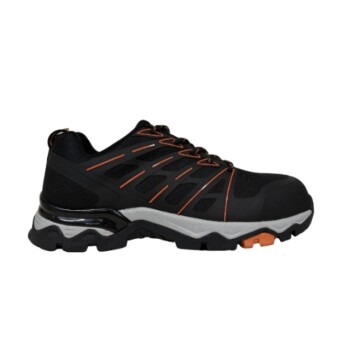
Standardized impact resistance tests are the definitive benchmark for ensuring that safety shoe toe caps provide repeatable, life-saving protection. These tests subject footwear to a precise kinetic energy load—typically 200 Joules—using a calibrated industrial drop hammer to measure structural deformation. By quantifying the exact threshold at which a toe cap fails, manufacturers can move beyond subjective claims and guarantee that every pair of shoes meets rigorous international safety standards.
The core value of standardized testing lies in its ability to eliminate manufacturing variability. For high-volume distributors and brand owners, these protocols provide the objective data necessary to ensure that mass-produced footwear maintains consistent protective integrity across global supply chains.
The Mechanics of Objective Safety Verification
The Physics of the 200 Joule Benchmark
To pass international safety standards, a toe cap must withstand a test energy of 200 Joules without compromising the internal clearance needed to protect the toes. This is achieved by dropping a 25kg steel striker from a specific height, allowing gravity to accelerate the load to a precise impact level.
Precision Through Industrial-Grade Apparatus
Standardized testing utilizes vertical guide rails to ensure the striker hits the toe cap with absolute accuracy and zero lateral deviation. This controlled environment ensures that the impact load is highly repeatable, allowing for a rigorous assessment of the shoe’s protective capacity under limit loads.
Measuring Internal Clearance
The test does not just look for cracks; it measures the minimum clearance remaining inside the toe cap after impact. This ensures that even if the material deforms, it does not crush the foot, providing a vital safety margin for workers in heavy industrial environments.
Material Integrity in High-Volume Manufacturing
Engineering Steel vs. Composite Caps
While both steel and composite toe caps must meet the same 200J requirement, they behave differently under stress. Steel offers superior protection against heavy impacts with a thinner profile, while composite materials provide non-conductive, lightweight alternatives for specialized electrical environments.
Consistency Across Massive Production Scales
For enterprises with a rich heritage since 1951, maintaining quality across millions of units requires state-of-the-art equipment and robust OEM/ODM protocols. Standardized testing ensures that a toe cap produced in a high-volume run today possesses the exact same protective integrity as the certified prototype.
Compliance with International Certifications
Robust testing is the foundation for securing comprehensive international certifications. These certifications are essential for B2B resellers and wholesalers who require documented proof of safety to mitigate liability and meet the strict regulatory demands of global markets.
Understanding the Trade-offs and Limitations
Weight vs. Profile Thickness
To achieve a 200J rating, composite toe caps must be significantly thicker than their steel counterparts. This can result in a bulkier shoe silhouette, which brand owners must balance against the need for non-metallic, lightweight properties.
The "Single-Impact" Rule
Standardized tests prove that a toe cap can survive a catastrophic event, but they also highlight a critical limitation: structural fatigue. Once a toe cap has absorbed a major impact, its integrity is compromised, and the footwear must be replaced immediately, regardless of its outward appearance.
Material Reaction to Environmental Extremes
Steel can conduct temperature, potentially causing discomfort in extreme cold, whereas composite materials remain thermally neutral. However, in high-pressure "crushing" scenarios, steel often maintains its structural shape more predictably than some lower-grade plastic alternatives.
How to Align Testing Standards with Your Business Goals
Making the Right Choice for Your Portfolio
- If your primary focus is heavy industrial supply: Prioritize steel toe caps that exceed the 200J impact test and offer high-performance compression resistance for maximum durability.
- If your primary focus is airport or electrical safety: Invest in premium composite toe caps that meet international 200J standards while offering non-metallic, scan-safe convenience.
- If your primary focus is brand reputation and risk mitigation: Partner with manufacturers who utilize state-of-the-art equipment and have a proven history of consistent large-volume delivery and certification compliance.
Rigorous impact testing transforms safety from a marketing claim into a verifiable engineering certainty, ensuring your supply chain remains both stable and secure.
Summary Table:
| Test Parameter | Standard Requirement | Business Value for Distributors |
|---|---|---|
| Impact Energy | 200 Joules (25kg drop) | Guaranteed protection & reduced liability |
| Clearance | Minimum internal height | Verifiable engineering for safety claims |
| Material Choice | Steel vs. Composite | Targeted options for diverse work zones |
| Production | Industrial-grade consistency | Reliable quality in high-volume orders |
Secure Your Supply Chain with Certified Safety Footwear
As a large-scale manufacturer serving global distributors and brand owners since 1951, 3515 provides the manufacturing excellence and technical reliability you need to scale your business. Our flagship Safety Shoes series undergoes rigorous 200J impact testing to ensure every pair meets international safety certifications, mitigating liability and protecting your brand reputation.
Why Partner with 3515?
- Massive Production Scale: Robust supply chain stability for consistent, large-volume delivery.
- Premium OEM/ODM Capabilities: Tailored footwear solutions for work, tactical, outdoor, and sneakers.
- State-of-the-Art Equipment: Precision engineering ensuring uniform quality across millions of units.
- Global Compliance: Comprehensive international certifications to meet strict regulatory demands in any market.
From high-performance tactical boots to formal dress shoes, 3515 offers comprehensive production capabilities to meet your diverse bulk requirements. Contact us today to discuss your next project!
References
- José Daniel Jiménez‐García, Francisco Álvarez-Salvago. Associations of Balance, Strength, and Gait Speed with Cognitive Function in Older Individuals over 60 Years: A Cross-Sectional Study. DOI: 10.3390/app14041500
This article is also based on technical information from 3515 Knowledge Base .
Related Products
- Premium Suede Sport Safety Shoes for Wholesale & Bulk Orders
- Premium Lightweight Safety Shoes for Wholesale & Bulk Orders
- Wholesale Anti-Smash & Puncture-Proof Safety Shoes Custom Manufacturing for Brands
- Premium KPU Injection Athletic Style Safety Shoes
- Premium Safety Shoes with Rotating Buckle Safety Sneakers
People Also Ask
- What industries have specific OSHA footwear requirements? Ensure Compliance & Protect Your Workforce
- What are the primary functions of professional safety shoes? Maximize Safety in Water Supply Confined Spaces
- What role do specialized safety shoes play in preventing falls? Engineering Stability in Industrial Environments
- Why are customized foot sensors or professional safety shoes incorporated into biomechanical testing? Precision Insights
- What happens during the cutting stage of safety shoes manufacturing? Precision, Process & Quality