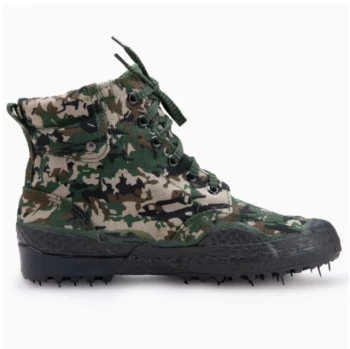
Standard hiking boots serve as a high-fidelity simulation tool for biomechanical testing, bridging the gap between controlled laboratory environments and rugged field conditions. By replicating specific physical characteristics—such as a weight of approximately 1.3 kg and a rigid, structured sole—they ensure that gait kinematics and physiological load data accurately reflect the real-world demands placed on soldiers and outdoor personnel.
In gait analysis, the validity of your data depends heavily on the authenticity of your equipment. While sneakers offer a baseline, standard hiking boots introduce the necessary mass and mechanical support to simulate true operational stress.
Simulating Operational Realism
Replicating Mass and Inertia
To achieve accurate physiological load testing, the footwear must mimic the actual weight carried in the field. Standard hiking boots typically weigh around 1.3 kg, a significant increase over standard athletic shoes.
This added mass alters the moment of inertia at the distal end of the leg. It forces the subject to exert more energy, providing a realistic measure of the physiological cost of movement.
Structural Integrity and Mechanics
Beyond weight, the structured sole design changes how the foot interacts with the ground. Unlike flexible sneakers, these boots provide substantial ankle support and specific traction profiles.
This structure modifies the gait cycle by limiting certain ranges of motion while stabilizing others. This accurately simulates the biomechanics required to navigate complex terrain or carry heavy loads.
Enhancing Data Relevance
Capturing Dynamic Foot Loads
Testing with everyday sneakers often results in "best-case scenario" data that fails to translate to the field. Standard hiking boots expose the subject to dynamic foot loads that are representative of actual operations.
This ensures that the stress recorded on joints and muscles in the lab mirrors what occurs during a hike or tactical maneuver.
Targeting Specific Demographics
The use of standard hiking boots is particularly critical when analyzing the movement efficiency of soldiers or outdoor professionals.
Data derived from this footwear allows researchers to predict fatigue and performance limitations in these specific groups. It moves the study from theoretical biomechanics to applied performance analysis.
Understanding the Trade-offs
Specificity vs. Generality
While hiking boots increase accuracy for field simulations, they are highly specialized tools. Using them for general population studies can skew baseline data, as the weight and rigidity may induce unnatural gait patterns in unconditioned subjects.
Treadmill Interface Limitations
The aggressive traction of a hiking boot allows for stability, but it interacts differently with a treadmill belt than pavement or dirt. Researchers must account for the friction differences between the structured sole and the treadmill surface to avoid data artifacts.
Making the Right Choice for Your Goal
To ensure your physiological load testing yields valid insights, you must align your equipment choices with the specific environment you intend to simulate.
- If your primary focus is military or field operation analysis: Prioritize standard hiking boots to capture the metabolic cost of the ~1.3 kg weight penalty and rigid support.
- If your primary focus is general clinical gait analysis: Be aware that the structured sole may mask natural foot flexions, making these boots unsuitable for standard mobility baselines.
By carefully selecting your footwear, you ensure that your experimental data is not just accurate, but operationally relevant to the user's real-world challenges.
Summary Table:
| Aspect | Contribution to Testing Accuracy |
|---|---|
| Simulating Operational Realism | |
| Replicating Mass (approx. 1.3 kg) | Mimics real-world load, altering inertia and providing a realistic measure of physiological cost and energy exertion. |
| Structural Integrity & Mechanics | Rigid sole design, ankle support, and specific traction modify gait cycles for complex terrain, accurately simulating biomechanics under operational stress. |
| Enhancing Data Relevance | |
| Capturing Dynamic Foot Loads | Exposes subjects to representative operational stresses, ensuring lab data mirrors real-world impact on joints and muscles. |
| Targeting Specific Demographics | Critical for analyzing movement efficiency, predicting fatigue, and performance limitations in soldiers and outdoor professionals. |
| Important Considerations | |
| Specificity vs. Generality | Specialized for field simulations; may skew baseline data for general population studies due to weight and rigidity. |
| Treadmill Interface Limitations | Aggressive traction interacts differently with treadmill surfaces; researchers must account for friction variations to avoid data artifacts. |
Elevate your footwear line with superior performance and operational realism.
As a large-scale manufacturer serving distributors and brand owners, 3515 offers comprehensive production capabilities for all footwear types, anchored by our flagship Safety Shoes series. Our extensive portfolio covers work and tactical boots, outdoor shoes, training shoes, and sneakers, as well as Dress & Formal shoes to meet diverse bulk requirements.
Whether you need robust tactical boots that stand up to rigorous gait testing or high-performance outdoor footwear, partner with us to ensure unparalleled quality and real-world relevance. Contact us today to discuss your production needs and discover how 3515 can be your trusted manufacturing partner!
References
- Ola Eiken, Stylianos N. Kounalakis. Effects of vision on energy expenditure and kinematics during level walking. DOI: 10.1007/s00421-022-04914-6
This article is also based on technical information from 3515 Knowledge Base .
Related Products
- Wholesale High-Traction Camo Boots - Custom Manufacturer for Brands
- Durable Rubber Sole Outdoor Shoes Wholesale & Custom Manufacturing
- Durable Spiked Camouflage Boots Wholesale & Factory Production
- Wholesale Lightweight Tactical Boots Custom Manufacturer for Desert & Combat Use
- Wholesale Waterproof Tactical Boots Custom Suede & High-Traction Soles
People Also Ask
- What are the key features of the new line of camo boots? Built for Extreme Cold & Rugged Terrain
- Are camo boots necessary for hunting success? Prioritize Performance Over Pattern
- What is the technical logic behind using closed-eye testing for tactical boots? Unlocking Peak Footwear Stability
- How does the Rank Score Test identify the primary causes of premature failure in tactical and work boots? Key Insights
- What shoes to wear for a security job? Durable, Protective Footwear for Long Shifts