I've got a handle on the reference material, and here's my plan of attack. I'm seeing the key trade-offs are convenience versus customization, and I need to highlight that.
First off, let's define the boot types:
- Pull-On Boots: These excel in ease of use, great for folks who need to change footwear frequently. They should be durable, with fewer stress points on the upper due to the lack of laces and eyelets, but fit is everything. Get the size wrong, and you're looking at blisters or heel slip, which can quickly negate any perceived durability or safety benefit.
- Lace-Up Boots: These offer superior adjustability and ankle support, making them essential for demanding jobs where stability is paramount. They're more customizable to specific foot shapes and offer better support, but the laces can be a potential tripping hazard.
Now, let's get into the specifics of what this means for the user:
- Convenience vs. Precision: The fundamental difference is the trade-off. Pull-ons are quick and easy, ideal for environments where you're constantly changing boots. Lace-ups demand more time, but they offer the precision of an adjustable fit, which is crucial for jobs requiring heavy lifting or uneven terrain.
- Support and Stability: Lace-ups provide inherent ankle support. Pull-ons often can have good arch support and cushioning, but they can't match the lace-up's ability to lock the ankle in place. The fit of a pull-on boot is critical for support.
- Durability and Fit: There's a myth of universal durability here. Pull-ons can last a long time on the upper, but the fit is everything. A poorly fitting pull-on is a recipe for premature wear and blisters, which negates all durability. A well-fitted lace-up is very durable and provides the benefit of being tightened or loosened over time.
So, the bottom line? It's about matching the boot to the job:
- For speed: Pull-ons are best.
- For ankle support: Lace-ups are the obvious choice.
- For long-term durability: A well-fitted lace-up often has the edge, but a pull-on's simple design reduces common failure points.
- For consistent fit day after day: Pull-ons provide this, while lace-ups can be tied differently each time.
Ultimately, the goal is to make a decision that ensures both safety and efficiency for the user's specific work needs. Let's make sure they choose the right tool for the job. At their core, pull-on work boots prioritize convenience and structural simplicity, while other styles like lace-up boots focus on providing a highly adjustable fit and superior ankle support. Pull-ons excel in environments where you need to get boots on and off quickly, whereas lace-ups are built for tasks requiring maximum stability and a customized lockdown.
The decision between pull-on and other work footwear is not about which is universally "better," but which design philosophy best aligns with your daily tasks, environment, and physical needs. It is a fundamental trade-off between speed and precision.
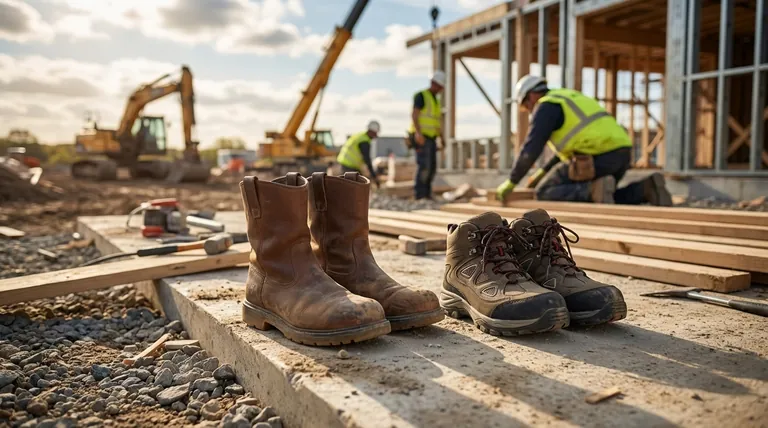
The Core Difference: Convenience vs. Customization
The most significant distinction between pull-on and lace-up boots lies in their closure systems, which dictates their primary strengths and weaknesses.
The Unmatched Speed of Pull-On Boots
The slip-on design is the defining feature of a pull-on boot. This provides a clear advantage in speed and ease of use.
There are no laces to tie, adjust, or come undone during the day. This reduces a potential tripping hazard and is ideal for workers who frequently move between clean and dirty environments.
The Precise Fit of Lace-Up Boots
Lace-up boots offer a highly customizable fit that pull-on boots cannot match.
By adjusting the lacing, you can fine-tune tightness across different parts of your foot, accommodating unique foot shapes or thicker socks. This ability to create a secure lockdown is critical for stability.
A Deeper Look at Support and Durability
While both styles aim to protect your feet, they achieve it through different structural priorities. How they support you and how they wear out over time are key differentiators.
Ankle Support: The Lace-Up Advantage
Lace-up boots provide significantly more ankle support. The lacing system allows you to securely wrap the boot around your ankle, reducing the risk of rolls and sprains on uneven or shifting surfaces.
Pull-on boots, by design, have a wider opening and offer minimal ankle stabilization. This makes them less suitable for logging, heavy construction, or hiking over rough terrain.
Structural Integrity and Wear Points
Pull-on boots possess a simpler construction with fewer potential failure points. Without eyelets to bend or laces to snap, the upper part of the boot often maintains its structural integrity for longer.
Conversely, laces and eyelets on other boots are common areas for wear and tear. However, a poor-fitting pull-on can lead to excessive rubbing and premature wear on the interior lining, especially around the heel.
The Importance of a Perfect Initial Fit
The lack of adjustability in pull-on boots makes the initial sizing absolutely critical. An improper fit can lead to heel slippage, blisters, or a general lack of security, which can be both uncomfortable and unsafe.
You must ensure the size is correct from the start, as there is no way to tighten the boot once it's on your foot.
Understanding the Trade-offs
Choosing footwear is an exercise in balancing competing benefits. Understanding the inherent compromises in each design is key to making an informed decision.
Comfort: Cushioning vs. Security
Both boot types can feature advanced cushioning and arch support. All-day comfort is a goal for any quality work boot.
However, the feeling of comfort differs. In pull-on boots, it comes from a seamless interior and freedom of movement. In lace-ups, it comes from a sense of security and the foot being held firmly in place, eliminating micro-movements that cause fatigue.
Safety: Tripping Hazards vs. Loose Fit
Pull-on boots eliminate the trip hazard posed by untied laces, a clear safety benefit in environments with moving machinery or debris.
However, a loose-fitting pull-on boot can be its own safety risk. It may slip off at a critical moment or cause instability that leads to a fall. A secure fit is a crucial component of personal protective equipment.
Making the Right Choice for Your Work
To select the best boot, analyze your daily responsibilities and environment with objectivity. Your goal is to align the boot's strengths with your primary needs.
- If your primary focus is speed and convenience: Pull-on boots are the superior choice, especially if you change footwear often or work in relatively flat, predictable environments.
- If your primary focus is ankle support and stability: Lace-up boots are non-negotiable for work on uneven terrain, ladders, or when carrying heavy loads.
- If your primary focus is accommodating a unique foot shape: The adjustability of lace-up boots provides a more reliable and secure fit.
- If your primary focus is minimizing potential snagging or tripping hazards: Pull-on boots offer a streamlined and safer design by eliminating laces entirely.
Ultimately, the right work boot is the one that provides the appropriate level of protection and support for your specific task, ensuring both safety and productivity.
Summary Table:
| Feature | Pull-On Boots | Lace-Up Boots |
|---|---|---|
| Primary Strength | Speed & Convenience | Adjustable Fit & Ankle Support |
| Best For | Quick changes, flat terrain | Uneven ground, heavy lifting |
| Ankle Support | Minimal | Superior |
| Durability Factor | Fewer failure points (no laces/eyelets) | Laces/eyelets can wear |
| Key Consideration | Perfect initial fit is critical | Can be fine-tuned for a secure fit |
Need the Perfect Work Boot for Your Team?
As a large-scale manufacturer, 3515 produces a comprehensive range of durable footwear for distributors, brand owners, and bulk clients. Whether your workforce needs the speed of pull-on boots or the superior support of lace-ups, we have the production capabilities and expertise to deliver.
We help you:
- Enhance worker safety and productivity with the right boot for the job.
- Streamline your supply chain with reliable, high-volume manufacturing.
- Build your brand with custom footwear solutions.
Let's discuss your specific needs. Contact our team today for a consultation.
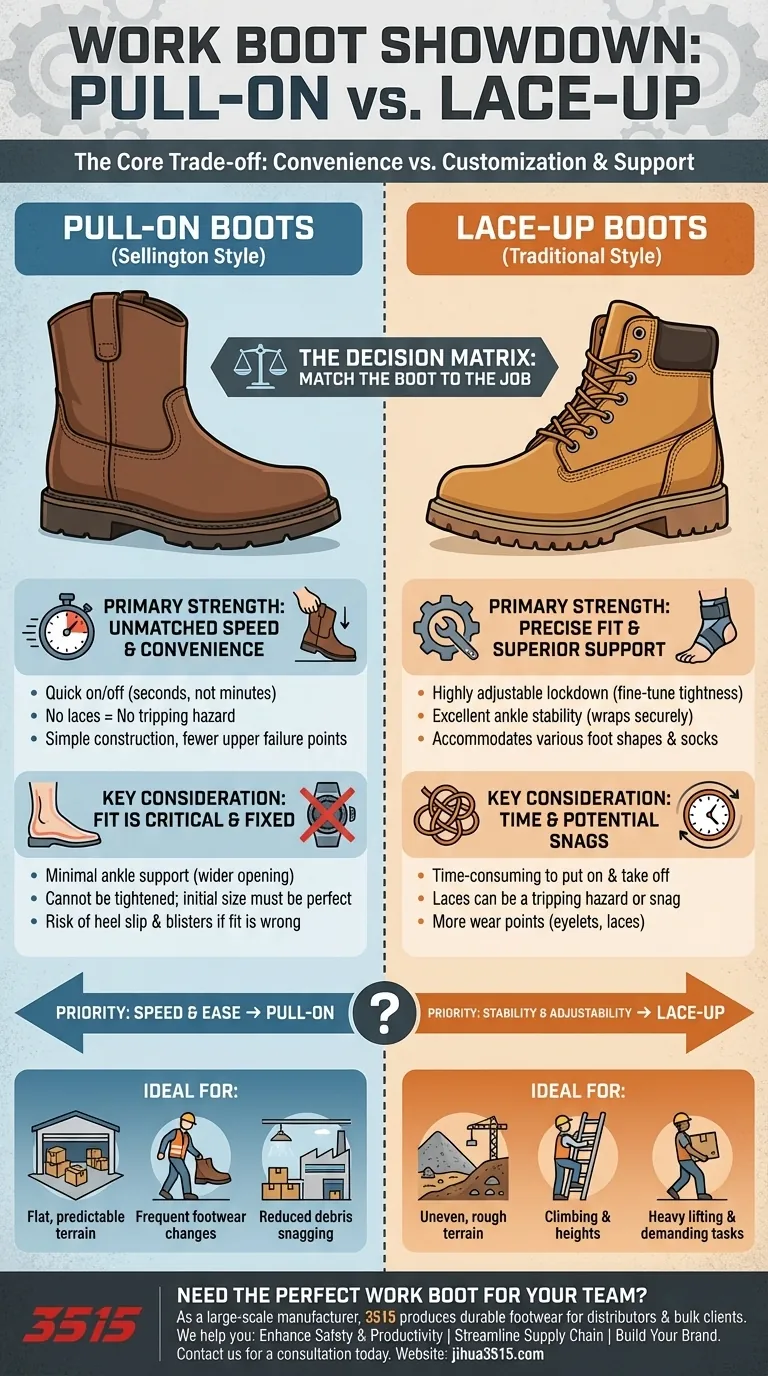
Visual Guide
Related Products
- Wholesale Leather Work Boots with Customizable Wedge Sole for Brands
- Durable Leather Moc Toe Work Boots for Wholesale & Custom Manufacturing
- Durable Leather Work Boots for Wholesale & Custom Manufacturing
- Durable Moc-Toe Wedge Work Boots | Wholesale Manufacturing for Brands
- Durable Goodyear Welt Leather Work Boots for Wholesale & Private Label
People Also Ask
- What is the difference between full-grain and top-grain leather? Premium Material Guide for Boot Manufacturers
- What are the advantages of leather as an upper material for work boots? Unmatched Durability & Custom Comfort
- How can leather work boots be protected from environmental elements? A 3-Step Guide to Lasting Durability
- What is the complete process for deep cleaning leather work boots? A Step-by-Step Guide to Preserve Your Investment
- What are the key qualities of leather for work boots? Superior Durability, Breathability & Custom Fit