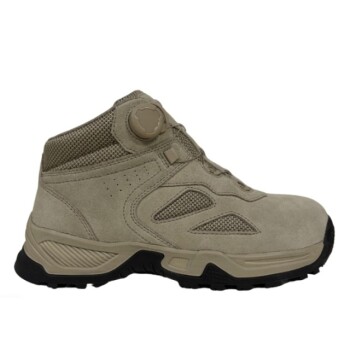
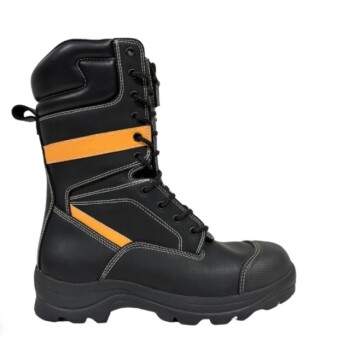
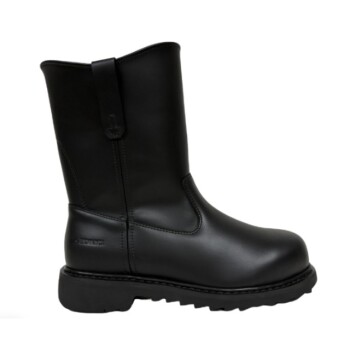
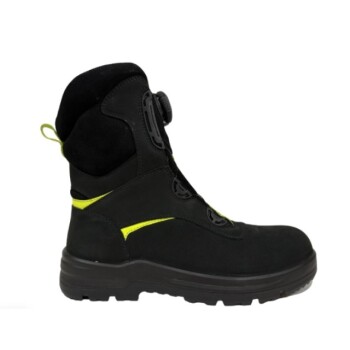
Integrated mechanical dial quick-release systems represent a critical evolution in fire safety footwear, directly addressing the need for speed and stability. By utilizing knobs and high-strength steel wires to replace standard laces, these systems enable firefighters to don or remove boots rapidly while ensuring a precise, locked-in fit that standard lacing cannot consistently replicate.
In high-stakes rescue environments, these systems bridge the gap between readiness and safety. They eliminate the latency of tying laces and the danger of tripping hazards, ensuring the boot functions as a seamless extension of the operator.
The Mechanics of Rapid Response
Speed of Donning and Doffing
In rescue operations, response time is the single most valuable metric. Integrated dial systems allow firefighters to secure their boots in seconds simply by turning a knob.
This eliminates the time-consuming process of manually tightening and tying laces. Equally important is the ability to quickly release the boot (doffing) after a long mission or in the event of an injury requiring immediate foot access.
The Steel Wire Advantage
Instead of fabric laces, which can stretch, fray, or absorb water, these systems utilize high-strength steel wires.
These wires provide a robust closing mechanism that withstands the rigors of an emergency environment. They maintain tension consistently, ensuring the boot does not loosen as the materials shift during movement.
Enhancing Stability and Safety
Eliminating Trip Hazards
One of the most dangerous, yet overlooked, risks in a fire rescue scenario is a loose lace. Traditional laces can untie or snag on debris, creating a severe tripping hazard.
Mechanical dial systems contain the lacing mechanism internally. There are no dangling ends or loops to catch on rebar, furniture, or rough terrain, significantly improving the firefighter's safety profile.
Achieving a Precise, Secure Wrap
A boot that fits poorly compromises agility. The dial system allows for a customized, micro-adjustable fit that creates a secure wrap around the foot.
This "locked-in" feel is essential for long-duration missions. It stabilizes the foot and ankle, reducing fatigue and preventing the internal slippage that often leads to blisters or rolled ankles.
Understanding the Operational Trade-offs
While the benefits of mechanical systems are clear, relying on a mechanism rather than a knot introduces specific considerations.
Mechanical Complexity
Unlike a traditional lace, which can be easily knotted if it breaks, a mechanical dial is a complex assembly. While rare, damage to the knob mechanism due to high impact could potentially render the tightening system inoperable until repaired.
Field Repairability
Replacing a snapped steel wire or a jammed dial in the field is more difficult than replacing a fabric lace. Users must weigh the massive advantage in daily speed and fit against the slight risk of mechanical damage in extreme scenarios.
Making the Right Choice for Your Mission
When selecting footwear for rescue operations, the choice between dials and laces depends on your specific operational priorities.
- If your primary focus is rapid response time: The dial system is superior, offering the fastest possible transition from rest to readiness.
- If your primary focus is safety in debris-heavy environments: The snag-free design of the integrated system minimizes trip hazards and entanglement risks.
Adopting this technology transforms the boot from a passive protective layer into an active tool that enhances both speed and stability.
Summary Table:
| Feature | Mechanical Dial System | Traditional Lacing |
|---|---|---|
| Donning Speed | Instant (Seconds) | Slow (Manual Tying) |
| Fit Consistency | Micro-adjustable & Locked-in | Prone to Stretching/Loosening |
| Safety Profile | Snag-free; No Trip Hazards | High Risk of Untying/Snagging |
| Durability | High-strength Steel Wire | Fabric (Fraying/Water Absorption) |
| Repairability | Mechanical Assembly (Expert) | Simple (User Replaceable) |
Partner with 3515 for High-Performance Safety Footwear
As a large-scale manufacturer serving distributors and brand owners, 3515 offers comprehensive production capabilities for all footwear types, anchored by our flagship Safety Shoes series. Our integrated dial systems are designed to provide the rapid response and stability required in life-saving missions.
Our extensive portfolio covers work and tactical boots, outdoor shoes, training shoes, and sneakers, as well as Dress & Formal shoes to meet your diverse bulk requirements.
Ready to elevate your product line with advanced safety technology? Contact us today to discuss your wholesale or OEM needs and discover the value we bring to your brand.
References
- Marianna Tomašková, Jozef Krajňák. Features and Sustainable Design of Firefighting Safety Footwear for Fire Extinguishing and Rescue Operations. DOI: 10.3390/su152015108
This article is also based on technical information from 3515 Knowledge Base .
Related Products
- Premium Wholesale Tactical Style Safety Shoes Boots with Quick Lacing
- Premium Wholesale Wheat Nubuck Safety Boot with Rapid Lacing System
- High Performance Fire-Retardant Waterproof Safety Boots
- Wholesale Lightweight Tactical Boots with Dial Closure OEM & Bulk Orders
- Premium Flame-Retardant Waterproof Safety Boots and Shoes
People Also Ask
- How are gait analysis research findings applied to the functional design of safety shoes and tactical boots?
- How do quality certification standards for safety shoes reduce perceived risk? Buy Online with Technical Certainty
- How does anthropomorphic design influence material selection? Enhance Footwear Performance through Biological Alignment
- Why is the synchronization of craftsmanship and UX development emphasized for bulk customization of safety shoes?
- How can specialized footwear mitigate safety risks? High-Volume OEM/ODM Solutions since 1951