
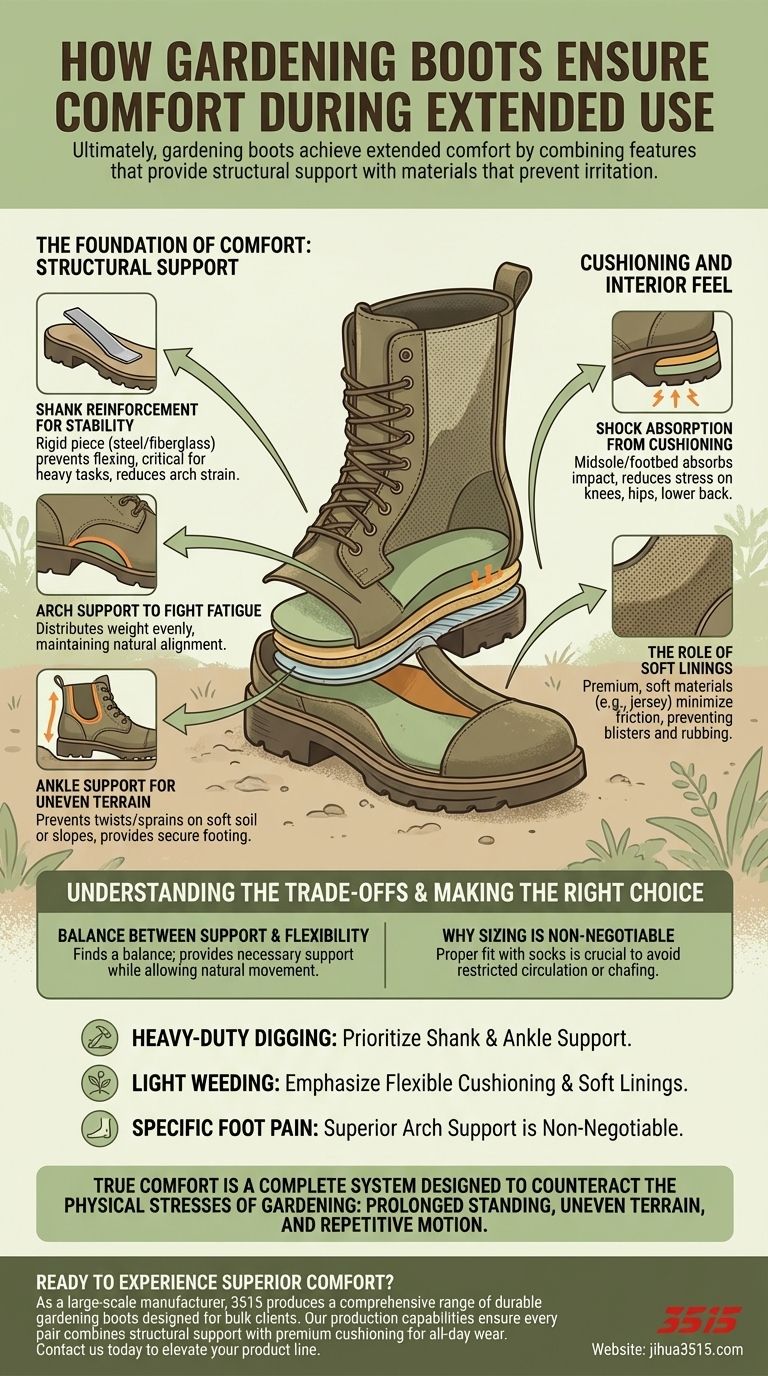
Ultimately, gardening boots achieve extended comfort by combining features that provide structural support with materials that prevent irritation. Key elements include shank-reinforced designs for stability, ample cushioning for shock absorption, and soft interior linings to prevent blisters and rubbing.
True comfort in a gardening boot isn't about a single feature, but a complete system designed to counteract the specific physical stresses of gardening—prolonged standing, uneven terrain, and repetitive motion.
The Foundation of Comfort: Structural Support
The most significant source of foot fatigue comes from a lack of proper support. Quality gardening boots are engineered to function as a stable platform for your entire body.
Shank Reinforcement for Stability
A shank is a rigid piece of material, often steel or fiberglass, built into the sole of the boot between the heel and the ball of the foot.
This reinforcement prevents the boot from flexing in the middle, which is critical when pressing down on a shovel or navigating uneven ground. It provides stability and reduces the strain on your arches.
Arch Support to Fight Fatigue
Proper arch support is essential for distributing your weight evenly across your feet during long hours of standing or walking.
Without it, the muscles and ligaments in your feet can become strained, leading to pain and fatigue. Good arch support helps maintain your foot's natural alignment.
Ankle Support for Uneven Terrain
Gardening rarely happens on a perfectly flat surface. Good boots provide ankle support to prevent twists and sprains when walking on soft soil, slopes, or around obstacles.
This stability gives you a more secure footing, allowing you to move with confidence and reducing the micro-adjustments your muscles would otherwise have to make.
Cushioning and Interior Feel
While structure prevents strain, the interior components provide immediate, tactile comfort and protect your skin.
Shock Absorption from Cushioning
Every step you take sends impact through your feet and up into your joints. Ample cushioning in the midsole and footbed acts as a shock absorber.
This feature is critical for reducing the cumulative stress on your knees, hips, and lower back over a long day in the yard.
The Role of Soft Linings
The inside of the boot is just as important as the outside. Premium, soft linings, such as jersey, are used to minimize friction against your skin.
This simple feature is the primary defense against the rubbing that causes irritation, hot spots, and painful blisters during extended wear.
Understanding the Trade-offs
Choosing the right boot involves balancing competing needs. No single boot is perfect for every task or person.
The Balance Between Support and Flexibility
An extremely rigid boot offers maximum support for heavy digging but can feel restrictive for lighter tasks. A highly flexible boot is comfortable for walking but offers little protection.
The best design finds a balance, providing shank and ankle support where needed while allowing for natural foot movement.
Why Sizing Is Non-Negotiable
Even the best-designed boot will fail if the fit is wrong. Proper sizing is crucial for comfort and performance.
You must account for the thickness of your socks. A boot that is too tight can restrict circulation, while a boot that is too loose will cause your foot to slide, leading to instability and chafing.
Making the Right Choice for Your Goal
Select your boot based on the primary demands of your gardening tasks.
- If your primary focus is heavy-duty digging and landscaping: Prioritize boots with robust shank reinforcement and excellent ankle support.
- If your primary focus is light weeding and planting: Emphasize flexible cushioning and soft, breathable interior linings for all-day comfort.
- If you struggle with specific foot pain: Make superior arch support your non-negotiable starting point.
Investing in footwear designed for the task is the most effective way to ensure comfort and prevent fatigue.
Summary Table:
| Comfort Feature | Key Benefit |
|---|---|
| Shank Reinforcement | Provides stability and prevents flexing on uneven ground. |
| Arch Support | Distributes weight evenly to reduce foot strain and fatigue. |
| Ankle Support | Prevents twists and sprains, offering secure footing. |
| Shock Absorption | Cushions impact to protect joints from repetitive stress. |
| Soft Interior Linings | Minimizes friction to prevent blisters and skin irritation. |
Ready to experience superior comfort? As a large-scale manufacturer, 3515 produces a comprehensive range of durable gardening boots designed for distributors, brand owners, and bulk clients. Our production capabilities ensure every pair combines structural support with premium cushioning for all-day wear. Contact us today to discuss your footwear needs and elevate your product line with boots built for performance and comfort.
Visual Guide
Related Products
- Durable Goodyear Welt Leather Work Boots for Wholesale & Private Label
- Factory Direct Wholesale Rain Boots Durable Waterproof & Fully Customizable
- Wholesale High-Traction Camo Boots - Custom Manufacturer for Brands
- Wholesale Tactical Boots High-Traction & Reflective for Bulk & Brand Orders
- Durable Moc-Toe Wedge Work Boots | Wholesale Manufacturing for Brands
People Also Ask
- What is the difference between full-grain and top-grain leather? Premium Material Guide for Boot Manufacturers
- What are the advantages of leather as an upper material for work boots? Unmatched Durability & Custom Comfort
- Why is it important to waterproof leather work boots? Protect Your Investment and Performance
- How should new leather work boots be broken in? A Guide to Comfort and Durability
- What are the advantages of leather uppers in work boots? Unmatched Durability & Protection

















