
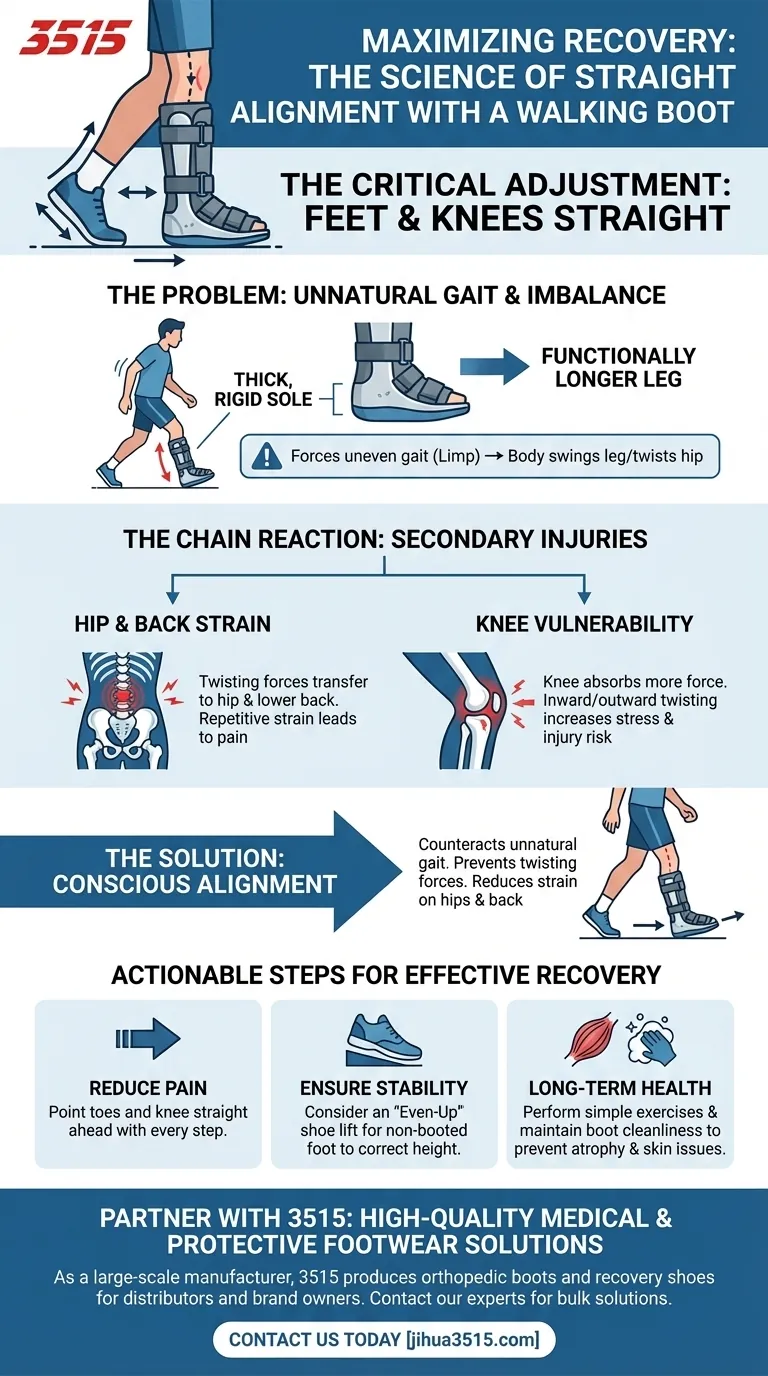
Keeping your feet and knees straight is a critical adjustment when wearing a walking boot because it directly counteracts the unnatural gait the boot creates. This conscious alignment prevents twisting forces from traveling up your leg, which reduces strain on your hips and back and minimizes the risk of secondary injuries.
A walking boot is a tool for healing one injury, but it forces an unnatural imbalance on your entire body. The key to a successful recovery is understanding that you're not just healing your foot—you're managing a temporary, full-body mechanical problem.
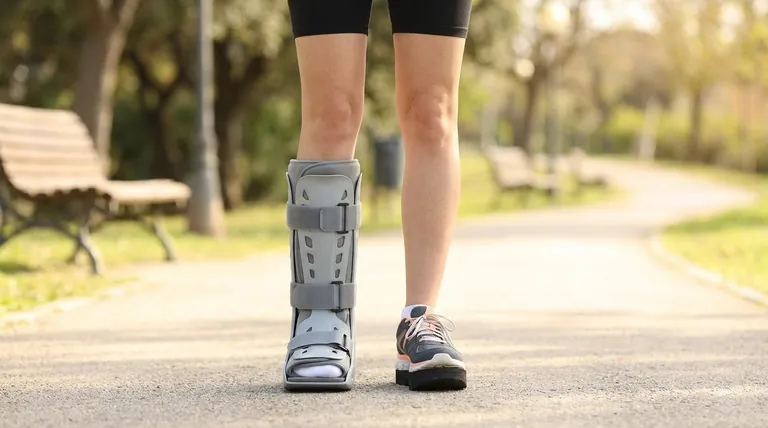
The Root Problem: An Unnatural Gait
Why the Boot Creates a Limp
A walking boot, by design, has a thick, rigid sole. This almost always makes the injured leg functionally longer than your uninjured leg.
This height difference forces you to adopt an uneven gait, or a limp, to compensate. Your body has to adjust with every single step you take.
The Source of Twisting Forces
To manage this unevenness, your body naturally wants to swing the booted leg outward or twist at the hip. This limping motion is the root cause of the strain that can develop in other joints.
The Chain Reaction of Misalignment
Strain on Your Hips and Back
When you fail to keep your foot and knee pointing forward, the twisting motion from your limp is transferred directly to your hip joint and lower back.
This repetitive, uneven strain can lead to significant pain and discomfort in areas that were not part of your original injury.
Vulnerability of the Knees
While your ankle is immobilized, your knee must absorb more force and movement than usual.
This added burden can cause the knee to fatigue quickly. If you also allow it to twist inward or outward, you place even more stress on the joint, increasing the risk of pain or further injury.
Common Pitfalls and How to Avoid Them
Ignoring Muscle Atrophy
The muscles in your lower leg are immobilized by the boot and will weaken over time if not addressed.
Your doctor or physical therapist may recommend simple exercises, like tensing and relaxing the muscles inside the boot, to help maintain strength and tone.
Neglecting Skin and Boot Care
It's vital to regularly check the skin on your foot and toes for redness or swelling, which could indicate the boot is too tight.
You must also keep the boot's liner clean to prevent skin irritation. Hand wash it with mild detergent and let it air dry completely.
Overlooking Safety Hazards
The sole of a walking boot can be very slippery, especially on wet or smooth surfaces.
Always exercise extreme caution when walking on potentially hazardous ground to prevent a fall, which could worsen your existing injury or cause a new one.
Making the Right Choice for Your Recovery
To minimize complications, you must be proactive. Your goal is not just to let your foot heal, but to protect the rest of your body from the side effects of the healing process.
- If your primary focus is reducing hip and back pain: Consciously point your toes and knee straight ahead with every step to prevent the transfer of twisting forces.
- If your primary focus is overall stability: Ask your doctor about an "Even-Up" shoe lift for your non-booted foot to correct the height discrepancy and promote a more natural gait.
- If your primary focus is long-term health: Follow your doctor's advice on simple muscle exercises and diligent boot care to prevent secondary issues like muscle atrophy and skin problems.
By actively managing your gait and caring for your equipment, you empower your body to heal correctly and efficiently.
Summary Table:
| Misalignment Issue | Consequence | Solution |
|---|---|---|
| Leg Length Discrepancy | Uneven gait (limp) | Use a shoe lift on the other foot |
| Foot/Knee Twisting Outward | Strain on hips and back | Consciously point foot and knee straight ahead |
| Muscle Atrophy | Weakness in the immobilized leg | Perform recommended muscle exercises |
| Slippery Boot Sole | Risk of falling | Exercise extreme caution on smooth/wet surfaces |
Ensure a Safe and Effective Recovery with the Right Footwear
As a large-scale manufacturer, 3515 produces a comprehensive range of medical and protective footwear for distributors, brand owners, and bulk clients. Our production capabilities encompass all types of orthopedic boots and recovery shoes designed for stability and comfort.
If you are a medical supplier or retailer looking for reliable walking boots to support your customers' recovery journeys, contact our experts today to discuss your needs and discover how we can provide high-quality, bulk footwear solutions for your business.
Visual Guide
Related Products
- Wholesale Durable Camouflage Canvas Shoes with High-Traction Cleated Rubber Sole
- Durable Rubber Sole Outdoor Shoes Wholesale & Custom Manufacturing
- Durable Goodyear Welt Leather Work Boots for Wholesale & Private Label
- Wholesale High-Traction Camo Boots - Custom Manufacturer for Brands
- Heavy-Duty Waterproof Nubuck Safety Boots Safety Shoes for Bulk Supply
People Also Ask
- Why is the selection of high-strength fabric materials necessary in the production of canvas shoes and training shoes?
- What are the properties of canvas as a shoe material? A Guide to Lightweight Comfort & Style
- Can canvas shoes be worn in rainy conditions? The Truth About Water Resistance
- What are some examples of vulcanized shoes? Discover the Flexibility and Board Feel of Classic Sneakers
- What are the characteristics of canvas as a shoe material? A Guide to Lightweight, Breathable Footwear



















