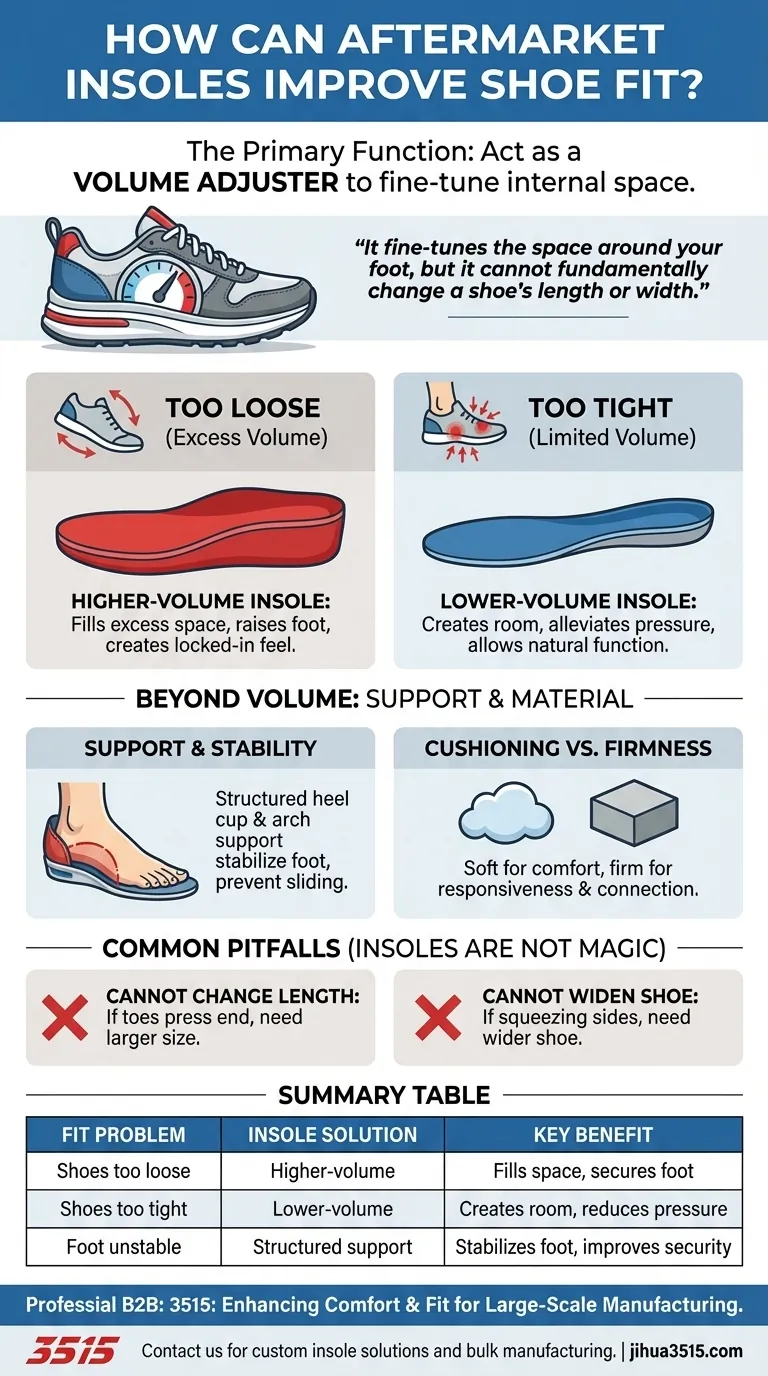
To improve shoe fit, aftermarket insoles work by altering the internal volume of your footwear. A thicker, higher-volume insole will take up more space to make a loose shoe feel snugger, while a thinner, lower-volume insole can create more room in a shoe that feels too tight.
The primary function of an aftermarket insole for fit correction is to act as a volume adjuster. It fine-tunes the space around your foot, but it cannot fundamentally change a shoe's length or width.
The Core Principle: Adjusting Internal Volume
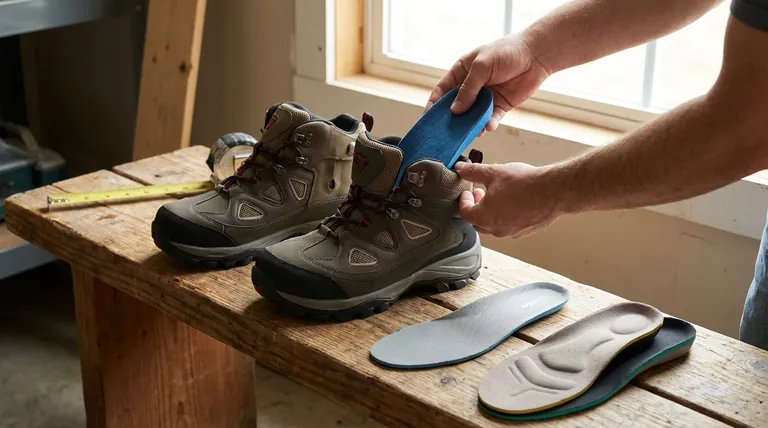
The most significant way an insole changes fit is by modifying the amount of space inside your shoe. Stock insoles that come with shoes are often simple, compressible foam placeholders.
For Shoes That Are Too Loose
If your foot slides around or your heel lifts excessively, your shoe has too much internal volume.
A higher-volume or thicker insole fills this excess space. This effectively raises your foot, pressing it more securely against the top and sides of the shoe for a locked-in feel.
For Shoes That Are Too Tight
If you feel pressure on the top of your foot or the shoe feels cramped, you need to create more space.
Replacing the stock insole with a lower-volume or thinner one can free up critical millimeters of room. This can alleviate pressure and give your foot more space to function naturally.
Beyond Volume: The Role of Shape and Support
While volume is the primary factor, the specific shape and material of the insole also play a crucial role in the sensation of fit.
How Support Improves Fit
A well-designed insole with a structured heel cup and arch support does more than just fill space. It cradles your foot.
This structure helps to stabilize your foot, preventing it from sliding forward or side-to-side. This stability can make a correctly sized shoe feel much more secure and responsive.
Cushioning vs. Firmness
The material directly impacts how the fit feels. A soft, cushioned insole can provide a snug, plush sensation, conforming to your foot's shape.
Conversely, a firmer, more rigid insole provides a more precise and connected feel to the shoe, which is often preferred for performance activities where stability is paramount.
Common Pitfalls to Avoid
Insoles are a powerful tool for refinement, but they are not a magic solution for a fundamentally incorrect shoe size.
Insoles Cannot Change Shoe Length
An insole cannot fix a shoe that is too short. If your toes are pressing against the end of the shoe, you need a larger size.
Insoles Cannot Widen a Shoe
Similarly, if the shoe is too narrow and squeezing the sides of your foot, a different insole will not change the width of the shoe's sole and upper. You need a wider shoe.
Creating New Problems
Be aware that adding a very thick insole can sometimes create new issues. It might raise your heel too high, causing it to slip out of the shoe, or push the top of your foot uncomfortably against the laces.
How to Apply This to Your Fit Problem
Begin by identifying the specific issue you want to solve before choosing an insole.
- If your primary focus is making a loose shoe snugger: You need a higher-volume insole to fill the excess space and secure your foot.
- If your primary focus is creating space in a tight shoe: You need a lower-volume insole to reduce pressure and increase room.
- If your primary focus is reducing foot slippage or instability: Look for an insole with a deep, structured heel cup and appropriate arch support to stabilize your foot.
Ultimately, selecting the right insole is about matching its volume and shape to your specific foot and shoe combination.
Summary Table:
| Fit Problem | Insole Solution | Key Benefit |
|---|---|---|
| Shoes too loose | Use a higher-volume, thicker insole | Fills excess space, secures foot, prevents slippage |
| Shoes too tight | Use a lower-volume, thinner insole | Creates more room, reduces pressure on foot |
| Foot feels unstable | Use an insole with structured heel cup & arch support | Stabilizes foot, improves responsiveness & security |
Struggling with inconsistent shoe fit across your product line? As a large-scale manufacturer, 3515 produces a comprehensive range of footwear for distributors, brand owners, and bulk clients. Our production capabilities encompass all types of shoes and boots, and we can integrate custom insole solutions directly into your footwear designs to ensure a perfect fit for your customers from the first wear. Let us help you enhance comfort, reduce returns, and boost customer satisfaction. Contact 3515 today to discuss your manufacturing needs and perfect your footwear's fit.
Visual Guide
Related Products
- Lightweight Breathable Sneakers with Wet-Traction Grip for Wholesale & Private Label
- Wholesale Breathable Athletic Sneakers - Custom Lightweight Cushioned Footwear Manufacturer
- Wholesale Lightweight Cushioned Athletic Sneakers for Custom Bulk Production
- Wholesale Durable Safety Boots Manufacturer Customizable Steel Toe Work Boots
- Lightweight Breathable Training Shoes for Wholesale & Custom OEM Manufacturing
People Also Ask
- Why are breathable sneakers necessary for tropical commuting? Stay Cool and Dry in High Humidity
- What role do lightweight training shoes play in urban traffic? Boost Agility and Reaction for Safer City Navigation
- How do lightweight shoes provide support? The Science of Efficient Cushioning & Stability
- How do lightweight shoes contribute to healthier feet? Reduce Fatigue & Prevent Foot Problems
- What are the style advantages of lightweight shoes? Sleek, Versatile & Modern Comfort