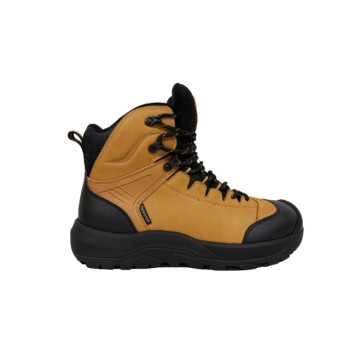
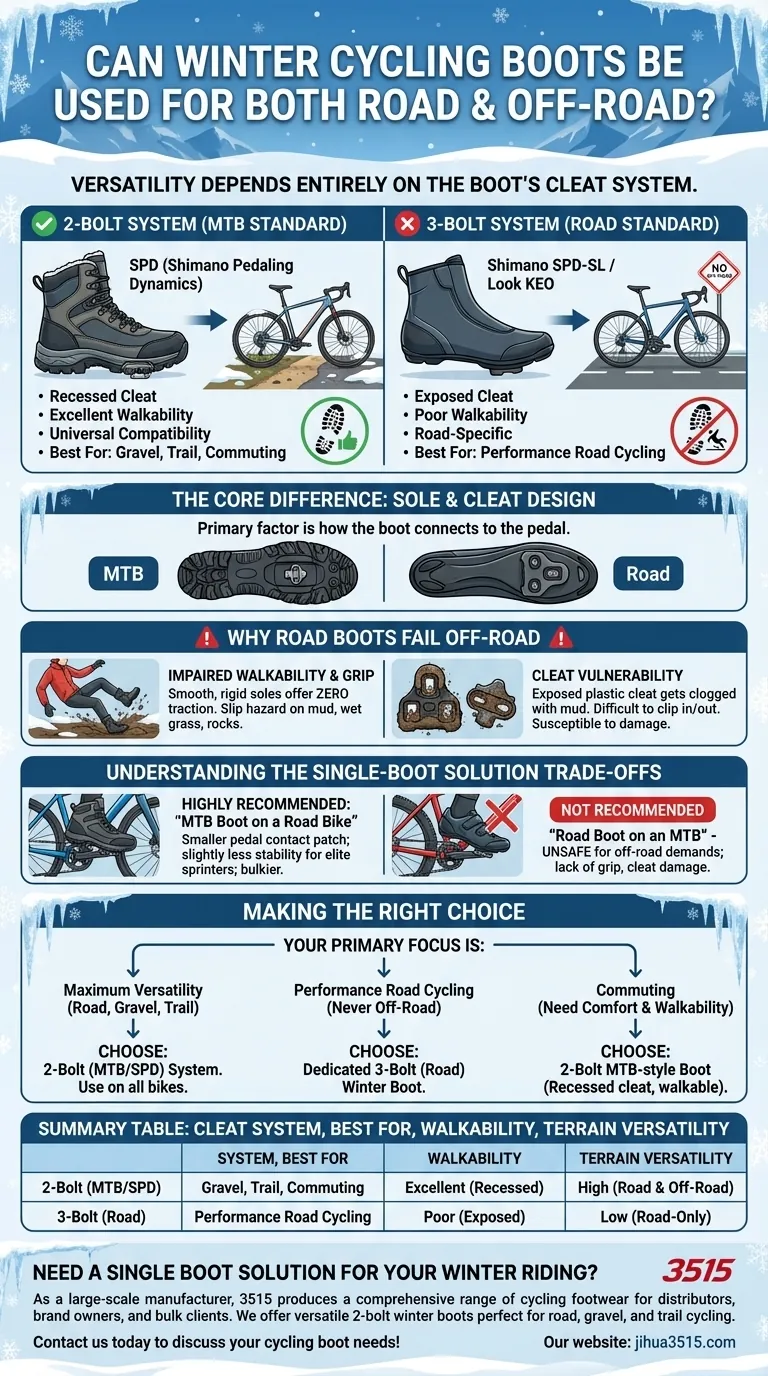
Yes, some winter cycling boots can be used for both road and off-road riding, but this versatility depends entirely on the boot's cleat system. The most adaptable models are those designed for a 2-bolt mountain bike (MTB) style cleat, which can be used with the appropriate pedals on any bike. Conversely, winter boots built exclusively for 3-bolt road cleats are unsuitable for any off-road use.
The central decision in choosing a versatile winter boot is not about the terrain, but about the sole. A boot with a 2-bolt cleat system offers universal compatibility and walkability, making it the practical one-boot solution, while a 3-bolt system prioritizes road-specific power transfer at the cost of all versatility.
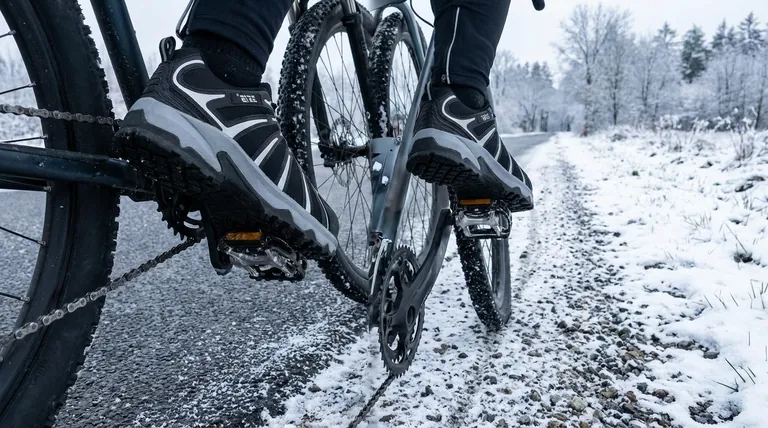
The Core Difference: Cleat and Sole Design
The primary factor dictating a boot's use case is how it connects to the pedal. This is determined by the bolt pattern on the sole, which falls into two main categories.
The 2-Bolt System (MTB Standard)
The 2-bolt system, commonly known as SPD (Shimano Pedaling Dynamics), is the standard for mountain biking, gravel riding, and commuting.
Its defining feature is a small metal cleat that attaches to the shoe with two bolts. This cleat is recessed into the boot's treaded outsole, keeping it from making contact with the ground when you walk. This design provides excellent walkability and grip on slick or uneven surfaces.
The 3-Bolt System (Road Standard)
The 3-bolt system, used by systems like Shimano SPD-SL and Look KEO, is the standard for performance road cycling.
It uses a large, plastic cleat that provides a wide, stable platform against the pedal. This maximizes power transfer and stability during high-intensity road efforts. However, this cleat is fully external, making the boots extremely difficult and awkward to walk in.
Why Road Boots Fail Off-Road
Using a winter boot with a 3-bolt road cleat for any off-road or mixed-terrain riding is impractical and unsafe for two critical reasons.
Impaired Walkability and Grip
Road boot soles are typically smooth and rigid, offering zero traction. Attempting to walk on mud, wet grass, or rocks is a significant slip hazard. Even a brief dismount to navigate an obstacle becomes treacherous.
Cleat Vulnerability
The exposed plastic road cleat is easily clogged with mud and debris. This can prevent you from securely clipping into or out of your pedal, which is a major safety risk. The cleat itself is also susceptible to damage from walking on hard, uneven surfaces.
Understanding the Trade-offs of a Single-Boot Solution
For cyclists who ride both road and trails in the winter, the most effective strategy is to standardize on a single pedal system. This almost always means using MTB-style pedals and boots across all bikes.
The "MTB Boot on a Road Bike" Scenario
This is the most common and highly recommended approach for a one-boot quiver. You equip all your bikes with 2-bolt compatible pedals.
The primary trade-off is a smaller pedal contact patch compared to a dedicated road system. While most riders will never notice a difference, some elite racers may feel it offers slightly less stability during an all-out sprint. These boots can also be bulkier than their sleek road-specific counterparts.
The "Road Boot on an MTB" Scenario
This approach is not recommended under any circumstances. The complete lack of grip and the vulnerability of the cleat system make it fundamentally incompatible with the demands of off-road riding, where dismounting is often necessary.
Making the Right Choice for Your Cycling
Your decision should be guided by the type of riding you do most and your tolerance for compromise.
- If your primary focus is maximum versatility for road, gravel, and trail riding: Choose a winter boot with a 2-bolt (MTB/SPD) cleat system and use corresponding pedals on all your bikes.
- If your primary focus is performance road cycling and you never go off-road: A dedicated 3-bolt (road-specific) winter boot will offer the best power transfer and a familiar pedaling platform.
- If your primary focus is commuting and you need to walk comfortably and safely: The 2-bolt MTB-style boot is the only practical option due to its recessed cleat and walkable sole.
Ultimately, selecting your winter boot based on its sole and cleat system is the key to a safe, warm, and effective cold-weather riding season.
Summary Table:
| Cleat System | Best For | Walkability | Terrain Versatility |
|---|---|---|---|
| 2-Bolt (MTB/SPD) | Gravel, Trail, Commuting | Excellent (recessed cleat) | High (Road & Off-Road) |
| 3-Bolt (Road) | Performance Road Cycling | Poor (exposed cleat) | Low (Road-Only) |
Need a single boot solution for all your winter riding?
As a large-scale manufacturer, 3515 produces a comprehensive range of cycling footwear for distributors, brand owners, and bulk clients. Our production capabilities encompass all types of shoes and boots, including versatile 2-bolt winter boots perfect for road, gravel, and trail cycling.
We can help you provide your customers with the right footwear for a safe and warm riding season. Contact us today to discuss your cycling boot needs!
Visual Guide
Related Products
- Premium Insulated Safety Boots and Shoes for Wholesale & Bulk Orders
- Factory Direct Wholesale Rain Boots Durable Waterproof & Fully Customizable
- Durable Waterproof Rain Boots | Custom Manufacturer for Wholesale & Brands
- Heavy-Duty Waterproof Nubuck Safety Boots Safety Shoes for Bulk Supply
- Durable Goodyear Welt Leather Work Boots for Wholesale & Private Label
People Also Ask
- What are the recommended insulation ratings for mild winter conditions? A Guide for Active & Stationary Workers
- How does insulation thickness correlate with temperature ranges? A Guide to Choosing the Right Warmth
- What insulation level is needed for severe cold and stationary work? 1200g or Higher is Essential
- What safety advantages do insulated boots offer beyond warmth? Dielectric Protection & Superior Grip
- How does fleece lining contribute to the warmth of insulated boots? Trapping Air for Superior Cold Protection