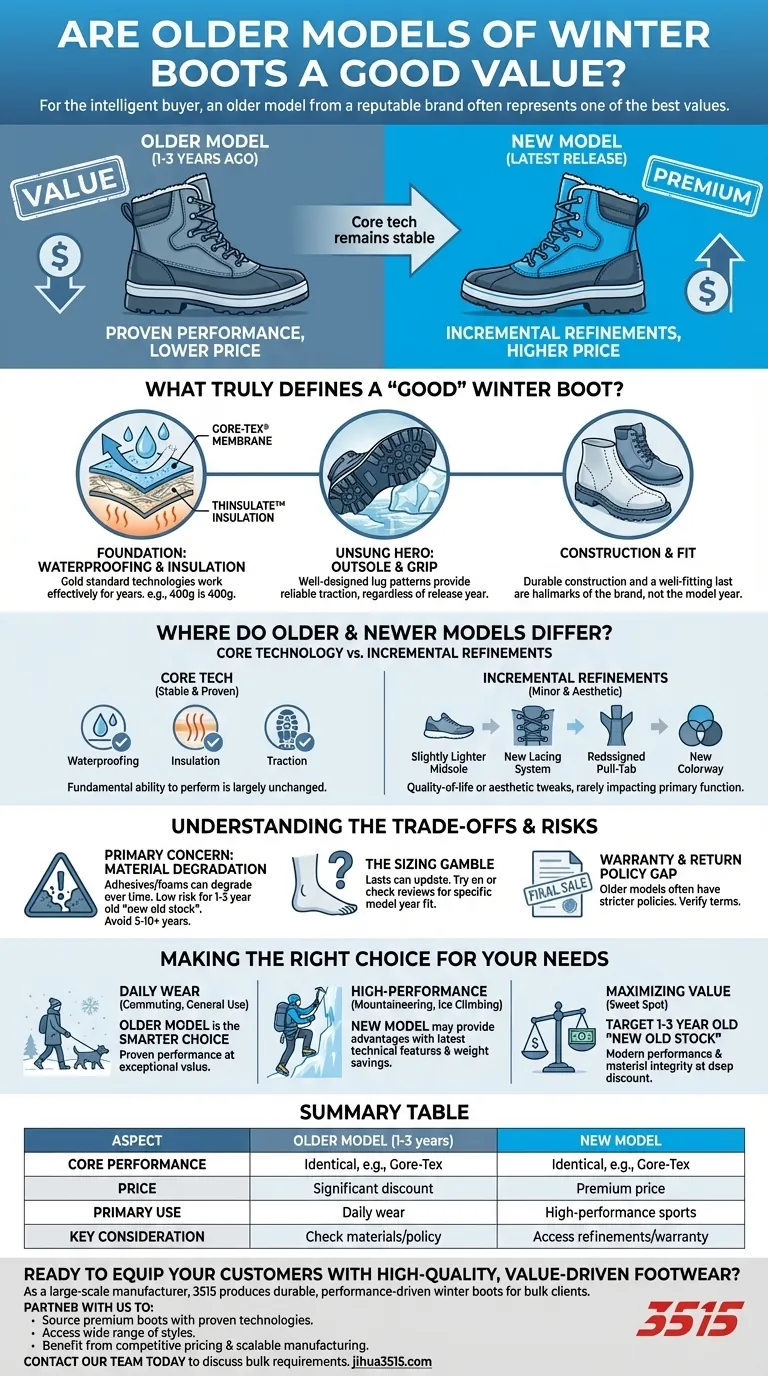
For the intelligent buyer, an older model of a winter boot from a reputable brand often represents one of the best values on the market. These boots typically retain the core technologies for warmth, waterproofing, and traction that truly matter, allowing you to acquire premium performance and comfort for a significantly lower price than the latest release.
The fundamental technologies that keep your feet warm and dry—like Gore-Tex membranes and Thinsulate insulation—have been industry standards for years. The key to finding value is understanding that you are often paying a premium for incremental refinements, not revolutionary breakthroughs.
What Truly Defines a "Good" Winter Boot?
Before comparing model years, it's critical to understand the foundational components of a high-quality winter boot. These core elements change very little over time, even as marketing campaigns highlight minor annual tweaks.
The Foundation: Waterproofing and Insulation
The primary job of a winter boot is to keep your feet warm and dry. This is achieved through a combination of a waterproof membrane and insulation.
Technologies like Gore-Tex have been the gold standard for decades for a reason: they work. A boot from two years ago with a Gore-Tex liner is just as waterproof as one released yesterday.
Similarly, the effectiveness of insulation is measured in grams (e.g., 200g, 400g). A boot with 400g of Thinsulate insulation from a past season provides the same level of warmth as a new one with the identical rating.
The Unsung Hero: The Outsole and Grip
Traction on snow and ice is determined by the rubber compound and the lug pattern of the outsole.
While manufacturers are always developing new proprietary rubber compounds, a well-designed, deep-lugged outsole from a top brand will provide excellent and reliable grip, regardless of its release year. The principles of traction do not undergo radical annual changes.
The Importance of Fit and Construction
A boot's comfort and durability come from its overall construction and the "last" (the foot-shaped mold it's built on). Reputable brands invest heavily in creating durable, well-fitting boots.
This core quality of construction is a hallmark of the brand itself, not the model year. An older, well-made boot will always outperform a poorly made new one.
Where Do Older and Newer Models Differ?
If the core technology is so stable, what are you giving up by choosing an older model? The differences are almost always at the margins.
Core Technology vs. Incremental Refinements
Most annual updates fall into the category of small refinements. This might include a slightly lighter midsole foam, a new lacing system for minor convenience, or a redesigned pull-tab.
These are quality-of-life improvements, but they rarely impact the boot's fundamental ability to perform its primary function.
Aesthetics and "Feather" Features
The most common and noticeable change from one season to the next is the colorway. If you are not set on having the latest trending color, you can find significant savings.
Other minor features, like a redesigned cuff or a new decorative stitch pattern, are purely aesthetic and have no bearing on performance.
Understanding the Trade-offs and Risks
Opting for an older model is a smart financial decision, but it requires awareness of a few potential pitfalls.
The Primary Concern: Material Degradation
This is the most important risk to consider. Adhesives, foams, and rubber can degrade over time, even in storage.
For boots that are 1-3 years old and sold as "new old stock" from a reputable retailer, this risk is extremely low. The danger increases significantly with boots that are 5-10+ years old or have been stored in poor conditions (like a hot warehouse).
The Sizing Gamble
Brands occasionally update their lasts, meaning a size 10 from one year might fit slightly differently than a size 10 from three years prior.
If possible, try on the boots or purchase from a retailer with a clear return policy. Check reviews from the specific model year you are considering for comments on fit.
The Warranty and Return Policy Gap
Older models sold on clearance often come with a "final sale" tag or a much stricter return policy. Always verify the terms before purchasing to ensure you are not stuck with a boot that doesn't fit.
Making the Right Choice for Your Needs
To decide if an older model is right for you, evaluate your primary use case.
- If your primary focus is daily wear and general use (e.g., commuting, shoveling snow, walking the dog): An older, discounted model is almost certainly the smarter choice, offering proven performance at an exceptional value.
- If your primary focus is high-performance winter sports (e.g., mountaineering, ice climbing): The specific technical features, crampon compatibility, and weight savings of the latest models may provide a meaningful advantage worth the extra cost.
- If your primary focus is maximizing value: Target "new old stock" boots from 1-3 seasons ago, as this is the sweet spot for obtaining modern performance and material integrity at a deep discount.
By prioritizing proven core function over fleeting seasonal features, you can confidently select a boot that will serve you well for years to come.
Summary Table:
| Aspect | Older Model (1-3 years) | New Model |
|---|---|---|
| Core Performance | Identical (e.g., Gore-Tex, Thinsulate) | Identical |
| Price | Significant discount | Premium price |
| Primary Use | Ideal for daily wear, general use | Best for high-performance sports |
| Key Consideration | Check material integrity & return policy | Access to latest refinements & full warranty |
Ready to Equip Your Customers with High-Quality, Value-Driven Footwear?
As a large-scale manufacturer, 3515 produces a comprehensive range of durable and performance-driven boots for distributors, brand owners, and bulk clients. Our production capabilities encompass all types of winter footwear, ensuring you get reliable products that meet market demands.
Partner with us to:
- Source premium winter boots built with proven technologies.
- Access a wide range of styles to suit various customer needs.
- Benefit from competitive pricing and scalable manufacturing.
Contact our team today to discuss your bulk footwear requirements and discover how we can add value to your supply chain.
Visual Guide
Related Products
- Premium Insulated Safety Boots and Shoes for Wholesale & Bulk Orders
- Factory Direct Wholesale Rain Boots Durable Waterproof & Fully Customizable
- Durable Waterproof Rain Boots | Custom Manufacturer for Wholesale & Brands
- Wholesale Waterproof Tactical Boots Custom Suede & High-Traction Soles
- Heavy-Duty Waterproof Nubuck Safety Boots Safety Shoes for Bulk Supply
People Also Ask
- What are the recommended insulation ratings for mild winter conditions? A Guide for Active & Stationary Workers
- How does insulation thickness correlate with temperature ranges? A Guide to Choosing the Right Warmth
- What insulation level is needed for severe cold and stationary work? 1200g or Higher is Essential
- What safety advantages do insulated boots offer beyond warmth? Dielectric Protection & Superior Grip
- How does fleece lining contribute to the warmth of insulated boots? Trapping Air for Superior Cold Protection