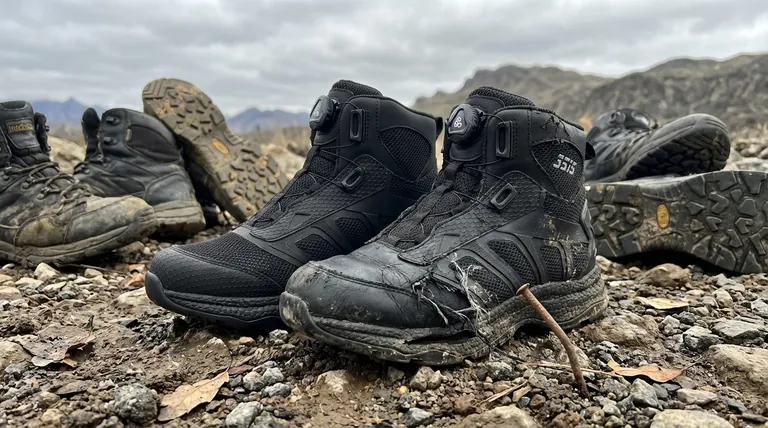
It’s a familiar scene in the quarterly budget review. The line item for footwear replacement is, once again, higher than projected. You see the reports: boots with separating soles, cracked leather, and worn-out waterproofing, all returned far before their expected service life is over.
Your team is equipped with what should be durable, high-performance gear. Yet, the cycle of issuing, failure, and replacement feels endless. It’s a constant drain on your budget, a logistical headache, and a persistent source of frustration.
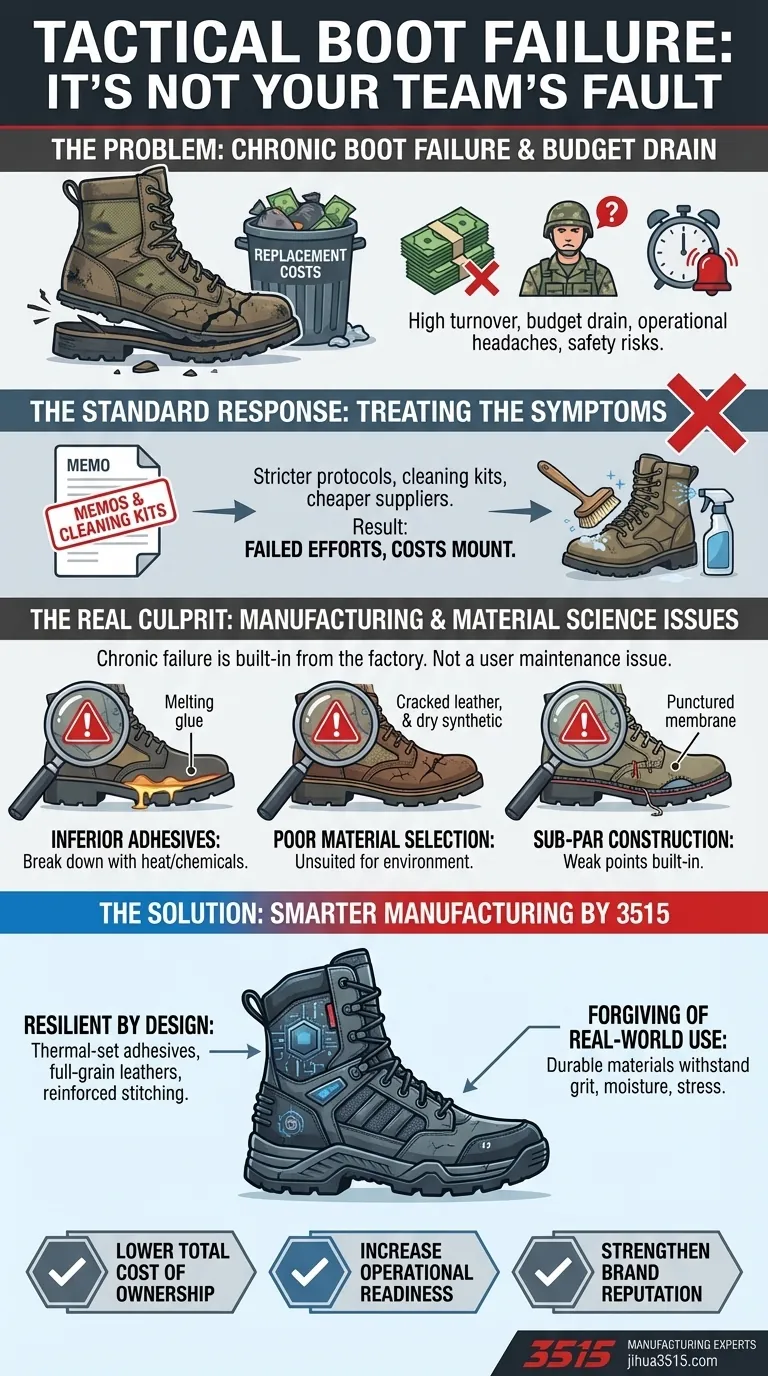
The Standard Response: More Memos, More Problems
When faced with high equipment turnover, the typical reaction is predictable. We assume the problem lies with the end-user.
First, we issue stricter maintenance protocols. Memos are sent out detailing the exact steps for cleaning, drying, and conditioning. We might even invest in official cleaning kits, hoping a standardized process will solve the issue. When that doesn't work, we might switch to a different, sometimes cheaper, supplier, attempting to offset the high replacement volume with a lower cost-per-unit.
But these efforts rarely make a dent. The boots keep failing, and the costs continue to mount.
This isn't just a financial issue. The consequences are operational. A team member with failed footwear in the field is a liability. It compromises their safety, effectiveness, and morale. For distributors and brand owners, a high failure rate leads to customer complaints, damaged reputations, and a drain on profitability. Trying to solve this with cleaning instructions is like trying to fix a cracked foundation with a new coat of paint—it ignores the real problem.
The Real Culprit: When Boots Are Designed to Fail
Here is the fundamental truth that changes the entire equation: Chronic boot failure is rarely a maintenance issue; it's a manufacturing and material science issue.
Proper care, like air-drying away from heat and using mild soap, is important. But that advice implicitly reveals a boot's inherent weaknesses. Why must they be kept away from heat? Because the adhesives used to bond the sole to the upper can't withstand it, causing delamination. Why does leather need constant conditioning? Because if an inferior grade is used, it will rapidly dry, shrink, and crack in demanding environments.
The "common solutions" fail because they treat the symptoms, not the disease. The disease is a boot that was not engineered for the realities of its intended use. The root causes of failure are often built-in from the start:
- Inferior Adhesives: Glues that break down with moderate heat exposure or contact with common chemicals.
- Poor Material Selection: Leathers that aren't suited for arid climates, or synthetic fabrics that lack the necessary abrasion resistance.
- Sub-par Construction: Weak stitching that unravels in high-stress areas or waterproofing membranes that are easily punctured.
No amount of diligent cleaning by your team can compensate for a boot that was fundamentally flawed before it even left the factory.
The Solution Isn't a Cleaning Kit—It's Smarter Manufacturing
To truly break the cycle of replacement, you don't need a better maintenance policy. You need a better-built boot, engineered from the ground up by a partner who understands the deep science of durability.
The solution requires a manufacturing process that directly addresses the root causes of failure. It means creating footwear that is:
- Resilient by Design: Using thermal-set adhesives that can withstand temperature spikes, selecting full-grain leathers appropriate for the target climate, and integrating reinforced stitching in critical flex points.
- Forgiving of Real-World Use: Constructed with materials that can handle the grit, moisture, and stress of the field without demanding a perfect, by-the-book cleaning regimen every single time.
This is where 3515 excels. We are not just an assembler of footwear; we are manufacturing experts. We understand that a boot is an engineered system where every component—from the eyelets to the outsole rubber compound—contributes to its service life. Our process is built on a deep understanding of material science, ensuring that the boots we produce for our clients are inherently durable and resistant to the very failures that plague your budget. We build boots designed to last, not designed to be replaced.
From Managing Costs to Enhancing Capability
Imagine a different budget meeting. One where footwear is a predictable, stable expense, not a recurring crisis. When you solve the problem of premature equipment failure at its source, you unlock significant new potential for your organization.
With reliable, long-lasting footwear, you can:
- Lower the Total Cost of Ownership: Dramatically reduce annual replacement costs and simplify your procurement logistics.
- Increase Operational Readiness: Equip your teams with gear they can trust, reducing downtime and enhancing performance and safety in the field.
- Strengthen Your Brand Reputation: For distributors and brand owners, offering a product known for its durability builds powerful customer loyalty and market credibility.
You can finally shift your focus from the reactive cycle of replacement to proactively enhancing your team's capabilities.
Stop treating the symptoms of footwear failure. Let's work together to address the root cause with expertly manufactured boots designed for the demands of your world. To discuss how our manufacturing expertise can solve your specific footwear challenges and lower your long-term costs, Contact Our Experts.
Visual Guide
Related Products
- Durable Leather Tactical Boots Wholesale & Custom Manufacturing for Brands
- High-Traction Suede Tactical Boots Wholesale & Custom Manufacturing
- Durable Leather High-Ankle Tactical Boots for Wholesale & Custom Manufacturing
- Durable Mid-Cut Tactical Boots for Wholesale & Private Label
- Wholesale Waterproof Tactical Boots Custom Suede & High-Traction Soles
Related Articles
- Why Your Tactical Boots Wear Out So Fast—And the Procurement Mistake Behind It
- The Agility-Protection Paradox: Deconstructing Safety in Modern Tactical Footwear
- Why Your Tactical Boots Keep Failing—And Why 'Tougher' Isn't the Answer
- How Tactical Boots Deliver Long-Term Value: A Cost & Performance Breakdown
- The Procurement Officer's Gamble: Why 'Tough Enough' Isn't Good Enough for Tactical Boots















