The Invisible Hazard in Plain Sight
We are wired to react to sudden, obvious dangers. A falling object or a rolling piece of heavy machinery commands our immediate attention. We instinctively understand the need for protection.
But we are notoriously bad at perceiving slow, cumulative threats. The gradual toll of fatigue over an eight-hour shift doesn't trigger the same alarm bells, yet it quietly degrades focus, slows reaction time, and is a silent partner in many workplace accidents.
The protective toe cap in a safety boot is designed to stop the first kind of threat. But the choice of material used to make it has a profound impact on the second.
The Tyranny of the "Strongest" Option
For decades, the answer was simple: steel. It’s the original material for safety toes, and its strength is undisputed. Psychologically, it feels like the safest choice. More weight, more metal, more protection.
This is a cognitive shortcut—a belief that "stronger is always better." But it ignores a fundamental law of workplace ergonomics: every ounce of weight on your feet is magnified over thousands of steps. A boot that is 500 grams heavier than its alternative adds tons of cumulative load for a worker to lift over the course of a week.
This is the unseen burden. The protection you feel from the steel is obvious. The fatigue it causes is subtle, until it isn't.
A Tale of Three Materials
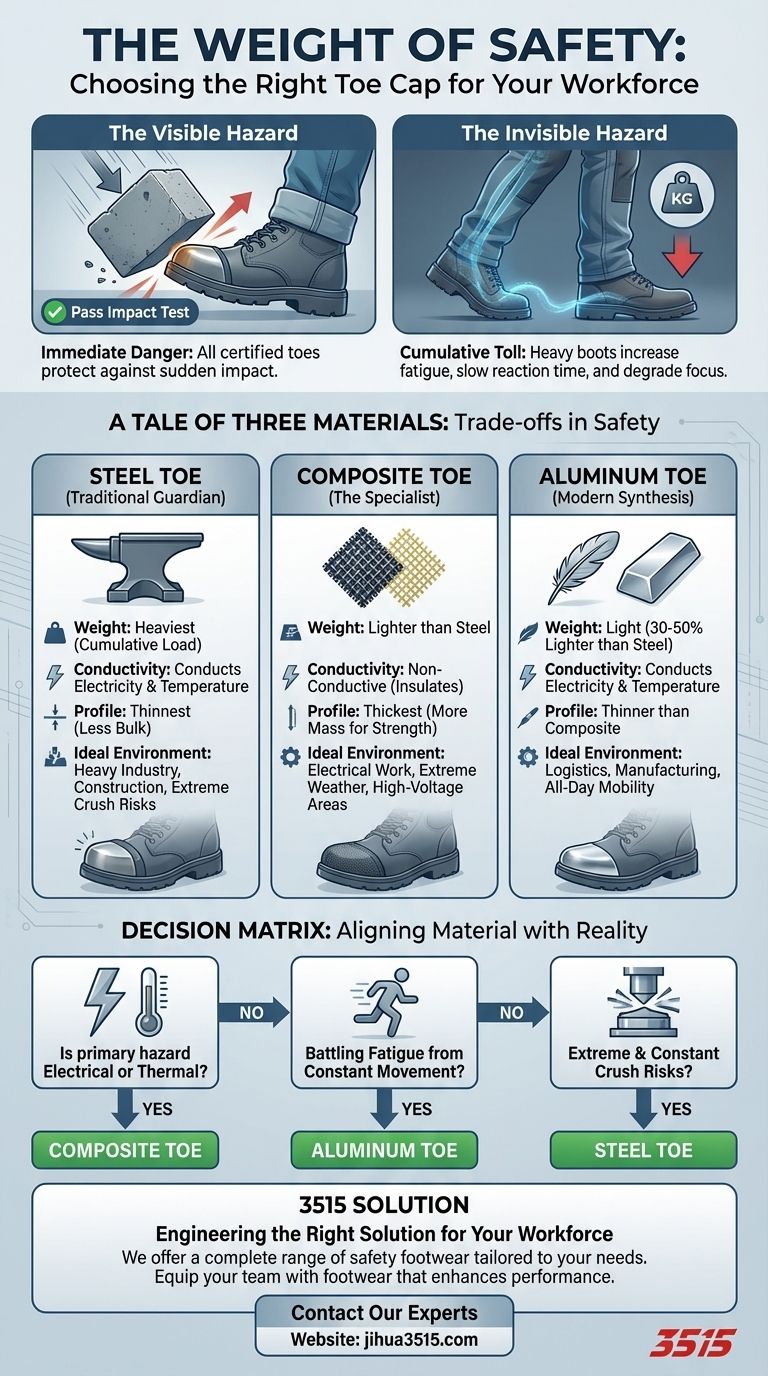
All certified safety toes—whether steel, aluminum, or composite—are engineered to meet the same rigorous ASTM standards for impact and compression. They will all protect you from that falling object.
The real difference lies in their secondary characteristics. The choice isn't about which is "best," but which set of trade-offs is best suited for a specific environment.
Steel: The Traditional Guardian
Steel remains a benchmark for a reason. It offers maximum protection in the thinnest possible profile, resulting in a less bulky boot. For environments with extreme, constant crushing hazards, its reputation is well-earned. Its weakness is its weight. It is the brute-force solution.
Composite: The Specialist
Made from non-metallic materials like carbon fiber or Kevlar, composite toes solve a problem steel and aluminum cannot: conductivity. They don't conduct electricity, heat, or cold. For electricians or anyone working in high-voltage areas or extreme temperatures, they are the only rational choice. Their trade-off is often bulk; they require more mass to achieve the same strength as metal.
Aluminum: The Modern Synthesis
This is where the equation changes. Aluminum alloys offer the same certified impact protection as steel but at a fraction of the weight—often 30-50% lighter.
This isn't a minor improvement; it's a fundamental shift in the balance between safety and human endurance. It provides the robust barrier of a metal cap without the significant fatigue penalty. It directly counters the invisible hazard by preserving a worker's energy and focus throughout the day.
The Decision Matrix: Aligning Material with Reality
Choosing the right toe cap is an exercise in systems thinking. You must match the material's properties to the full spectrum of your operational demands.
| Feature | Aluminum Toe | Steel Toe | Composite Toe |
|---|---|---|---|
| Primary Benefit | Lightweight Strength | Maximum Density | Non-Conductive |
| Weight | Light | Heaviest | Lighter than Steel |
| Conductivity | Conducts Electricity & Temp | Conducts Electricity & Temp | Insulates from Electricity & Temp |
| Profile/Thickness | Thinner than Composite | Thinnest | Thickest |
| Ideal Environment | Logistics, Manufacturing, All-Day Mobility | Heavy Industry, Construction | Electrical Work, Extreme Weather |
- Is your primary hazard electrical or thermal? The choice is made for you: Composite.
- Is your team battling fatigue from constant movement? The weight savings from Aluminum will have a direct impact on safety and productivity.
- Is the environment defined by extreme and constant crush risks? Steel remains a time-tested and reliable option.
Engineering the Right Solution for Your Workforce
The most advanced safety boot isn't the one made from the "strongest" material. It's the one that perfectly aligns with the physical and environmental realities of the job, acknowledging that the person wearing it is not a machine.
At 3515, we manufacture a complete range of safety footwear because we know that a one-size-fits-all approach to workplace safety is flawed. Our capabilities allow us to produce boots with aluminum, steel, or composite toes, tailored to the nuanced needs of distributors, brand owners, and large-scale clients. We help you solve the entire safety equation, not just pass an impact test.
Equip your team with footwear that enhances performance instead of draining it. Contact Our Experts
Visual Guide
Related Products
- Premium Suede Sport Safety Shoes for Wholesale & Bulk Orders
- Premium Lightweight Safety Shoes for Wholesale & Bulk Orders
- Wholesale Anti-Smash & Puncture-Proof Safety Shoes Custom Manufacturing for Brands
- Premium KPU Injection Athletic Style Safety Shoes
- Premium Safety Shoes with Rotating Buckle Safety Sneakers
Related Articles
- The Ghost in the Machine: Why an Obsolete Footwear Standard Creates Modern Risk
- Beyond the Steel Toe: The Hidden Ergonomics of Workplace Safety
- Why Traditional Laces Are a Hidden Safety Risk—And What to Do About It
- The True Cost of Skipping Safety Shoes: Long-Term Risks and Smart Protection
- How Safety Shoe Engineering Prevents Workplace Injuries Across Industries