The Invisible Load
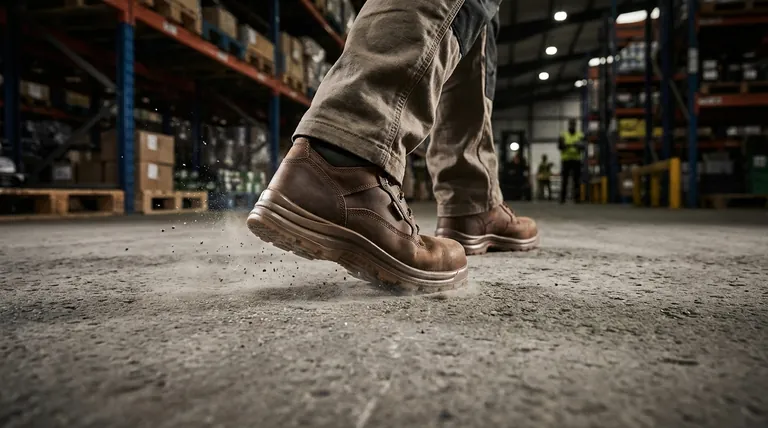
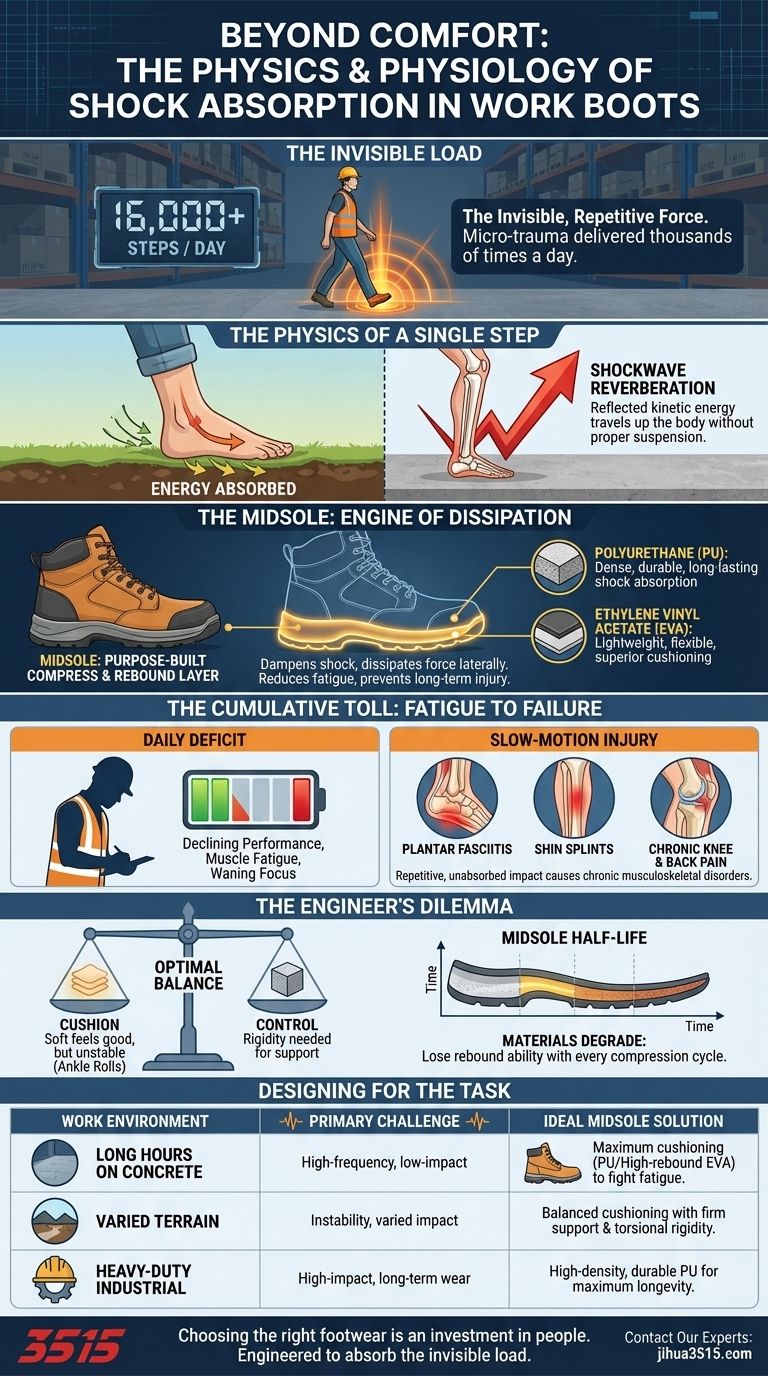
Imagine a warehouse worker. Over an eight-hour shift on a concrete floor, they take roughly 16,000 steps. Each step sends a shockwave up their body. It's an invisible, repetitive force—a micro-trauma delivered thousands of times a day.
We tend to think of workplace injuries as singular, dramatic events. A slip, a fall, a dropped object. But the most pervasive threat is often the one we don't see: the slow, cumulative damage from the ground up. This isn't a problem of comfort; it's a fundamental challenge of physics and physiology.
The Physics of a Single Step
Every footfall creates an impact force that must go somewhere. In nature, soft earth absorbs much of this energy. On concrete, asphalt, or steel grating, that energy is reflected directly back into the body's kinetic chain.
The Unseen Shockwave
Without a proper suspension system, this shockwave travels from the heel, through the ankle, up the shin, into the knee, and reverberates through the hips and lower back. Your body becomes the shock absorber.
This is where a boot's engineering comes into play. The single most important component for managing this force isn't on the outside—it's hidden inside.
The Midsole: An Engine of Dissipation
The midsole is the heart of a boot's shock absorption system. It is a purpose-built layer of material engineered to do one thing exceptionally well: compress and rebound.
- Polyurethane (PU): A dense, durable material that provides excellent, long-lasting shock absorption and support. It’s the workhorse for high-impact environments.
- Ethylene Vinyl Acetate (EVA): A lighter, more flexible foam that offers superior cushioning, often found in athletic footwear. It excels at reducing fatigue but can compress permanently over time.
When a foot strikes the ground, a well-designed midsole compresses, absorbing the shockwave's initial energy. It acts like a damper, dissipating the force laterally before it can travel up the leg. This small, engineered event, repeated thousands of times, is the difference between end-of-day fatigue and a long-term injury.
The Cumulative Toll: From Fatigue to Failure
The human body is remarkably resilient, but it has its limits. The psychological and physiological cost of unmanaged impact is immense, though it often goes unnoticed until the damage is done.
The Daily Deficit
Fatigue is more than just feeling tired. It's a measurable decline in physical and cognitive performance. As the body constantly fights the jarring force of each step, muscles work harder, energy is depleted faster, and mental focus wanes. An exhausted worker is a less productive and less safe worker.
The Slow-Motion Injury
This is the most critical consequence. Repetitive, unabsorbed impact is the primary cause of many chronic musculoskeletal disorders.
- Plantar Fasciitis: Inflammation of the tissue connecting the heel bone to the toes.
- Shin Splints: Pain along the shin bone from overworked muscles and stress on the bone.
- Chronic Knee & Back Pain: The eventual result of years of joint cartilage being worn down by repetitive shock.
These conditions aren't accidents. They are the predictable outcome of a system under sustained, unmitigated stress.
The Engineer's Dilemma: A Balancing Act
Creating the perfect shock-absorbing boot is not as simple as using the softest material possible. It's a series of deliberate engineering trade-offs.
Cushion vs. Control
An overly soft midsole can feel like walking on sand. While it absorbs impact, it can also feel unstable, increasing the risk of ankle rolls, especially on uneven terrain. The optimal design balances plush cushioning with the structural rigidity needed for firm arch and ankle support.
The Half-Life of a Midsole
Shock-absorbing materials degrade. With every compression cycle, they lose a small amount of their ability to rebound. Lighter foams like EVA lose their efficacy faster than denser materials like PU. This means a boot's protective capabilities diminish long before its exterior looks worn out.
A System, Not a Silver Bullet
Even the most advanced midsole technology is useless if the boot doesn't fit. Proper fit ensures the foot is correctly positioned to benefit from the engineered support and cushioning. Shock absorption is a key feature, but it's part of a larger system.
Designing for the Task, Not Just the Foot
As manufacturers, our role is to engineer solutions for specific environments. The right balance of shock absorption depends entirely on the job at hand. By understanding the underlying physics and physiology, we can create footwear that doesn't just protect, but actively preserves the long-term health of the wearer.
| Work Environment | Primary Challenge | Ideal Midsole Solution |
|---|---|---|
| Long hours on concrete | High-frequency, low-impact | Maximum cushioning (PU or high-rebound EVA) to fight fatigue. |
| Varied or uneven terrain | Instability, varied impact | Balanced cushioning with firm support and torsional rigidity. |
| Heavy-duty industrial | High-impact, long-term wear | High-density, durable PU for maximum longevity and protection. |
Choosing the right footwear is a direct investment in the most valuable asset any company has: its people. At 3515, we engineer our comprehensive range of safety shoes and boots with this principle at our core, ensuring every pair is built to absorb the invisible load of the modern workplace.
If you are a distributor, brand owner, or bulk purchaser looking to provide footwear that truly protects, Contact Our Experts.
Visual Guide
Related Products
- Premium Suede Sport Safety Shoes for Wholesale & Bulk Orders
- Premium Lightweight Safety Shoes for Wholesale & Bulk Orders
- Wholesale Anti-Smash & Puncture-Proof Safety Shoes Custom Manufacturing for Brands
- Premium KPU Injection Athletic Style Safety Shoes
- Premium Safety Shoes with Rotating Buckle Safety Sneakers
Related Articles
- The Ghost in the Machine: Why an Obsolete Footwear Standard Creates Modern Risk
- Beyond the Steel Toe: The Hidden Ergonomics of Workplace Safety
- Why Traditional Laces Are a Hidden Safety Risk—And What to Do About It
- The True Cost of Skipping Safety Shoes: Long-Term Risks and Smart Protection
- How Safety Shoe Engineering Prevents Workplace Injuries Across Industries