The Illusion of the "OSHA-Approved" Boot
In the world of workplace safety, we crave certainty. We look for a simple sticker, a clear seal of approval. The search for an "OSHA-approved" boot is a perfect example of this human tendency. We want to buy a product that solves our compliance problem.
But this is a cognitive error. We're searching for a simple hardware solution to what is, in reality, a complex diagnostic challenge.
The Occupational Safety and Health Administration (OSHA) doesn't approve specific boots. Instead, it mandates a process. True compliance isn't found in a product catalog; it begins with a thoughtful analysis of the work itself.
The Elegant Hand-Off: How OSHA and ASTM Work Together
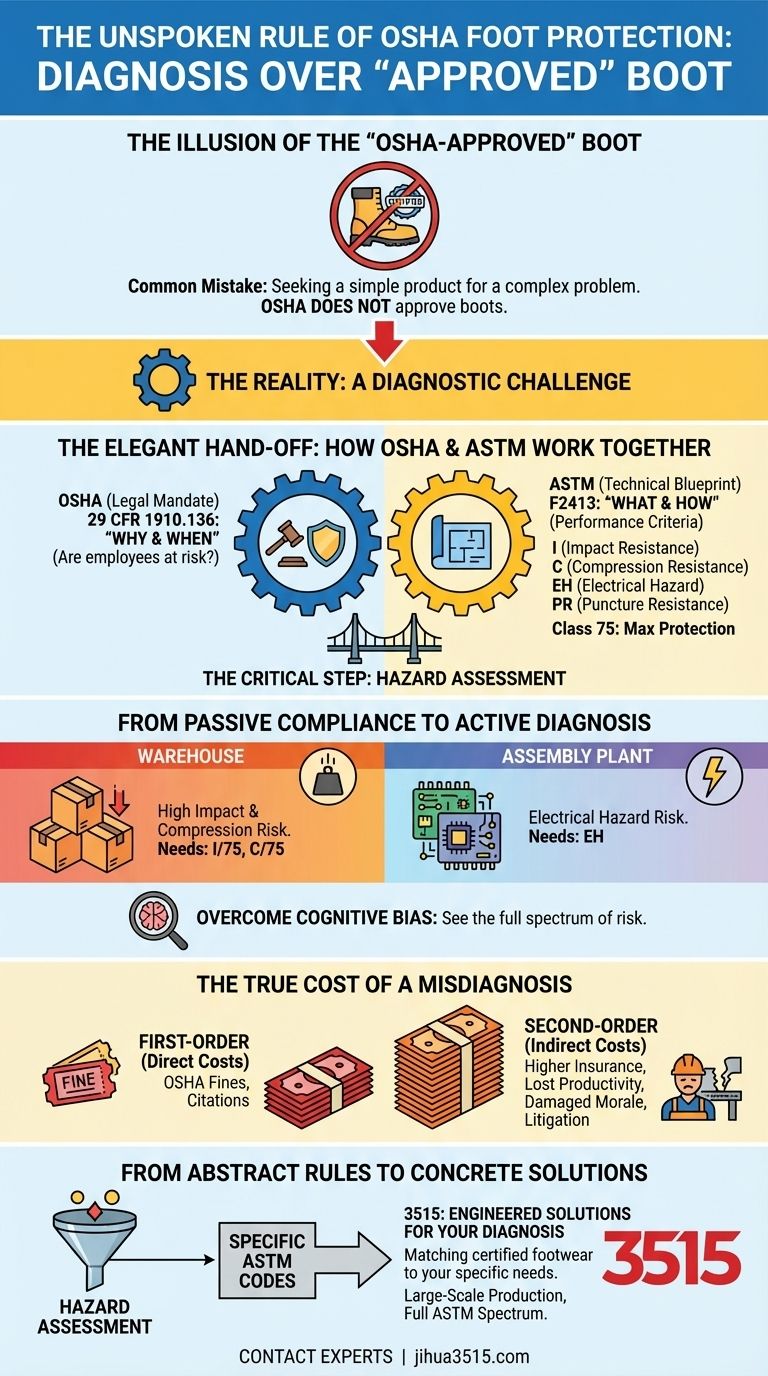
The regulatory framework for foot protection is a beautifully logical system built on a division of labor. OSHA provides the legal mandate, while consensus-based standards organizations provide the technical blueprint.
The Legal Mandate: OSHA 29 CFR 1910.136
Think of OSHA's rule as the "why" and the "when." This regulation legally requires employers to ensure workers use protective footwear whenever their feet are exposed to specific dangers. It sets the stage by forcing a crucial question: "Are my employees at risk?"
It intentionally avoids prescribing the answer, because the answer is different for every workplace.
The Technical Blueprint: ASTM F2413
ASTM International provides the "what" and the "how." The ASTM F2413 standard gives us a shared, testable language for performance. It outlines the minimum requirements for a boot to be considered protective against specific hazards.
To comply with OSHA's rule, footwear must meet the technical criteria laid out in this standard. The label inside the boot specifies which protections it offers.
- Impact Resistance (I): Protects against falling objects.
- Compression Resistance (C): Protects against rolling objects.
- Electrical Hazard (EH): Protects against accidental contact with live electrical circuits.
- Puncture Resistance (PR): Protects the sole from sharp objects.
The highest ratings for impact and compression are Class 75, meaning the toe cap can withstand 75 foot-pounds of impact and 2,500 pounds of pressure. This isn't just a feature; it's a precisely engineered and verified capability.
The Critical Step That Isn't in the Boot
The entire system hinges on one action that the employer, and only the employer, can perform: the hazard assessment.
This is the bridge connecting OSHA's legal question to ASTM's technical answers. Without it, you are simply guessing.
From Passive Compliance to Active Diagnosis
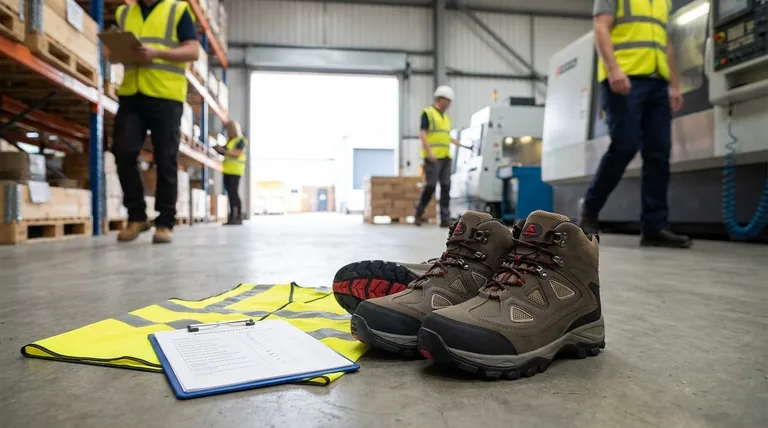
Imagine a warehouse where heavy crates are stacked high. Now, imagine an electronics assembly plant with sensitive, high-voltage equipment.
A manager looking for a simple "safety boot" might buy the same heavy, steel-toed model for both teams. This is passive compliance—checking a box.
Active diagnosis, however, reveals the truth. The warehouse needs boots with a high Impact (I/75) and Compression (C/75) rating. The assembly plant's primary need is for Electrical Hazard (EH) rated footwear, where a steel toe might even be counter-intuitive if not properly designed.
The hazard assessment transforms the vague goal of "safety" into a specific engineering requirement.
The Cognitive Blind Spot: Why We Misjudge Risk
Our brains are wired to prioritize dramatic, visible threats. We instinctively fear the falling pallet more than the silent, invisible hum of an electrical current or the slick, mundane patch of oil on the floor.
A formal, documented hazard assessment forces us to overcome these cognitive biases. It's a systematic process that pushes us to see the full spectrum of risk, not just the cinematic dangers.
The True Cost of a Misdiagnosis
Failing to perform a proper hazard assessment isn't just a procedural error. It's a misdiagnosis with severe first and second-order consequences.
| Consequence Type | Examples |
|---|---|
| First-Order (Direct Costs) | OSHA citations and fines, which can exceed $100,000 for willful or repeated violations. |
| Second-Order (Indirect Costs) | Increased workers' compensation premiums, lost productivity, damaged team morale, and civil litigation. |
The direct fine from OSHA is often the smallest part of the total cost. The real damage comes from the systemic fallout—the operational drag, the loss of trust, and the financial bleeding from insurance and legal battles.
From Abstract Rules to Concrete Solutions
Understanding this system reveals a clear path to true compliance and safety. The goal is not to find a universally "best" boot. The goal is to precisely match a specific, certified boot to a specific, identified hazard.
Once your hazard assessment is complete, your needs become crystal clear. You no longer need "safety boots"; you need "50 pairs of ASTM F2413-compliant footwear with I/75, C/75, and EH ratings."
This is where a manufacturing partner becomes essential. As a large-scale producer of a comprehensive range of footwear, 3515 excels at providing the specific, certified solutions your diagnostic process demands. We engineer and manufacture boots that meet the full spectrum of ASTM F2413 standards, ensuring that whatever hazard you identify, we can provide the precise tool for the job. We equip distributors and brand owners to meet the real-world needs of their clients, turning a well-executed assessment into a well-protected workforce.
Don't just buy boots; implement a safety system. Contact Our Experts to discuss how we can supply the right footwear for your specific needs.
Visual Guide
Related Products
- Premium Suede Sport Safety Shoes for Wholesale & Bulk Orders
- Premium Lightweight Safety Shoes for Wholesale & Bulk Orders
- Wholesale Anti-Smash & Puncture-Proof Safety Shoes Custom Manufacturing for Brands
- Premium KPU Injection Athletic Style Safety Shoes
- Premium Safety Shoes with Rotating Buckle Safety Sneakers
Related Articles
- The Ghost in the Machine: Why an Obsolete Footwear Standard Creates Modern Risk
- Beyond the Steel Toe: The Hidden Ergonomics of Workplace Safety
- Why Traditional Laces Are a Hidden Safety Risk—And What to Do About It
- The True Cost of Skipping Safety Shoes: Long-Term Risks and Smart Protection
- How Safety Shoe Engineering Prevents Workplace Injuries Across Industries