The Unspoken Contract
Every morning, millions of workers pull on a pair of boots. A lineman, a construction worker, a farmer. In that simple act, they make an unspoken contract. They place their trust in two pieces of leather, rubber, and metal to stand between them and a world of physical, chemical, and electrical risk.
This choice is more than a preference. It’s a cognitive calculation. The safest boot isn't the one with the most features; it’s the one with the right features. It's a tool perfectly engineered for a specific reality.
The Physics of Protection: Guarding Against the Seen
The most visceral threats are the ones we can imagine: a falling beam, a stray nail. The first job of a work boot is to defend against the simple, brutal physics of impact and puncture.
The Logic of the Toe Cap
The reinforced toe cap is the classic symbol of safety, but the choice of material is a critical trade-off between absolute protection and human fatigue.
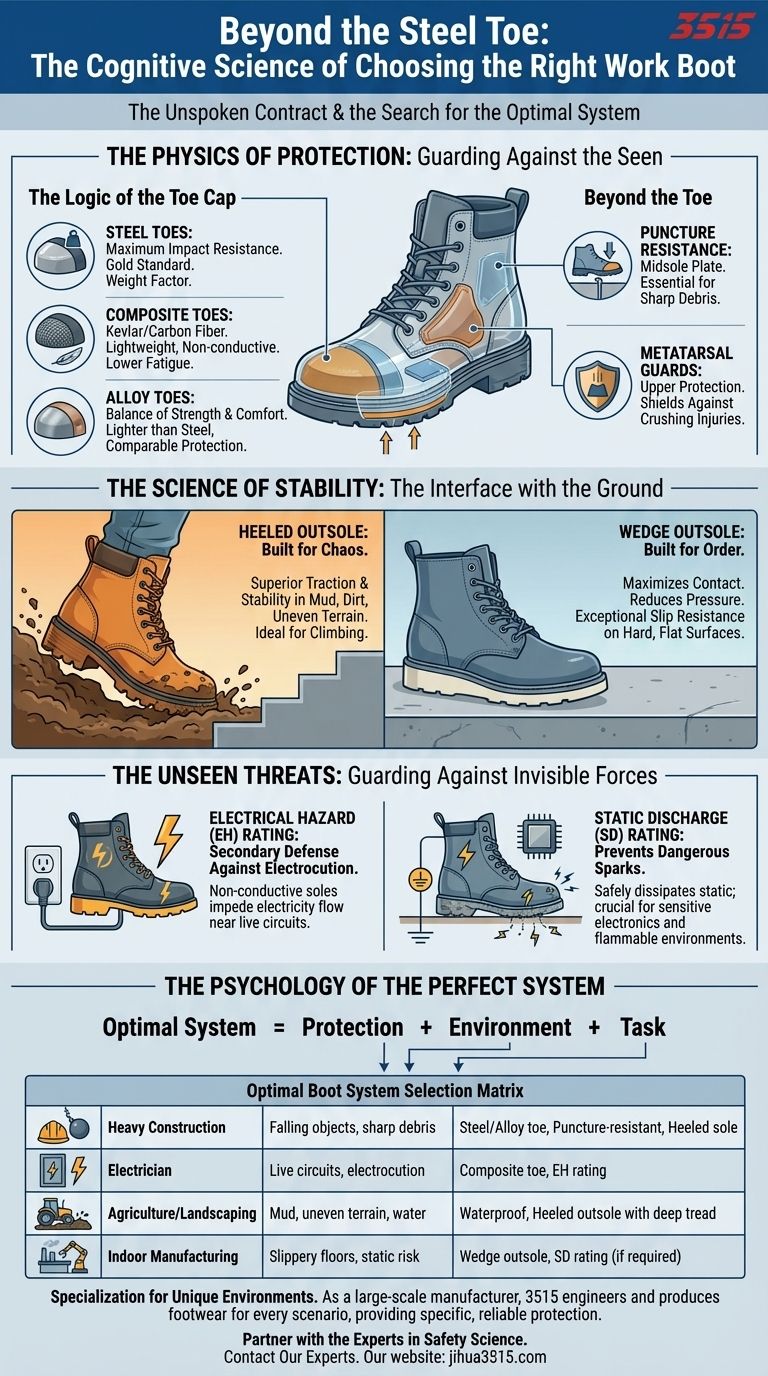
- Steel Toes: The gold standard for impact resistance. They are the strongest line of defense, but their weight is a constant factor in the energy a worker expends over an eight-hour shift.
- Composite Toes: Made from materials like Kevlar or carbon fiber, they offer significant protection at a lower weight. They don't conduct electricity or heat, making them a smarter choice for certain environments.
- Alloy Toes: Lighter than steel but with comparable strength, they represent a balance of protection and comfort, often at a premium.
Beyond the Toe: Puncture and Metatarsal Guards
Hazards aren't always direct. A nail underfoot is as dangerous as a falling box. A puncture-resistant plate in the midsole isn't a luxury; it's a necessity on sites littered with sharp debris.
Likewise, the metatarsal bones on top of the foot are surprisingly vulnerable. A metatarsal guard, which extends protection up from the toe cap, shields this area from crushing injuries.
The Science of Stability: The Interface with the Ground
A slip or fall is one of the most common workplace accidents. The outsole of a boot is the critical interface between the worker and their environment, and its design dictates their stability.
The Heeled vs. Wedge Sole Dilemma
This choice reflects a fundamental difference in terrain.
- Heeled Outsole: The deep treads and defined heel are built for chaos. They bite into mud, dirt, and uneven ground, providing superior traction and stability for climbing.
- Wedge Outsole: The uniform, flat surface is built for order. It maximizes contact with hard, flat surfaces like concrete or asphalt, reducing pressure points and offering exceptional slip resistance.
Choosing the wrong one creates risk. A heeled sole is unstable on flat concrete; a wedge sole clogs instantly with mud.
The Unseen Threats: Guarding Against Invisible Forces
The most insidious dangers are the ones you cannot see. Electricity and static discharge are silent threats that require highly specialized defenses.
- Electrical Hazard (EH) Rating: For anyone working near live circuits, EH-rated boots are a secondary line of defense against electrocution. Their non-conductive soles are designed to impede the flow of electricity through the body.
- Static Discharge (SD) Rating: In environments with sensitive electronics or flammable vapors, a single spark can be catastrophic. SD-rated boots safely dissipate the body's static electricity to the ground, preventing a dangerous discharge.
The Psychology of the Perfect System
There is no single "best" boot. The pursuit is not for maximum features, but for the optimal system—a perfect alignment of protection, environment, and task.
This requires a clear-eyed assessment of daily risks. A feature that protects against a non-existent threat adds weight, cost, and complexity without adding value. The goal is precise, efficient safety.
| Job Role | Dominant Hazards | Optimal Boot System |
|---|---|---|
| Heavy Construction | Falling objects, sharp debris | Steel/Alloy toe, Puncture-resistant, Heeled sole |
| Electrician | Live circuits, electrocution | Composite toe, EH rating |
| Agriculture/Landscaping | Mud, uneven terrain, water | Waterproof, Heeled outsole with deep tread |
| Indoor Manufacturing | Slippery floors, static risk | Wedge outsole, SD rating (if required) |
This level of specialization is where true safety is forged. It acknowledges that every work environment is unique and demands an equally unique solution. As a large-scale manufacturer, 3515 has the deep production capability to engineer and produce footwear for every scenario. We build boots that honor the unspoken contract, providing the specific, reliable protection distributors and brand owners need for their clients.
If you're looking for a manufacturing partner who understands the science behind safety, Contact Our Experts.
Visual Guide
Related Products
- Premium Suede Sport Safety Shoes for Wholesale & Bulk Orders
- Premium Lightweight Safety Shoes for Wholesale & Bulk Orders
- Wholesale Anti-Smash & Puncture-Proof Safety Shoes Custom Manufacturing for Brands
- Premium KPU Injection Athletic Style Safety Shoes
- Premium Safety Shoes with Rotating Buckle Safety Sneakers
Related Articles
- The Ghost in the Machine: Why an Obsolete Footwear Standard Creates Modern Risk
- Beyond the Steel Toe: The Hidden Ergonomics of Workplace Safety
- Why Traditional Laces Are a Hidden Safety Risk—And What to Do About It
- The True Cost of Skipping Safety Shoes: Long-Term Risks and Smart Protection
- How Safety Shoe Engineering Prevents Workplace Injuries Across Industries