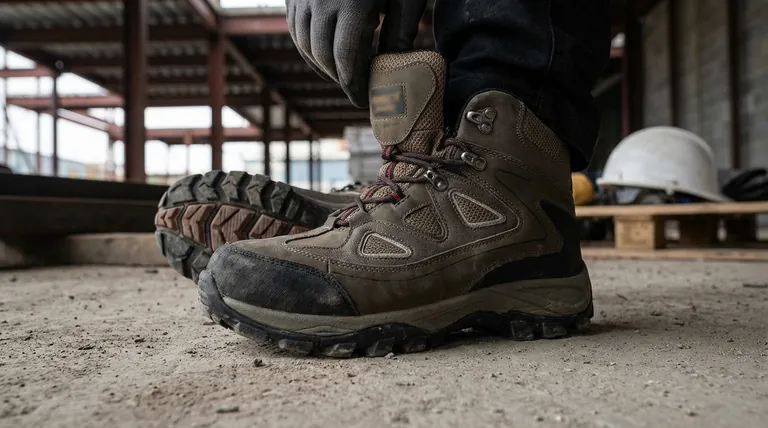
A Language We Cannot Afford to Misinterpret
On a busy loading dock, a pallet jack, heavy with goods, rolls over a worker's foot. In an electronics cleanroom, a tiny spark of static electricity from a technician's shoe ruins a thousand-dollar circuit board. On a construction site, a roofer steps on an upturned nail.
These are not just accidents; they are failures of a system. And often, the weakest link is the misunderstanding of a simple, powerful language: the code printed on the tongue of a safety boot.
The ASTM F2413-18 standard is more than a regulation. It's a precise grammar for communicating protection. Believing any "steel toe boot" will suffice for any job is like believing all fire extinguishers work on all types of fires. It's a dangerous assumption.
The Foundation: A Universal Promise
At the heart of the standard are two non-negotiable requirements for any footwear claiming to be protective. They are the baseline promise against the most common physical hazards.
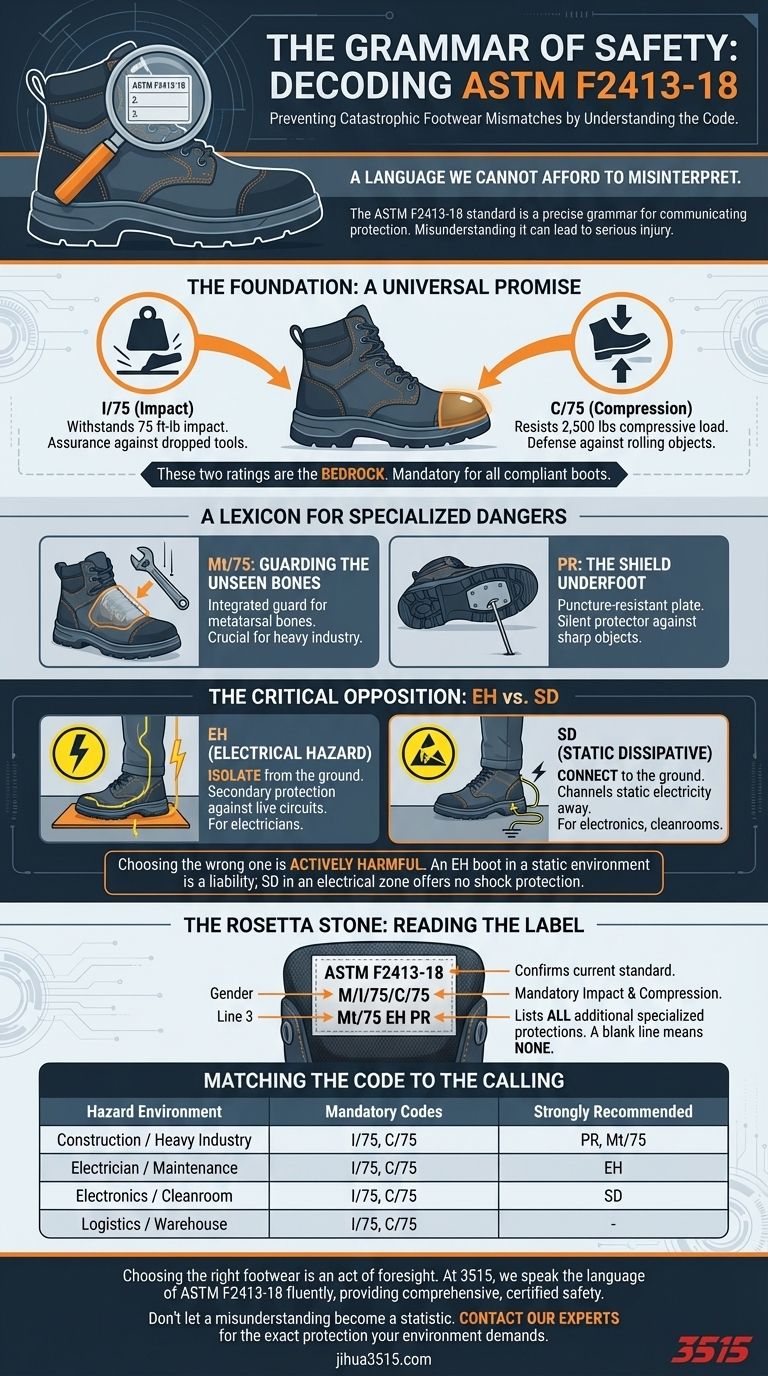
- I/75 (Impact): This signifies that the protective toe cap can withstand a 75 foot-pound impact. It’s the assurance against a heavy tool dropped from a workbench or a piece of material falling from a shelf.
- C/75 (Compression): This certifies the toe cap can resist a compressive load of 2,500 pounds. It’s the defense against rolling objects, like the pallet jack on the loading dock.
These two ratings are the bedrock. If a boot doesn't have them, it isn't a true ASTM-compliant safety boot.
A Lexicon for Specialized Dangers
Beyond the foundation, the standard provides a vocabulary for specific, and often invisible, threats. This is where a deep understanding becomes critical.
Mt/75: Guarding the Unseen Bones
A dropped object doesn't always land perfectly on the toe. The metatarsal bones, which form the top of the foot, are equally vulnerable. An Mt/75 rating means the boot has an integrated guard protecting this area—a crucial feature in heavy industry or material handling.
PR: The Shield Underfoot
The PR (Puncture Resistant) rating indicates a plate embedded in the sole. It's the silent protector that turns a potentially debilitating injury from a nail, a shard of metal, or broken glass into a non-event. For construction, demolition, and waste management, it is indispensable.
The Critical Opposition: EH vs. SD
Here lies the most common and dangerous misunderstanding. People see "electricity" and assume the protections are similar. They are opposites.
- EH (Electrical Hazard): This footwear is built with non-conductive soles to isolate you from the ground, providing a secondary source of protection against stepping on a live circuit. It's designed for an electrician.
- SD (Static Dissipative): This footwear is designed to connect you to the ground, safely channeling the body's static electricity away. It prevents a discharge that could ignite flammable materials or destroy sensitive electronics.
Choosing the wrong one is not neutral; it's actively harmful. An EH boot in a static-sensitive environment is a liability. An SD boot in an electrical hazard zone offers no protection from shock.
The Rosetta Stone: Reading the Label
The ASTM standard mandates a clear, three-line label, typically on the boot's tongue. This is your guide.
-
Line 1:
ASTM F2413-18- Confirms the boot meets the current standard.
-
Line 2:
M/I/75/C/75- Indicates the gender (
Mfor Male,Ffor Female) and the mandatory impact and compression ratings.
- Indicates the gender (
-
Line 3:
Mt/75 EH PR- Lists all additional, specialized protections the boot offers. A blank line means it has none beyond the toe cap.
This label isn't marketing. It is a legally binding declaration of the boot's performance capabilities.
Matching the Code to the Calling
The final step is translating this language into a practical choice. The environment dictates the necessary protection.
| Hazard Environment | Mandatory Codes | Strongly Recommended |
|---|---|---|
| Construction / Heavy Industry | I/75, C/75 |
PR, Mt/75 |
| Electrician / Maintenance | I/75, C/75 |
EH |
| Electronics / Cleanroom | I/75, C/75 |
SD |
| Logistics / Warehouse | I/75, C/75 |
- |
Choosing the right footwear is an act of foresight. It’s a systematic decision, not a simple purchase. It requires acknowledging the specific risks of a job and deploying precisely the right tool to mitigate them.
At 3515, we manufacture a comprehensive range of footwear that speaks the language of ASTM F2413-18 fluently. We build boots that meet not just the foundational I/75 and C/75 standards, but also the specialized requirements for EH, PR, Mt, and SD protections. For brand owners and bulk clients, we provide the assurance that your team's foundation is built on tested, certified, and appropriate safety.
Don't let a misunderstanding become a statistic. Contact Our Experts to ensure your footwear provides the exact protection your environment demands.
Visual Guide
Related Products
- Premium Suede Sport Safety Shoes for Wholesale & Bulk Orders
- Premium Lightweight Safety Shoes for Wholesale & Bulk Orders
- Wholesale Anti-Smash & Puncture-Proof Safety Shoes Custom Manufacturing for Brands
- Premium KPU Injection Athletic Style Safety Shoes
- Premium Safety Shoes with Rotating Buckle Safety Sneakers
Related Articles
- The Ghost in the Machine: Why an Obsolete Footwear Standard Creates Modern Risk
- Beyond the Steel Toe: The Hidden Ergonomics of Workplace Safety
- Why Traditional Laces Are a Hidden Safety Risk—And What to Do About It
- The True Cost of Skipping Safety Shoes: Long-Term Risks and Smart Protection
- How Safety Shoe Engineering Prevents Workplace Injuries Across Industries



















