The Psychology of Invisible Protection
We are notoriously bad at judging low-probability, high-consequence risks.
On a construction site or in a warehouse, a catastrophic foot injury is statistically unlikely on any given day. A worker can go years without a single incident. This long stretch of normalcy creates a dangerous sense of comfort. The safety boot becomes just another part of the uniform, its true purpose forgotten.
But its protection isn't passive. It is a highly engineered system waiting to perform a critical, one-time job. Its value isn't in its daily use, but in the absolute trust that it will function perfectly in that one split second when everything goes wrong.
A System for Managing Catastrophe
To understand a modern safety boot, you must stop thinking of it as a hard hat for the foot. It’s a sophisticated energy management system, designed to control the physics of a catastrophic event.
The Crumple Zone for Your Foot
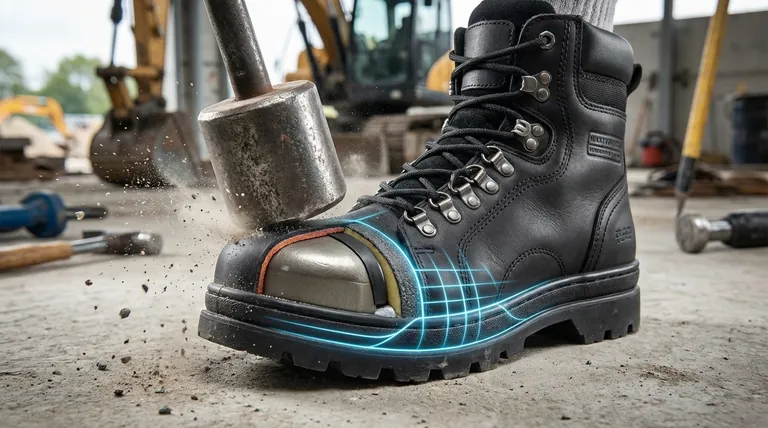
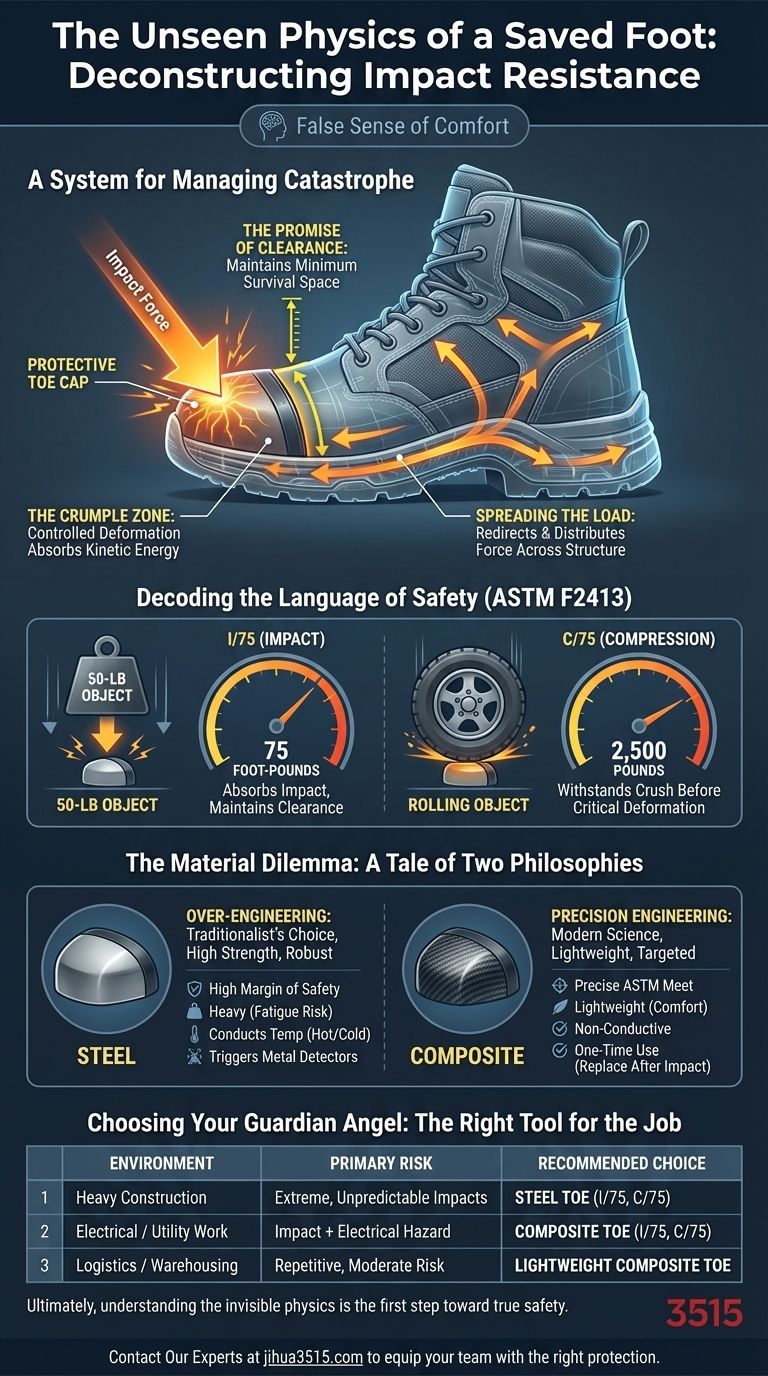
The heart of the system is the protective toe cap. When a heavy object strikes, the cap is designed to deform in a controlled manner. Like the crumple zone of a car, this deformation absorbs and dissipates a massive amount of kinetic energy that would otherwise be transferred directly to the bones of your foot.
It’s a sacrificial act of engineering. The boot is damaged so you are not.
Spreading the Load
The system doesn't just block the force; it redirects it. The impact energy is channeled away from the point of contact and distributed across the boot's entire reinforced structure.
A concentrated force shatters bone. A distributed force is merely a heavy blow. This principle is the difference between a debilitating fracture and a survivable incident.
The Promise of Clearance
The ultimate goal of this system is to maintain a minimum survival space for your toes after the impact. This is the true measure of its success. A boot that stops an object but collapses on the foot has failed. The engineering ensures that even after absorbing a life-altering force, a protective gap remains.
Decoding the Language of Safety
In engineering, standards are the language of trust. They provide objective proof that a product will perform as promised. For safety footwear, the primary standard in the U.S. is ASTM F2413.
Within this standard, two ratings are critical:
- I/75 (Impact): This certifies the toe cap can withstand an impact of 75 foot-pounds. Imagine a 50-pound (22.7 kg) object dropped from a height of 1.5 feet. The boot must absorb that force while maintaining the required internal clearance.
- C/75 (Compression): This certifies the toe can withstand a compressive load of 2,500 pounds (1,134 kg) before deforming to a critical level. This is the risk from a slow-moving rolling object, like a heavy cart or vehicle wheel.
The Material Dilemma: A Tale of Two Philosophies
The choice between a steel or composite toe cap is not just about material. It’s a choice between two distinct safety philosophies.
Steel: The Logic of Over-Engineering
Steel is the traditionalist’s choice. It’s incredibly strong and can often withstand forces far exceeding the I/75 standard, providing a significant margin of safety.
However, this robustness comes with trade-offs. Steel is heavy, which can lead to fatigue over a long shift. It also readily conducts temperature, making boots cold in the winter and hot in the summer, and will trigger metal detectors.
Composite: The Logic of Precision Engineering
Composite toes—made from materials like carbon fiber, Kevlar, or specialized plastics—are a product of modern material science. They are engineered to meet the ASTM standard precisely, without the excess weight.
The benefits are significant: they are much lighter, do not conduct heat, cold, or electricity, and are ideal for environments with metal detectors. The crucial caveat is that after one major impact, their engineered structure is compromised. It did its job perfectly, once, and must then be replaced.
Choosing Your Guardian Angel
The right choice depends entirely on a clear-eyed assessment of your environment. There is no single "best" material, only the right tool for the job.
| Environment | Primary Risk | Optimal Philosophy | Recommended Choice |
|---|---|---|---|
| Heavy Construction | Extreme, unpredictable impacts | Over-Engineering | Steel Toe (I/75, C/75) |
| Electrical / Utility Work | Impact + Electrical Hazard | Precision Engineering | Composite Toe (I/75, C/75) |
| Logistics / Warehousing | Repetitive tasks, moderate risk | Precision (for Comfort & Mobility) | Lightweight Composite Toe |
Ultimately, a safety boot is one of the most personal and critical pieces of equipment a worker will ever use. Understanding the invisible physics and engineering philosophies built into it is the first step toward ensuring true safety.
Choosing the right system requires a manufacturing partner who understands these nuances. As a large-scale producer of footwear, 3515 manufactures a comprehensive range of ASTM-compliant safety boots, from over-engineered steel toes to precision composite models, for brand owners and bulk clients. We build the systems that protect your workforce. To equip your team with the right protection for their specific risks, Contact Our Experts.
Visual Guide
Related Products
- Premium Suede Sport Safety Shoes for Wholesale & Bulk Orders
- Premium Lightweight Safety Shoes for Wholesale & Bulk Orders
- Wholesale Anti-Smash & Puncture-Proof Safety Shoes Custom Manufacturing for Brands
- Premium KPU Injection Athletic Style Safety Shoes
- Premium Safety Shoes with Rotating Buckle Safety Sneakers
Related Articles
- The Ghost in the Machine: Why an Obsolete Footwear Standard Creates Modern Risk
- Beyond the Steel Toe: The Hidden Ergonomics of Workplace Safety
- Why Traditional Laces Are a Hidden Safety Risk—And What to Do About It
- The True Cost of Skipping Safety Shoes: Long-Term Risks and Smart Protection
- How Safety Shoe Engineering Prevents Workplace Injuries Across Industries