A Standard is a Promise
A safety manager walks the floor, eyes scanning for hazards. A procurement officer reviews a purchase order, checking a line item for "ANSI-approved boots." Both are acting in good faith.
Yet, one of these actions is based on a ghost—a standard that vanished nearly two decades ago.
The persistence of obsolete information, like the retired ANSI Z41 safety footwear standard, isn't just a clerical error. It's a cognitive shortcut, a reliance on institutional memory that can create a dangerous gap between perceived safety and actual, legally-mandated protection. It exposes a fascinating vulnerability in our safety systems: our trust in what we think we know.
The Quiet Evolution of Protection
Standards are not static rules carved in stone. They are living documents that represent our collective, evolving understanding of risk. The transition from ANSI Z41 to ASTM F2413 in 2005 wasn't a simple name change; it was a fundamental upgrade in the engineering and philosophy of safety.
From a Foundation to a Modern Framework
The American National Standards Institute (ANSI) Z41 standard laid the critical groundwork for protective footwear in the United States. It established the core principles of protection.
But as materials science advanced and our understanding of workplace hazards grew more nuanced, the system needed to evolve. The American Society for Testing and Materials (ASTM) took charge, creating a more specialized, rigorous, and transparent process for certifying the gear that protects our people.
What Endures: The Physics of Safety
The core promise of a safety toe has not changed. The foundational requirements for resisting force, carried over from ANSI Z41, remain central to the ASTM standard.
- Impact (I/75): Protection against a 75 foot-pound impact.
- Compression (C/75): Protection against a 2,500-pound compressive load.
These ratings are a testament to the enduring physics of protection. But the new standard builds upon them, adding clarity and a broader scope of specialized protections.
Decoding the Modern Label
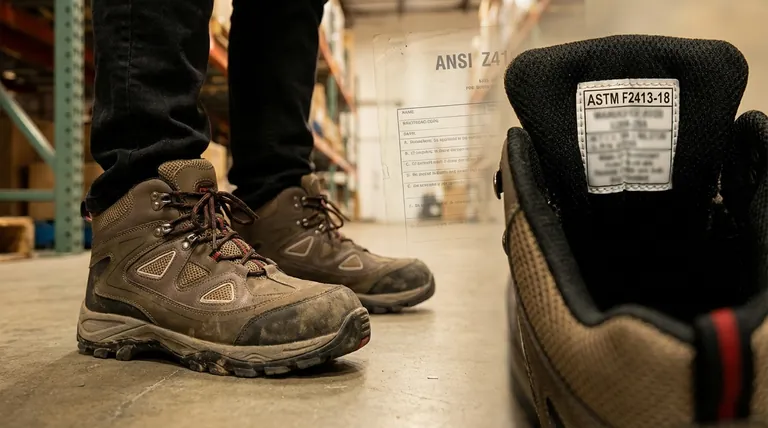
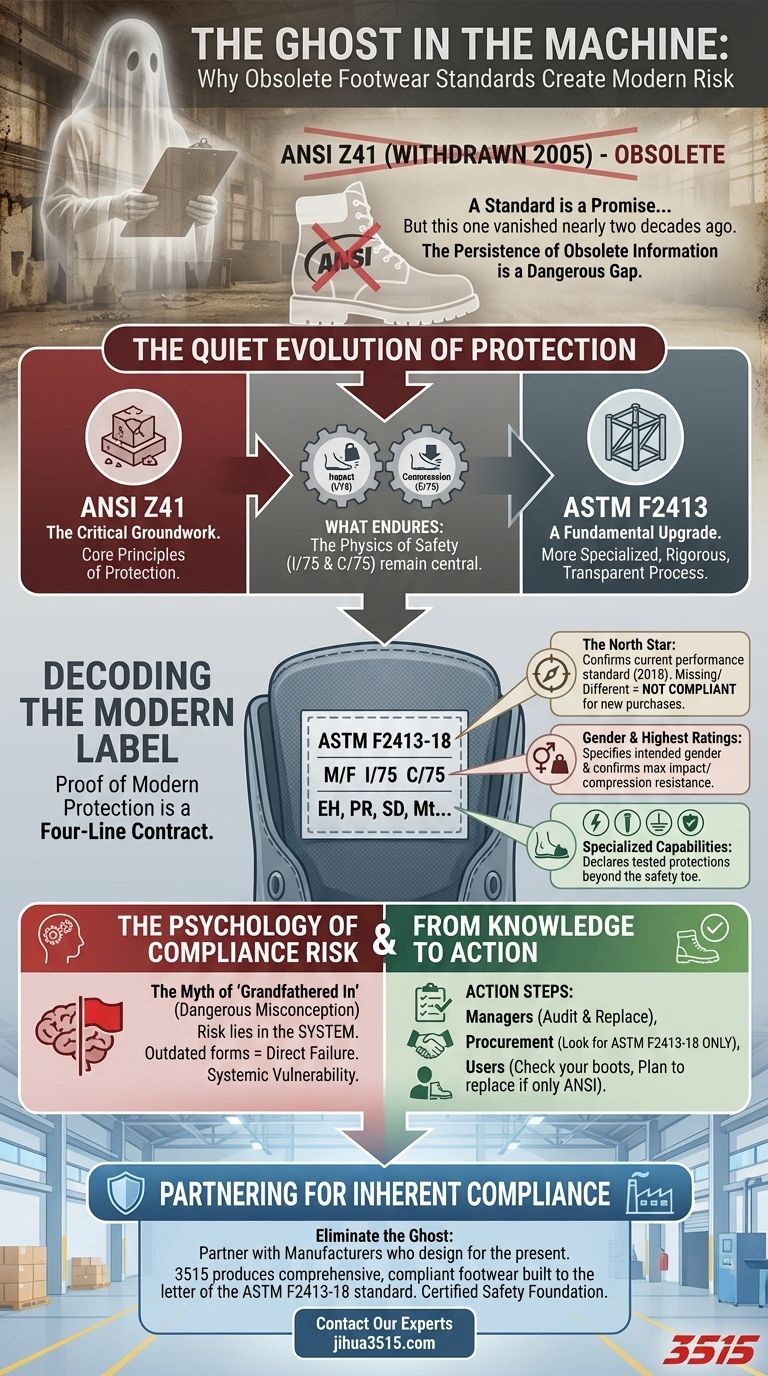
You can no longer find compliance in an "ANSI Z41" stamp. Instead, proof of modern protection is delivered in a clear, concise format, typically stitched inside the tongue of the boot. Think of it as a four-line contract of safety.
Line 1: ASTM F2413-18
This is the North Star. It confirms the footwear meets the current performance standard, last updated in 2018. If this line is missing or different, the footwear is not compliant for new purchases.
Line 2: M/F I/75 C/75
This line specifies the intended gender (Male/Female) and confirms the highest ratings for Impact and Compression resistance.
Lines 3 & 4: EH, PR, SD...
Here, the boot declares its specialized capabilities. These codes denote specific, tested protections beyond the safety toe:
- EH: Electrical Hazard
- PR: Puncture Resistance
- SD: Static Dissipative
- Mt: Metatarsal Guard
The Psychology of Compliance Risk
There's a persistent myth that old, ANSI-rated boots are "grandfathered in." This is a dangerous misconception rooted in our natural resistance to change.
While a well-maintained pair of old boots might not trigger an immediate citation, the real risk lies in the system. Any new footwear procured for the workplace must conform to the current ASTM F2413 standard to meet OSHA requirements (29 CFR 1910.136).
Relying on outdated procurement forms, safety manuals, or tribal knowledge referencing "ANSI Z41" is a direct failure of the safety program. It perpetuates a ghost standard and builds a systemic vulnerability that only reveals itself after an incident.
From Knowledge to Action
Updating a safety program is about more than just changing an acronym. It's about building a resilient system that defaults to the correct, modern standard.
- For Safety Program Managers: Audit all PPE policies, training materials, and procurement documents. Erase every reference to "ANSI Z41" and replace it with "ASTM F2413-18 (or most recent version)." This is a simple action that closes a massive compliance gap.
- For Procurement Professionals: Your job is to make the right choice the easy choice. Look exclusively for the ASTM F2413-18 label on any new footwear. Ignore any mention of ANSI.
- For the End User: Check your boots. If they only reference ANSI Z41, they are based on outdated testing methods. Plan to replace them.
| Standard | Status | Key Implication |
|---|---|---|
| ANSI Z41 | Obsolete (Withdrawn 2005) | No longer recognized for new footwear. A red flag in safety programs. |
| ASTM F2413-18 | Current & Required | The legally recognized standard for all new safety footwear purchases. |
Partnering for Inherent Compliance
Ultimately, the most effective way to eliminate the ghost of an old standard is to partner with those who design and build for the present. A manufacturer whose entire process is built around the current ASTM F2413 standard removes the burden of compliance from your shoulders.
As a large-scale manufacturer, 3515 produces a comprehensive range of footwear for distributors and bulk clients built to the letter of the ASTM F2413-18 standard. Our production capabilities ensure every boot we make is a compliant, reliable, and modern piece of personal protective equipment. We don't just sell boots; we provide a foundation of certified safety.
To ensure your team is protected by today's standards, not yesterday's memories, Contact Our Experts.
Visual Guide
Related Products
- Premium Suede Sport Safety Shoes for Wholesale & Bulk Orders
- Premium Lightweight Safety Shoes for Wholesale & Bulk Orders
- Premium KPU Injection Athletic Style Safety Shoes
- Advanced KPU Athletic Safety Shoe with Steel Toe Cap Anti-Slip Rotary Lacing System
- Premium Safety Shoes with Rotating Buckle Safety Sneakers
Related Articles
- Beyond the Steel Toe: The Hidden Ergonomics of Workplace Safety
- Why Traditional Laces Are a Hidden Safety Risk—And What to Do About It
- The True Cost of Skipping Safety Shoes: Long-Term Risks and Smart Protection
- How Safety Shoe Engineering Prevents Workplace Injuries Across Industries
- Beyond the Steel Toe: The Cognitive Science of Choosing the Right Work Boot