The Illusion of Safety
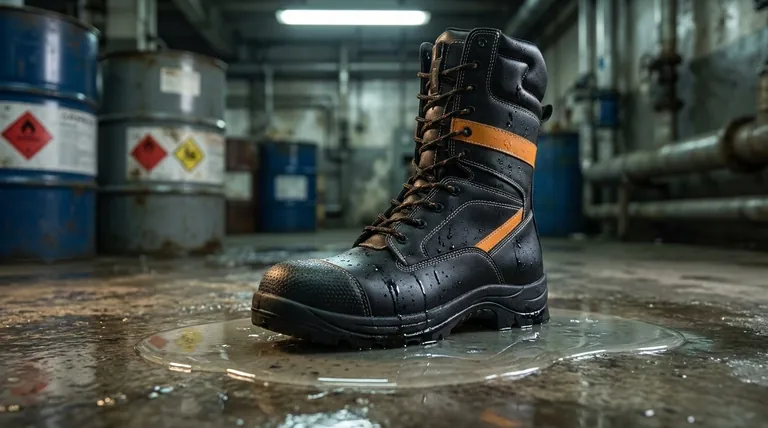
A worker stands on a wet concrete floor. The air is thick with the faint, sharp smell of industrial solvents. On their feet, a pair of heavy-duty safety boots look pristine and indestructible.
They feel safe.
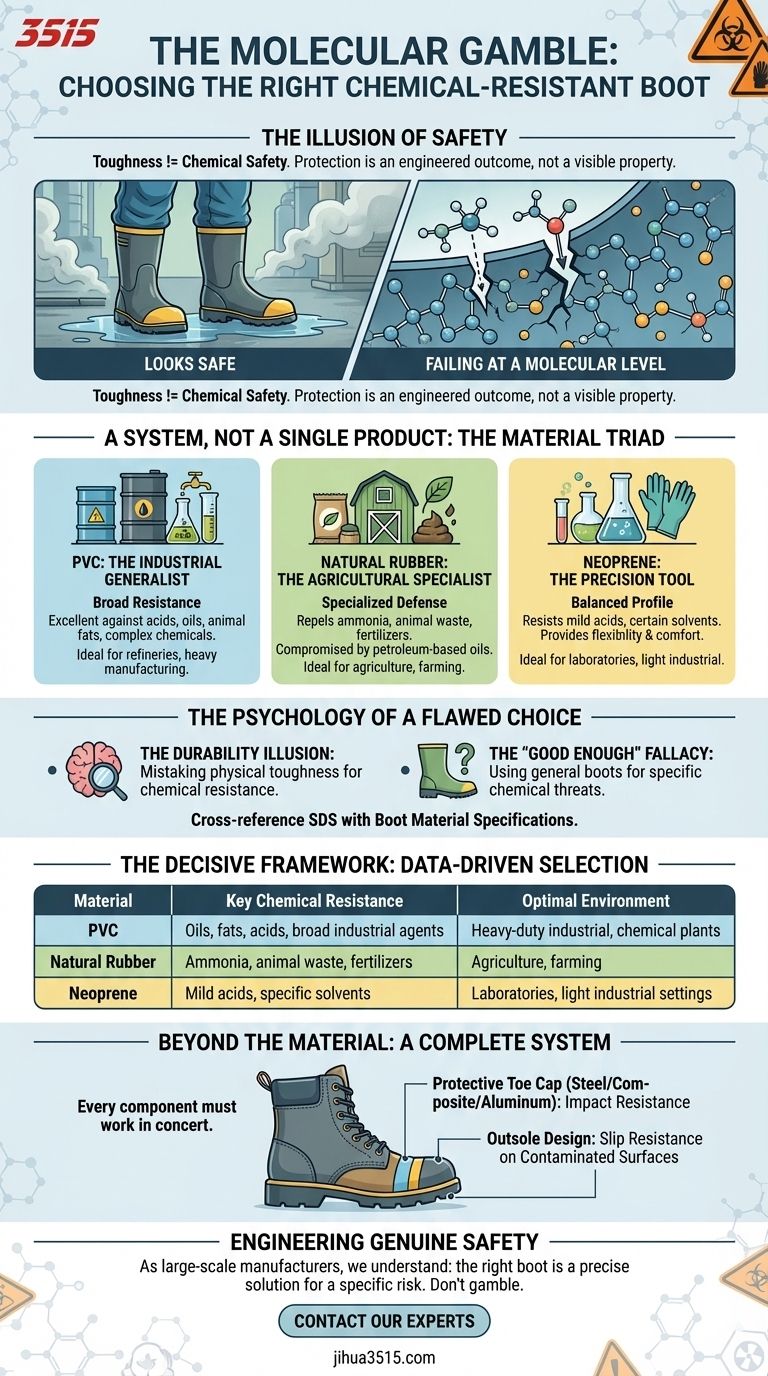
But safety, in a chemically hazardous environment, is not something you can see or feel. It's happening—or failing—at a molecular level. The boot that appears solid might be silently degrading, its polymer chains breaking down, becoming permeable. Protection is not a given; it's a specific, engineered outcome.
The most dangerous assumption in workplace safety is that a "tough" boot is a "safe" boot. This misunderstanding is a critical failure point.
A System, Not a Single Product
Choosing a chemical-resistant boot isn't like choosing a regular work boot. You are not selecting for general durability. You are selecting a specific material system designed to counter a specific chemical threat.
The decision hinges on a triad of core materials: PVC, Natural Rubber, and Neoprene. Each functions as a unique key for a particular chemical lock.
PVC: The Industrial Generalist
Polyvinyl Chloride (PVC) is a synthetic polymer that acts as a formidable barrier. Think of it as the most versatile defender.
Its strength lies in its broad resistance profile. It stands up exceptionally well against a wide range of acids, oils, animal fats, and complex industrial chemicals. This makes it the default choice for the high-stakes environments of refineries, chemical plants, and heavy manufacturing.
Where other materials might falter when exposed to a cocktail of substances, PVC often holds the line.
Natural Rubber: The Agricultural Specialist
Natural rubber is a testament to specialized design. It is highly effective, but within a narrower scope.
Its molecular structure is particularly adept at repelling ammonia, animal waste, and common fertilizers. This gives it a distinct advantage in agricultural settings, where these specific substances are the primary daily threat.
However, expose it to certain petroleum-based oils, and its integrity can be compromised. This isn't a flaw; it's a specialization.
Neoprene: The Precision Tool
Neoprene, a synthetic rubber, offers a balanced profile for targeted applications. It’s the right tool for a very specific job.
It excels in environments with mild acids and certain solvents, such as laboratories or light industrial settings. It provides flexibility and comfort while ensuring protection against a known, less aggressive set of chemicals.
The Psychology of a Flawed Choice
Why would an experienced safety manager select the wrong boot? It often comes down to cognitive biases.
- The Durability Illusion: We are psychologically wired to equate physical toughness with overall protection. A thick, heavy boot feels safer. Yet, a chemical can silently permeate it without leaving a visible mark until it's too late. Chemical resistance is an invisible property.
- The "Good Enough" Fallacy: In the absence of precise information, we often opt for a general-purpose solution. But in chemical safety, there is no "one-size-fits-all." The only path to certainty is cross-referencing the boot's material specifications with the Safety Data Sheet (SDS) for every chemical in the workplace.
A safety boot that is 90% right for the job is 100% wrong when a failure occurs.
The Decisive Framework
Making the right choice is a deliberate, analytical process, not an intuitive one. It requires stripping away assumptions and focusing on the data.
| Material | Key Chemical Resistance | Optimal Environment |
|---|---|---|
| PVC | Oils, fats, acids, broad industrial agents | Heavy-duty industrial, chemical plants |
| Natural Rubber | Ammonia, animal waste, fertilizers | Agriculture, farming |
| Neoprene | Mild acids, specific solvents | Laboratories, light industrial settings |
Beyond the primary material, the boot is a complete system. The protective toe cap—be it steel, composite, or aluminum—adds a layer of impact resistance. The outsole's design determines its slip resistance on contaminated surfaces. Every component must work in concert.
This level of detail is not optional; it is the foundation of genuine safety. As a large-scale manufacturer of all types of footwear, we understand that creating the right safety boot is about engineering a precise solution for a specific risk. We produce a comprehensive range of chemical-resistant boots because we know that every work environment presents a unique molecular gamble.
Ensuring your team has the right equipment isn't just about compliance; it's about acknowledging the reality of the risks they face. Contact Our Experts
Visual Guide
Related Products
- Premium Oil Wax Leather Safety Boots for Bulk Purchase
- Wholesale Durable Safety Boots | Custom Steel Toe & Puncture-Resistant Manufacturing
- Puncture-Resistant Velcro Safety Boots for Wholesale & Custom Manufacturing
- Premium High-Cut Waterproof Safety Boots Manufacturing & Wholesale Solutions
- Heavy-Duty Goodyear Welted Pull-On Safety Rigger Boot
Related Articles
- How to Choose Safety Boots That Reduce Fatigue Without Sacrificing Protection
- How Industrial Professionals Can Balance Safety Boot Requirements with Professional Appearance
- The Anatomy of Trust: A Systems Approach to Workplace Foot Protection
- The Lacing Paradox: Why the Safest Boots Contain Their Own Greatest Risk
- The Chemistry of Failure: Why Oil-Resistant and Waterproof Boots Solve Fundamentally Different Problems