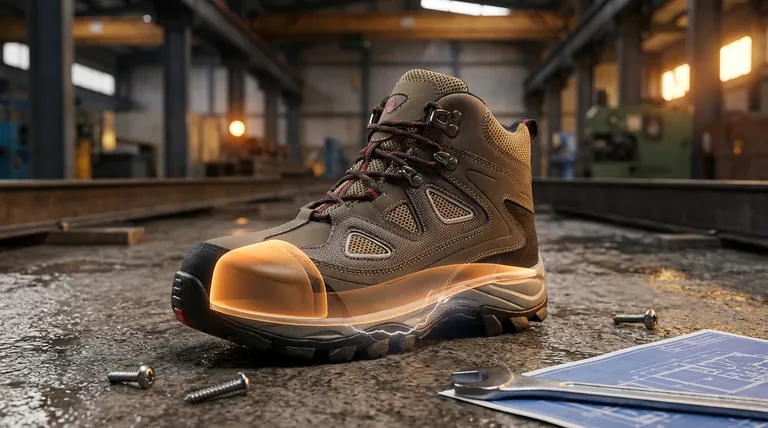
The Unseen Agreement
A construction worker plants his foot firmly, unaware of the upturned nail just beneath the dust. An airport technician kneels to service a panel, her movements generating a small static charge. In both scenarios, an injury is prevented not by conscious action, but by a silent, engineered agreement.
That agreement is the safety boot.
We often think of safety equipment in terms of brute force—a hard hat, a steel plate. But the modern safety boot is far more nuanced. It is a system of specialized protections, a wearable piece of risk analysis. Understanding this system is to understand the anatomy of trust between a worker and their most fundamental tool.
The Non-Negotiable Core: A Foundation of Protection
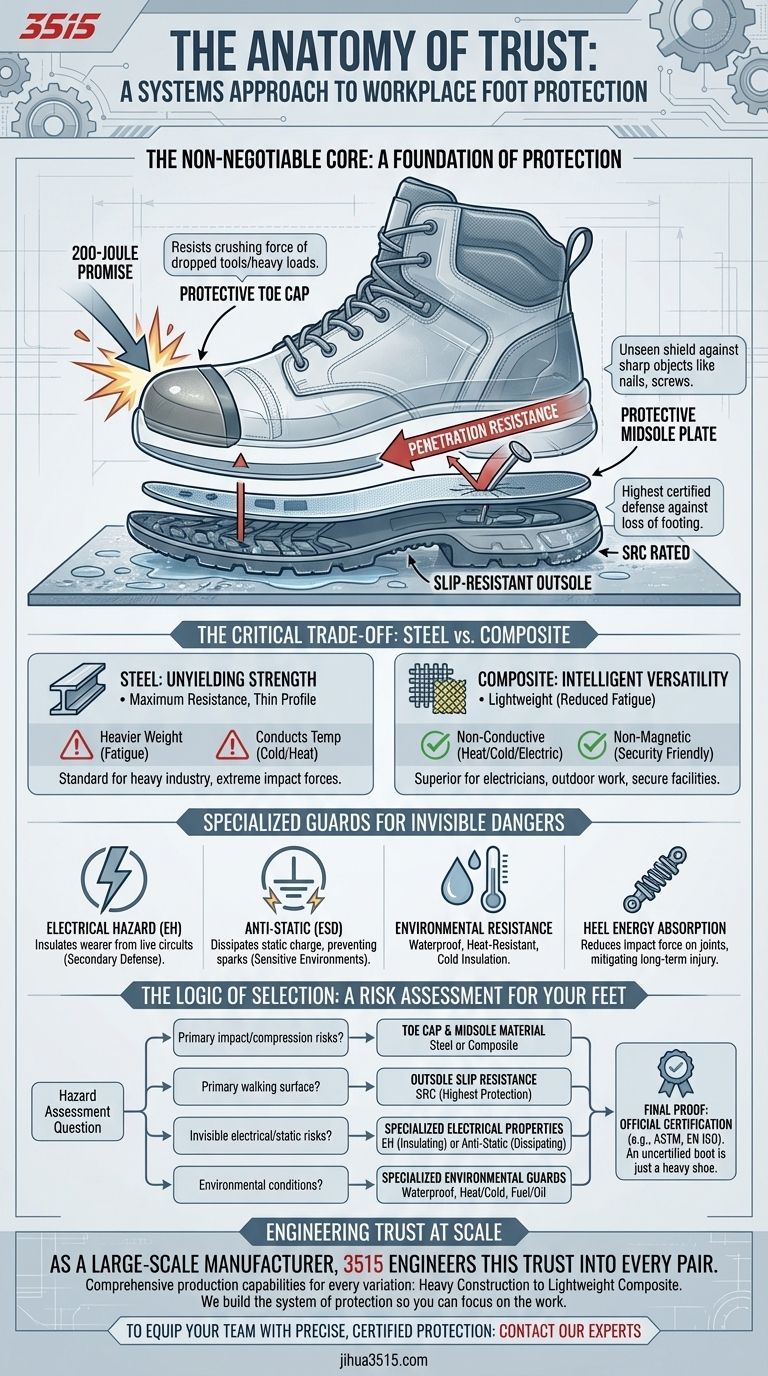
Every certified safety boot is built on a universal foundation. These three core features address the most immediate and severe threats to foot safety, forming the baseline of trust.
The 200-Joule Promise: The Protective Toe Cap
The most iconic feature of a safety boot is its protective toe cap. But "steel toe" is just a shorthand. The true standard is a tested promise: the ability to withstand a 200-joule impact. This is the engineered defense against the sudden, crushing force of a dropped tool or a heavy load.
The Threat from Below: Penetration Resistance
The ground is an unpredictable surface. A protective midsole plate is the unseen shield against sharp objects—nails, screws, metal shards—that can puncture an ordinary sole. It’s a quiet guardian against a sudden, debilitating injury.
Defying Gravity: The Physics of a Slip-Resistant Outsole
Slips and falls are relentlessly common workplace accidents. A boot's outsole is where physics meets the factory floor. Ratings like SRC signify a boot has passed rigorous testing on both wet ceramic tile and slick steel, offering the highest certified defense against a loss of footing.
The Critical Trade-Off: Steel vs. Composite
The choice between steel and composite materials for toe caps and midsoles is more than a technical specification. It’s a decision about balancing raw strength against the human factors of weight, fatigue, and environmental context.
The Unyielding Strength of Steel
Steel has long been the benchmark for protection. It offers maximum resistance in a thin profile, making it the standard in heavy industry where crushing and impact forces are extreme.
But this strength comes with costs. Steel is heavy, and over thousands of steps a day, that weight contributes to fatigue. It also readily conducts temperature, making it uncomfortable in extreme cold or heat.
The Intelligent Versatility of Composite
Composite materials—like Kevlar, carbon fiber, and fiberglass—are the lighter-weight alternative. This reduction in weight is a direct investment in reducing worker fatigue over a long shift.
More importantly, composites are non-conductive. They don't transfer cold or heat, and they don't conduct electricity, making them the superior choice for electricians or outdoor workers. As they are non-metallic, they are essential for secure facilities with metal detectors.
The "best" material doesn't exist in a vacuum. The right choice reflects a deep understanding of the specific workplace ecosystem.
Specialized Guards for Invisible Dangers
Beyond the core components lies a suite of specialized protections for hazards that are often unseen.
-
Electrical Hazard (EH): An EH-rated boot is designed to insulate the wearer from the ground, providing a crucial secondary defense against accidental contact with a live circuit.
-
Anti-Static (ESD): In environments with sensitive electronics or flammable materials, anti-static boots do the opposite. They safely dissipate the body's static charge to the ground, preventing a damaging or explosive spark.
-
Environmental Resistance: This includes everything from waterproof membranes for wet conditions to heat-resistant outsoles for high-temperature surfaces and cold insulation for sub-zero work.
-
Heel Energy Absorption: This feature isn't just about comfort. It actively reduces the impact force on a worker's joints and spine with every step, mitigating the risk of long-term musculoskeletal injury. It’s a design feature that acknowledges a career is a marathon, not a sprint.
The Logic of Selection: A Risk Assessment for Your Feet
Choosing the right boot is a critical risk assessment. The process begins with asking the right questions.
| Hazard Assessment Question | Leads to a Decision On... | Key Options |
|---|---|---|
| What are the primary impact or compression risks? | Toe Cap & Midsole Material | Steel or Composite |
| What is the primary walking surface? | Outsole Slip Resistance | SRC for the highest, most versatile protection |
| Are there invisible electrical or static risks? | Specialized Electrical Properties | EH (insulating) or Anti-Static (dissipating) |
| What are the environmental conditions? | Specialized Environmental Guards | Waterproof, Heat/Cold Resistance, Fuel/Oil |
Ultimately, official certification (like ASTM or EN ISO standards) is the final proof. An uncertified boot is just a heavy shoe; a certified boot is a promise kept.
Engineering Trust at Scale
For distributors, brand owners, and organizations responsible for entire workforces, this level of detail can be daunting. The challenge isn't just finding a boot; it's sourcing a reliable system of protection that accounts for dozens of different roles and risks.
As a large-scale manufacturer, 3515 engineers this trust into every pair. Our comprehensive production capabilities cover every variation of safety footwear—from classic steel-toed boots for heavy construction to lightweight, anti-static composite shoes for secure facilities. We build the system of protection so you can focus on the work.
To equip your team with the precise, certified protection they need, Contact Our Experts.
Visual Guide
Related Products
- Puncture-Resistant Velcro Safety Boots for Wholesale & Custom Manufacturing
- Premium Grain Leather Safety Boots for Bulk Supply
- Wholesale Durable Safety Boots | Custom Steel Toe & Puncture-Resistant Manufacturing
- Heavy-Duty Waterproof Nubuck Safety Boots Safety Shoes for Bulk Supply
- Premium Oil Wax Leather Safety Boots for Bulk Purchase
Related Articles
- The Unseen Engineering: Why Steel Toes Succeed or Fail in Oily Environments
- The Lacing Paradox: Why the Safest Boots Contain Their Own Greatest Risk
- How Industrial Professionals Can Balance Safety Boot Requirements with Professional Appearance
- How to Choose Safety Boots That Reduce Fatigue Without Sacrificing Protection
- Composite vs. Steel Toe Boots: When Lighter Protection Outperforms Traditional Safety