The Moment of Impact
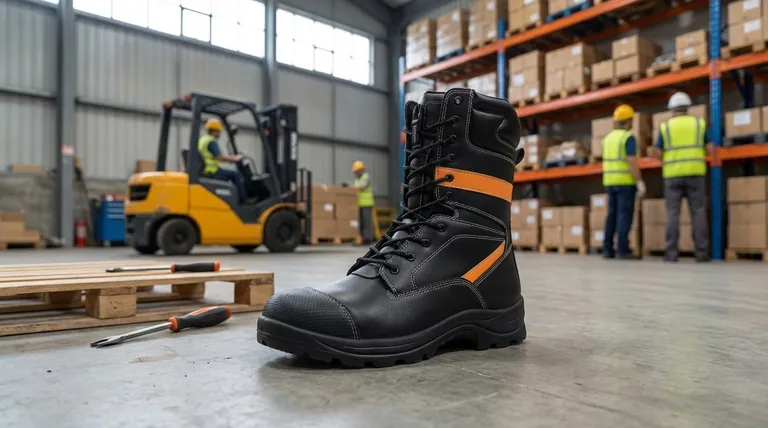
Imagine a distribution center. A worker pivots as a heavy pallet is lowered, but a crate slips from the top. It falls four feet.
The difference between a bruised foot and a career-ending injury is the centimeter of reinforced steel over their toes. That small piece of equipment prevented a personal tragedy and a corporate liability.
But who is responsible for ensuring that steel is there? More specifically, who is responsible for paying for it? The answer reveals a deep understanding of systems, human psychology, and the invisible line between personal clothing and professional safety equipment.
A Law Against Human Nature
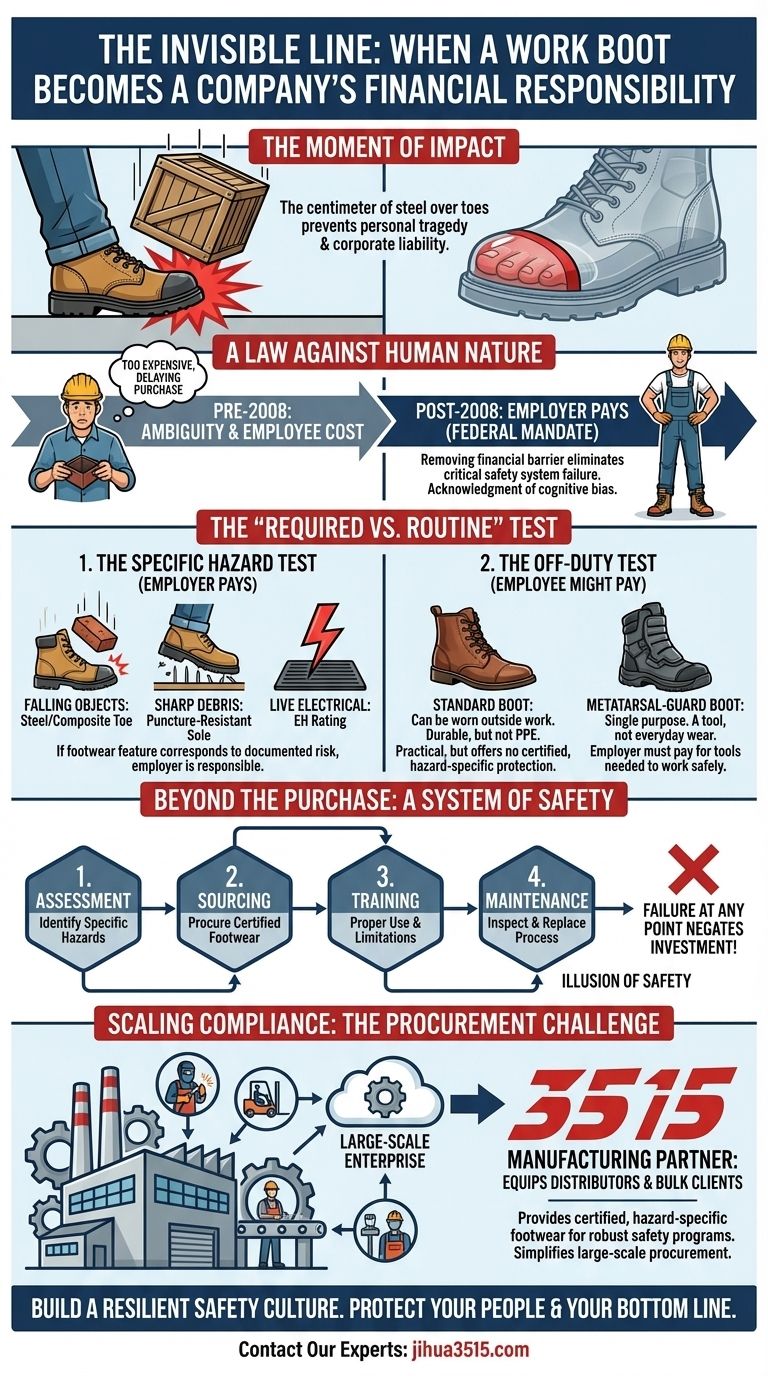
The core principle was clarified by a federal mandate in 2008: if safety footwear is required as Personal Protective Equipment (PPE) to mitigate a specific job hazard, the employer must pay for it.
This wasn't just a financial rule; it was a psychological one.
Before this, ambiguity often left the cost to the employee. This created a dangerous friction. When faced with an out-of-pocket expense, it's human nature to delay, to search for a cheaper (and often less effective) alternative, or to rationalize that the risk isn't that high.
The 2008 rule was an acknowledgment of this cognitive bias. By removing the financial barrier for the employee, it aimed to eliminate a critical point of failure in the safety system.
The "Required vs. Routine" Test
The law's logic doesn't revolve around the shoe itself, but around the hazard it's meant to prevent. This creates two simple, powerful tests to draw that invisible line.
1. The Specific Hazard Test
Is the footwear designed to protect against a documented, specific risk in the workplace? If so, it's required PPE.
- Falling Objects: Mandates a steel or composite safety toe.
- Sharp Debris on the Floor: Requires a puncture-resistant sole.
- Live Electrical Circuits: Necessitates an Electrical Hazard (EH) rating.
If a feature on the boot directly corresponds to a risk identified in a workplace hazard assessment, the financial responsibility falls to the employer.
2. The Off-Duty Test
The key exception is for non-specialty footwear that can be worn outside of work. The simple question is: Could an employee reasonably wear these shoes as part of their everyday wardrobe?
A sturdy pair of standard leather work boots might be practical for a job, but if they offer no certified, hazard-specific protection, the employer may not be required to pay. They are durable, but not technically PPE.
A pair of ASTM-certified, metatarsal-guard boots, however, has a single purpose. You don't wear them to the grocery store. They are a tool. And the employer must pay for the tools needed to do the job safely.
Beyond the Purchase: A System of Safety
Providing the correct boot is just the first step. An employer's legal and ethical obligation extends to creating a comprehensive safety system.
This system includes four critical links:
- Assessment: Correctly identifying the specific hazards each role will face.
- Sourcing: Procuring footwear that is certified and engineered to protect against those specific hazards.
- Training: Teaching employees on the proper use, limitations, and care of their equipment.
- Maintenance: Implementing a clear process for inspecting footwear and replacing it when it becomes worn, damaged, or compromised.
A failure at any point in this chain—providing the wrong type of boot or failing to replace a damaged one—negates the entire investment and re-introduces the risk. A well-funded but poorly managed PPE program creates only the illusion of safety.
Scaling Compliance: The Procurement Challenge
For a small business, managing this system is straightforward. But for a large-scale enterprise with hundreds or thousands of employees across dozens of roles, it becomes a monumental logistical challenge.
How do you ensure the right certified boot is provided for the welder, the forklift operator, and the line worker? How do you manage procurement and replacement at scale while ensuring compliance and controlling costs?
This is where a manufacturing partner becomes a strategic asset. As a large-scale producer of a comprehensive range of footwear, 3515 equips distributors, brand owners, and bulk clients to build robust safety programs. We provide the certified, hazard-specific footwear that serves as the foundation for a compliant and effective safety system, simplifying the complexities of large-scale procurement.
The decision of who pays for a work boot is more than a line item in a budget. It's a reflection of a company's commitment to building a resilient safety culture from the ground up. To build a program that protects both your people and your bottom line, you need the right partner.
If you are looking to create a scalable, compliant, and effective safety footwear program, Contact Our Experts
Visual Guide
Related Products
- Premium Suede Sport Safety Shoes for Wholesale & Bulk Orders
- Premium Lightweight Safety Shoes for Wholesale & Bulk Orders
- Wholesale Anti-Smash & Puncture-Proof Safety Shoes Custom Manufacturing for Brands
- Premium KPU Injection Athletic Style Safety Shoes
- Premium Safety Shoes with Rotating Buckle Safety Sneakers
Related Articles
- The Ghost in the Machine: Why an Obsolete Footwear Standard Creates Modern Risk
- Beyond the Steel Toe: The Hidden Ergonomics of Workplace Safety
- Why Traditional Laces Are a Hidden Safety Risk—And What to Do About It
- The True Cost of Skipping Safety Shoes: Long-Term Risks and Smart Protection
- How Safety Shoe Engineering Prevents Workplace Injuries Across Industries