The Mechanic and the Lab Technician
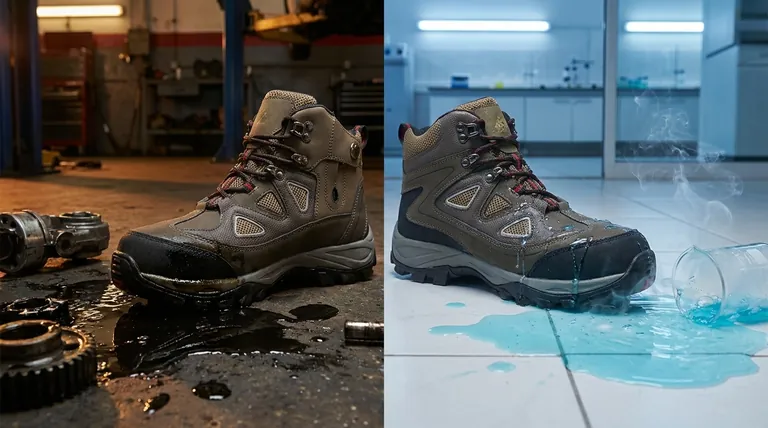
Imagine a seasoned auto mechanic. For years, their biggest footwear complaint was soles that turned soft and cracked, ruined by constant exposure to grease and oil on the garage floor. An "oil-resistant" boot solved this perfectly. The sole stayed firm, the grip reliable. It was a problem of durability.
Now, picture a lab technician handling industrial solvents. One small spill, and the liquid soaks through their standard work boot in seconds. The result isn't a worn-out sole; it's a severe chemical burn. This is a problem of personal safety.
Both scenarios involve "chemicals," but the risks they pose to footwear and the wearer are fundamentally different. This is the crux of a dangerous assumption made every day in industrial environments: confusing oil resistance with chemical resistance.
A Dangerous Mental Shortcut
Our brains are wired for efficiency. We create mental shortcuts to navigate the world. When we see the word "oil" and know it's a chemical, our brain logically but incorrectly expands the safety promise of an "oil-resistant" label to cover all chemicals.
This is a cognitive bias known as overgeneralization. We take a specific attribute—resistance to petroleum—and apply it to a broad, unrelated category that includes acids, bases, and caustic solvents. In the world of Personal Protective Equipment (PPE), this mental shortcut can lead to catastrophic failure.
The language of safety is precise for a reason. Understanding the engineering intent behind each term is the first step to true workplace safety.
The Engineering of Durability: What "Oil-Resistant" Truly Means
A Battle for the Outsole
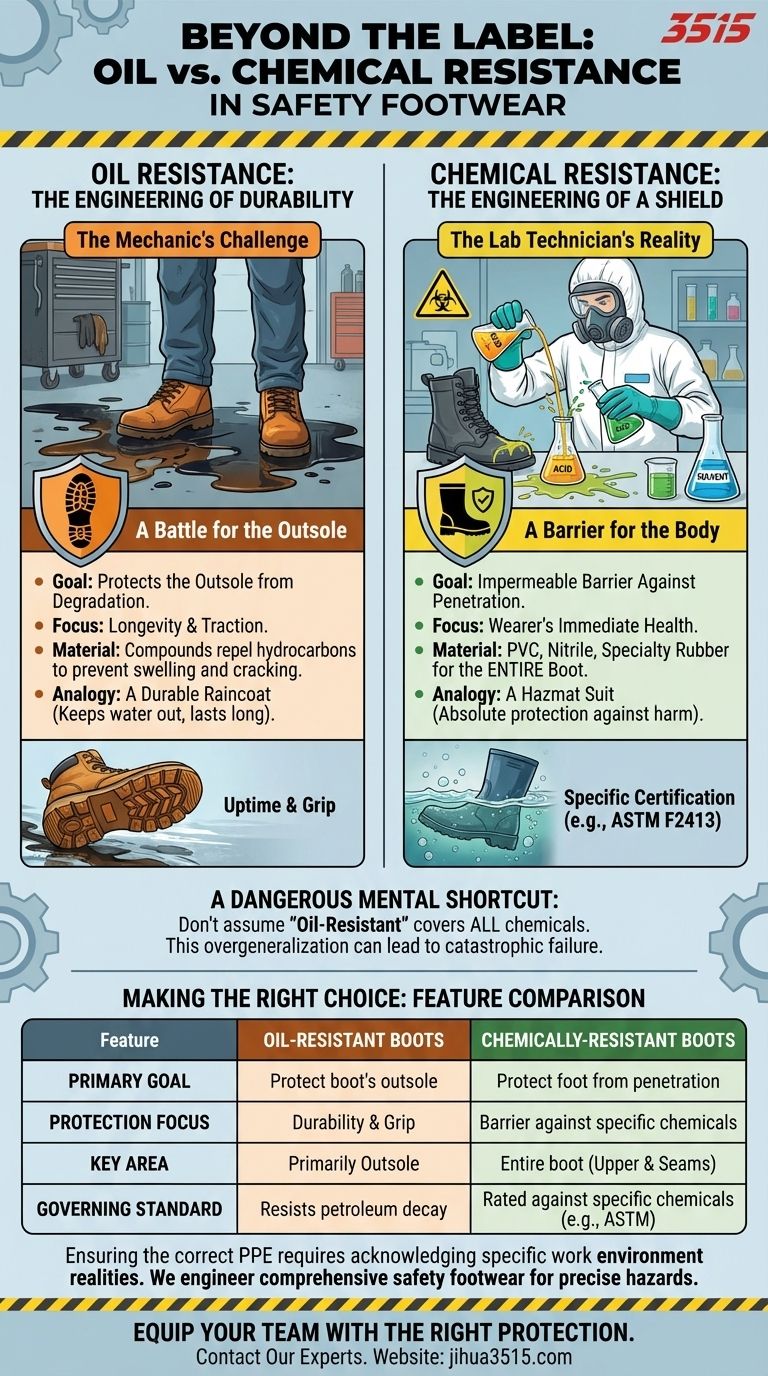
The "oil-resistant" designation is an engineering solution to a material science problem. It almost always refers to the boot’s outsole.
When standard rubber or synthetic compounds are exposed to petroleum products, they begin to break down. They swell, lose their tensile strength, and become brittle. An oil-resistant sole is made from a compound specifically formulated to repel these hydrocarbons, preventing degradation.
The Goal is Uptime and Grip
The primary purpose of oil resistance is to protect the boot itself, not the person wearing it from chemical exposure. It ensures two things:
- Longevity: The boot won't prematurely fail in environments rich with oil and grease.
- Traction: The sole maintains its integrity, ensuring a reliable grip on slippery surfaces.
It is a feature of durability and structural integrity, first and foremost.
The Engineering of a Shield: Deconstructing Chemical Resistance
A Barrier for the Body
Chemical resistance is an entirely different engineering discipline. Its focus shifts from the boot’s longevity to the wearer’s immediate health.
A chemically-resistant boot is designed to be an impermeable barrier. The entire boot—including the upper, the seams, and the sole—is constructed from materials like PVC, nitrile, or specialty-treated rubber that can withstand penetration from specific hazardous liquids for a documented period.
The Language of Certification
True chemical-resistant footwear is rated against rigorous safety standards, such as ASTM F2413 in the United States. These certifications aren't general; they are highly specific. They define the exact chemicals a boot was tested against and the duration it held up before penetration occurred.
A boot resistant to sulfuric acid might offer zero protection against acetone. The details matter.
A Raincoat vs. a Hazmat Suit
The easiest way to frame this is with an analogy.
An oil-resistant boot is like a durable raincoat. It’s expertly designed for a specific, common challenge—keeping water out and lasting through many storms.
A chemical-resistant boot is a hazmat suit. It is a piece of specialized equipment, engineered to provide an absolute barrier against substances that can cause immediate, severe harm.
You would never wear a raincoat to clean up a toxic spill. The same logic must be applied to your footwear.
Making the Right Choice
| Feature | Oil-Resistant Boots | Chemically-Resistant Boots |
|---|---|---|
| Primary Goal | Protect the boot's outsole from degradation | Protect the foot from hazardous substance penetration |
| Protection Focus | Durability and grip on oily surfaces | Barrier against specific chemicals (acids, solvents, etc.) |
| Key Area | Primarily the outsole material | The entire boot, including upper and seams |
| Governing Standard | Resists petroleum-based product decay | Rated against standards like ASTM for specific chemicals |
Ensuring your team has the correct PPE isn't just about compliance; it's about acknowledging the specific realities of their work environment. As a large-scale manufacturer of all footwear types, we help distributors and brand owners navigate these critical distinctions, engineering boots certified for the precise hazards their clients face.
Whether the challenge is the constant wear from an oil-slicked factory floor or the acute danger of a chemical processing plant, the solution must be engineered for the purpose. We produce the comprehensive range of safety footwear that honors that principle.
If you need to equip your team with the right protection, let's ensure there are no dangerous assumptions. Contact Our Experts
Visual Guide
Related Products
- Premium Suede Sport Safety Shoes for Wholesale & Bulk Orders
- Premium Lightweight Safety Shoes for Wholesale & Bulk Orders
- Wholesale Anti-Smash & Puncture-Proof Safety Shoes Custom Manufacturing for Brands
- Premium KPU Injection Athletic Style Safety Shoes
- Premium Safety Shoes with Rotating Buckle Safety Sneakers
Related Articles
- The Ghost in the Machine: Why an Obsolete Footwear Standard Creates Modern Risk
- Beyond the Steel Toe: The Hidden Ergonomics of Workplace Safety
- Why Traditional Laces Are a Hidden Safety Risk—And What to Do About It
- The True Cost of Skipping Safety Shoes: Long-Term Risks and Smart Protection
- How Safety Shoe Engineering Prevents Workplace Injuries Across Industries