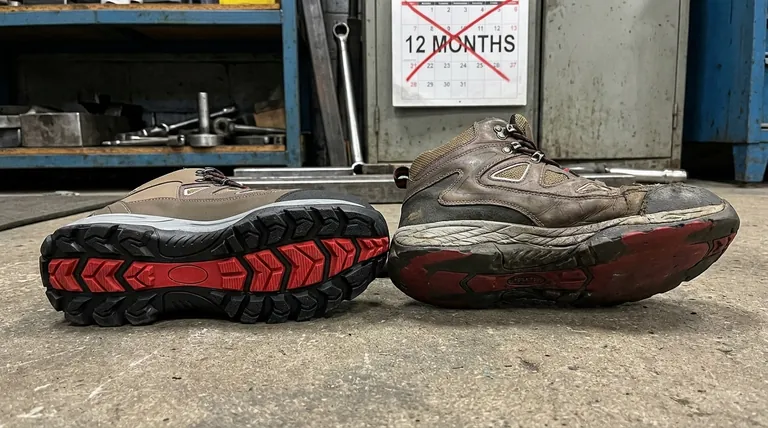
Your company has a clear policy: replace all safety boots every 12 months. The budget is set, the schedule is clear, and on paper, you've fulfilled your duty of care. Yet, a slip-and-fall incident occurs on a wet floor. The investigation finds the employee's boots, only eight months old, had dangerously worn treads.
How could this happen? You followed the industry-standard guideline, but it still wasn't enough. This scenario is more than a hypothetical; it's a quiet risk lurking in countless facilities, driven by a fundamental misunderstanding of what makes a safety boot "safe."
The Vicious Cycle of "Good Enough" Footwear
The problem described above is incredibly common. In an attempt to manage safety and budgets, many organizations fall into one of several traps:
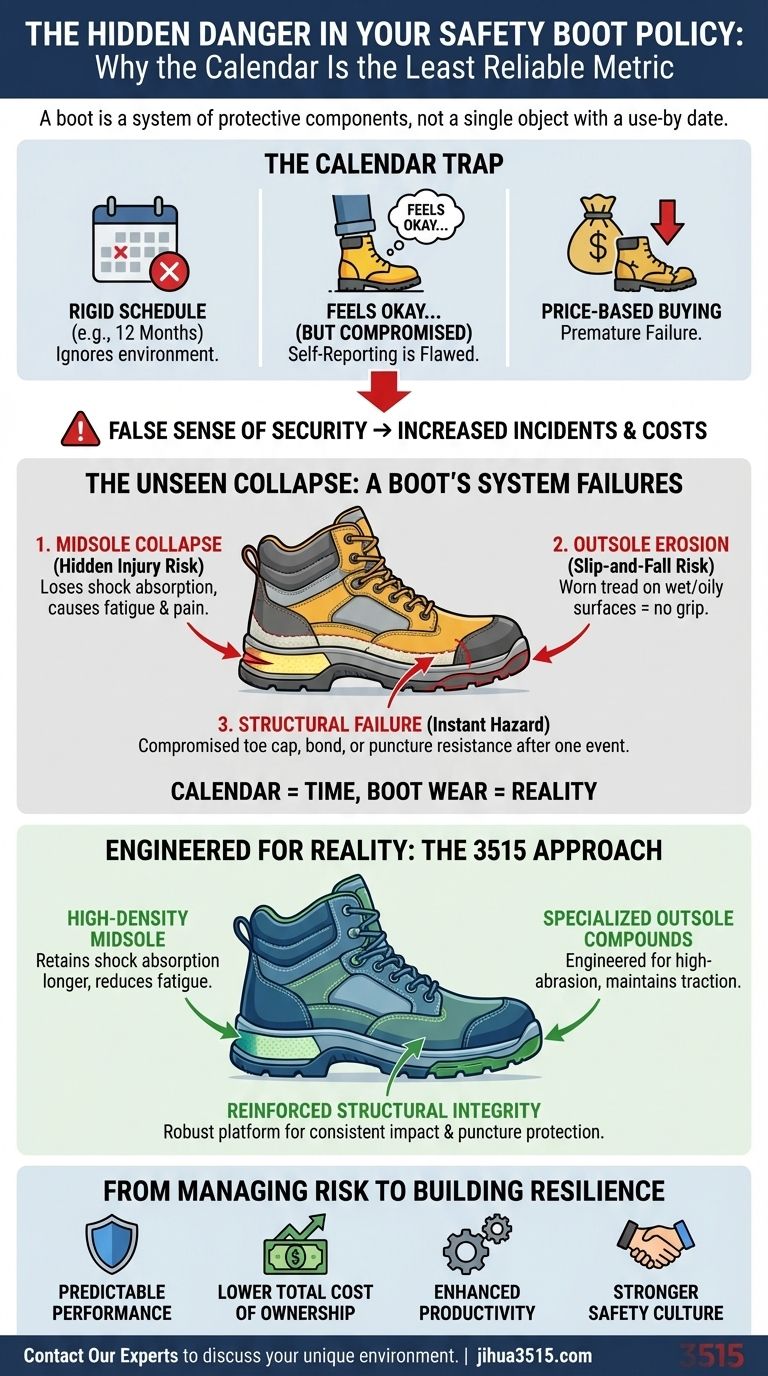
- The Rigid Calendar Schedule: Mandating replacement every 6, 9, or 12 months. This feels responsible, but it ignores the single most important factor: the actual work environment. A boot worn on smooth concrete faces entirely different stresses than one worn on abrasive gravel or in chemical-heavy areas.
- Relying on Employee Self-Reporting: This assumes employees know what to look for and will prioritize safety over the comfort of their broken-in boots. Often, a boot feels most "comfortable" right after its critical support structures have failed.
- Purchasing Based on Price Alone: To offset the cost of frequent, calendar-based replacements, some companies opt for the cheapest available footwear. This often leads to premature failure, creating an even shorter, more dangerous replacement cycle.
These common strategies share a single, critical flaw: they create a false sense of security. The business consequences are significant, ranging from increased workers' compensation claims and lost productivity due to foot fatigue to the severe financial and reputational damage of a preventable, major incident. You're spending the budget, but you're not fully buying the safety you need.
The Real Culprit: A Boot Is a System, Not a Single Object
The turning point in understanding this problem is to stop thinking about a boot's age in months and start thinking about it as a system of protective components, each with its own unique failure point. A calendar date cannot see a crushed midsole or a compromised safety toe.
Here’s what’s really happening on the ground:
The Unseen Collapse of the Midsole
The midsole is the hidden layer of foam that provides shock absorption. It's the boot's suspension system. With every step, this material compresses. Over thousands of cycles, it loses its ability to bounce back. This "compression set" is invisible from the outside, but the worker feels it as foot, leg, and back pain. The boot no longer absorbs impact; it transfers it directly to the body, accelerating fatigue and increasing the risk of musculoskeletal injuries.
The Gradual Erosion of the Outsole
The outsole's tread is designed to channel water and oil away, ensuring grip. As it wears down, it becomes smooth. On a perfectly dry day, this might go unnoticed. On a wet or oily surface, this translates to a catastrophic loss of traction. The common "solutions" fail because they don't account for the specific abrasive quality of your work surfaces, which can erase a tread pattern months ahead of schedule.
The Sudden Failure of the Structure
The integrity of the boot depends on the upper, the toe cap, and the bond holding them to the sole. A single event—a heavy object dropped on the toe, a deep cut from a piece of metal—can compromise this system instantly. The toe cap might have a micro-fracture, or the sole's puncture resistance could be breached. The boot may look fine, but its protective capability is gone. It has done its job once and must be retired.
Relying on a calendar is like assuming your car's tires are fine because it's not yet time for an oil change. The two are unrelated; one is based on time, the other on wear, tear, and acute damage.
Engineered for Reality: The 3515 Approach to Durability
To truly solve this problem, you don't need a better calendar; you need a better boot—one engineered from the ground up to resist the specific failure points that put your team at risk. This is a manufacturing and materials science challenge, not a scheduling one.
A truly reliable safety boot is the result of conscious design choices based on a deep understanding of workplace realities.
- Addressing Midsole Collapse: We utilize high-density, low-compression midsole compounds that retain their shock-absorbing properties for far longer than standard materials. This directly translates to reduced worker fatigue and a longer effective lifespan for the boot.
- Maximizing Outsole Life: Our footwear is built with specialized outsole compounds formulated for high-abrasion environments. The tread patterns are designed not just for initial grip, but to maintain their traction characteristics even as they wear.
- Ensuring Structural Integrity: From reinforced stitching and high-tensile upper materials to secure bonding methods that fuse the sole to the upper, our manufacturing process creates a robust platform. This ensures the boot maintains its structural support and protection against impacts and punctures throughout its service life.
As a large-scale manufacturer, our entire process is built to deliver this level of consistency and durability at scale. We don't just assemble footwear; we engineer a reliable piece of personal protective equipment.
From Managing Risk to Building Resilience
When your workforce is equipped with footwear designed for durability, the entire safety dynamic changes. You can move away from arbitrary and wasteful replacement schedules and toward a more intelligent, condition-based safety program.
This shift unlocks powerful new advantages:
- Predictable Performance: You gain confidence that your footwear will perform as expected, reducing the likelihood of premature failures and the incidents they cause.
- Lower Total Cost of Ownership: While a more durable boot may have a different initial cost, it reduces the frequency of replacement and, more importantly, the immense downstream costs associated with workplace injuries.
- Enhanced Productivity: Workers who aren't suffering from foot and leg fatigue are safer, more focused, and more productive throughout their shifts.
- A Stronger Safety Culture: Providing high-quality equipment sends a clear message that you are investing in your team's well-being, not just checking a compliance box.
Ensuring every pair of boots meets these demanding standards across your entire operation isn't just about footwear; it's about operational reliability and the foundation of your safety program. It requires a manufacturing partner with the scale, expertise, and quality control to deliver consistent performance, pair after pair.
Let our team help you design a footwear program built on the principles of durability and real-world performance. Contact Our Experts to discuss your unique work environment and how we can build a safer, more resilient foundation for your team.
Visual Guide
Related Products
- Puncture-Resistant Velcro Safety Boots for Wholesale & Custom Manufacturing
- Wholesale Durable Safety Boots | Custom Steel Toe & Puncture-Resistant Manufacturing
- Premium Grain Leather Safety Boots for Bulk Supply
- Heavy-Duty Waterproof Nubuck Safety Boots Safety Shoes for Bulk Supply
- Premium High-Cut Waterproof Safety Boots Manufacturing & Wholesale Solutions
Related Articles
- The Unseen Engineering: Why Steel Toes Succeed or Fail in Oily Environments
- The Anatomy of Trust: A Systems Approach to Workplace Foot Protection
- The Lacing Paradox: Why the Safest Boots Contain Their Own Greatest Risk
- How Industrial Professionals Can Balance Safety Boot Requirements with Professional Appearance
- How to Choose Safety Boots That Reduce Fatigue Without Sacrificing Protection